President William Ruto
With Ruto touring Maa country, Gachagua building his opposition machinery and Mount Kenya in political flux, the battle for State House has already left Nairobi far behind.
By Levis Wangamati
Kenya’s 2027 general election is still months away, but the political contest is already moving faster than the electoral calendar, with President William Ruto, former Deputy President Rigathi Gachagua and a clutch of opposition figures all repositioning simultaneously across the country’s most contested counties.
The evidence is everywhere. Presidential tours dressed as development visits. Opposition rallies framed as grassroots mobilisation. Governors publicly choosing sides. Senators building national movements from city podiums. The formal campaign has not begun, but the decisions being made today — the alliances formed, the endorsements secured, the communities visited — will determine the electoral arithmetic of August 2027. Every rally, every public appearance, every political disagreement is becoming another piece of a puzzle that Kenya’s leaders are already racing to solve.
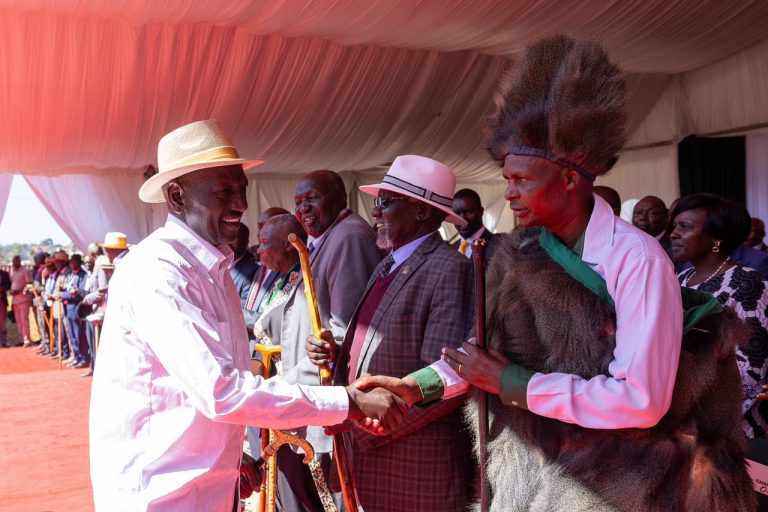
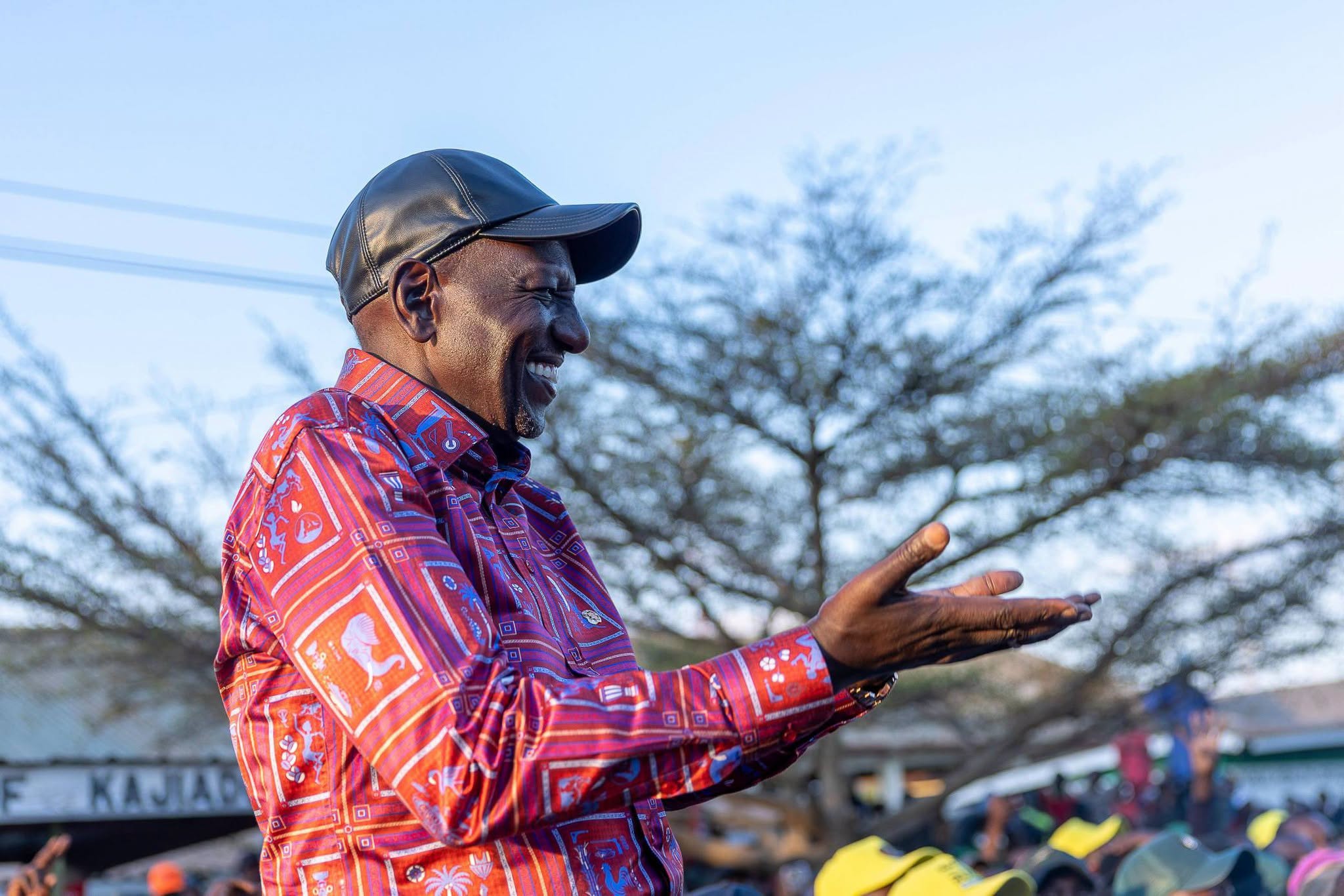
Ruto’s renewed political activity in the Maa region is therefore more than a routine presidential tour. Development projects may sit at the centre of the official programme, but politics follows wherever a sitting president travels, particularly when the country is steadily approaching a general election. Visibility itself has become political currency, and Ruto understands that the road to a second term cannot be built from State House alone. It must pass through communities whose votes will determine whether his administration earns another five years.
The Maa region carries particular strategic weight because it sits at the intersection of development politics, regional identity and national coalition-building. Ruto’s presence there allows him to demonstrate government activity while reminding voters that the presidency retains enormous institutional and political reach. Yet every development announcement is now being read through the lens of 2027. The opposition will frame the tour as a consolidation exercise ahead of the campaign peak; the administration will present it as evidence of a government delivering across the country. Both readings contain truth, and both will be tested at the ballot box.
The opposition narrative, however, is being assembled from several different political centres simultaneously — and that may prove either its greatest strength or its most dangerous weakness. Gachagua has been steadily building the Democracy for the Citizens Party as a vehicle for his post-government political ambitions. His strategy depends on grassroots mobilisation, particularly in regions where he believes dissatisfaction with Ruto can be converted into electoral support. His political tours are not merely about addressing rallies or sharpening his critique of the administration. They are attempts to establish an alternative political network before the formal campaign season reaches full intensity.
But Gachagua faces a challenge that has defeated many opposition formations in Kenya’s political history. Opposition politics here has long been vulnerable to fragmentation: leaders can agree on what they oppose while disagreeing sharply on who should lead, which party should carry the coalition banner and how power should be distributed after a potential victory. His task is consequently not simply to defeat Ruto politically. It is to convince competing opposition figures that cooperation is more valuable than individual ambition. If the opposition enters 2027 with several centres of power pulling in different directions, the mathematics that looks promising today could quickly become an electoral liability.
That is where Nairobi Senator Edwin Sifuna enters the picture. His Linda Mwananchi movement has continued a nationwide mobilisation effort following tours across multiple counties, with another Nairobi rally already announced. The geographical spread of those engagements matters because it reflects a deliberate attempt to transform political energy concentrated in the capital into a genuinely national movement. Sifuna’s significance has grown because he represents something distinct from the traditional opposition formula. He is younger than most established presidential contenders, highly visible in public debate and demonstrably capable of communicating directly with an urban and increasingly politically independent generation.
Whether Sifuna ultimately becomes a presidential contender, a coalition negotiator or one of the most influential figures in an eventual opposition administration remains unclear. What is becoming increasingly difficult to dismiss, however, is the political space he occupies. Attempts to contain his influence within ODM’s structures risk producing precisely the opposite effect — transforming him into a symbol of resistance, and political history demonstrates repeatedly that marginalising a popular figure can accelerate rather than arrest their rise.
Meanwhile, Mount Kenya remains one of the most consequential and contested pieces of the 2027 puzzle. Kirinyaga Governor Anne Waiguru’s decision to reject Gachagua’s political camp and reaffirm her support for Ruto illustrates just how complicated the region has become. Mount Kenya is no longer behaving as a single political constituency. It contains competing interests, personalities and ambitions, and politicians across the spectrum are being forced to choose between national alliances and intensifying regional pressures. The old assumption that Mount Kenya votes as a bloc has not merely been tested — it is being systematically dismantled by the very politicians who once relied on it.
This is why 2027 will not be won by simply declaring that one region belongs to one politician. Kenyan politics has become too fluid for that model to remain reliable. The formula in which a presidential candidate secures victory by locking down a handful of ethnic or regional voting blocs faces mounting pressure from economic frustrations, generational change and increasingly independent political calculations. Voters are not abandoning regional considerations entirely, but they are becoming progressively harder for political leaders to treat as permanent property. Any politician who assumes that yesterday’s pattern will automatically become tomorrow’s risks discovering too late that the electoral mathematics has shifted beneath them.
There is another dimension to the intensifying mobilisation that deserves more serious attention than it has so far received: political violence. Migori Senator Eddy Oketch has warned that political goonism is occurring across the political divide and called for accountability regardless of party affiliation. His warning should not be treated as a footnote. Kenya has experienced the consequences of political violence before, and the country cannot afford to allow intimidation to normalise itself as part of electoral competition.
Political mobilisation should be about persuading citizens, defending records and presenting credible alternative programmes. Once intimidation becomes part of the toolkit, the quality of democracy begins to deteriorate long before a single vote is cast. Politicians who condemn violence when it targets their opponents while excusing it when it benefits their own side are not defending democracy — they are corroding it. The credibility of the 2027 election will depend not only on the conduct of the electoral commission but on whether political parties and their supporters respect the democratic space in which the contest takes place.
Kenya has, in this sense, entered two simultaneous political battles. The first is the familiar contest for State House, in which Ruto seeks to defend his presidency while Gachagua builds an alternative political centre and other opposition figures position themselves for coalition negotiations. The second battle is larger and potentially more consequential: a contest over the character of Kenyan politics itself. Will 2027 be an election defined by ideas, records and policy alternatives, or another cycle dominated by personalities, patronage and political identity?
That question is not abstract. It will shape what kind of country Kenya becomes in the decade that follows.
The decisive contest will not be settled in Nairobi’s political corridors or at the largest rally. It will unfold in counties, constituencies and communities where millions of voters will weigh political promises against lived economic experience. Kenya’s politicians are already counting. Soon, quietly and with characteristic patience, the voters will begin doing exactly the same.
Similar Posts by The Mt Kenya Times:
- Mt Kenya Times ePAPER October 21, 2026
- Kenya confirms ninth Ebola case as outbreak remains contained within single cluster
- Musk pledges SpaceX share for every American child in 2027
- Abiy calls for deeper Kenya-Ethiopia trade partnership at Eldoret ceremony
- Kenya’s oil moment: Promise, responsibility and the long road from Turkana to market
About the Author