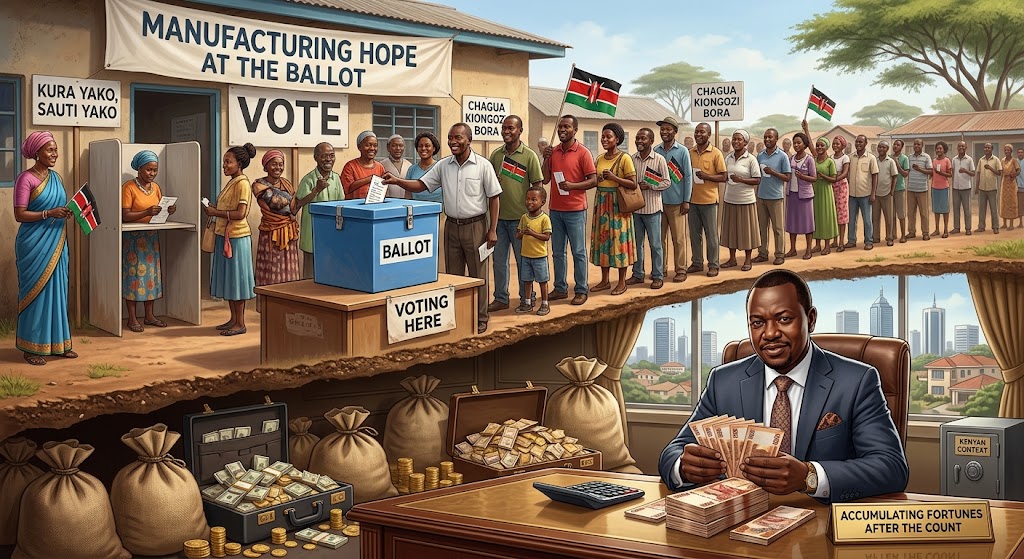
Manufacturing hope at the ballot, accumulating fortunes after the count
By Jerameel Kevins Owuor Odhiambo
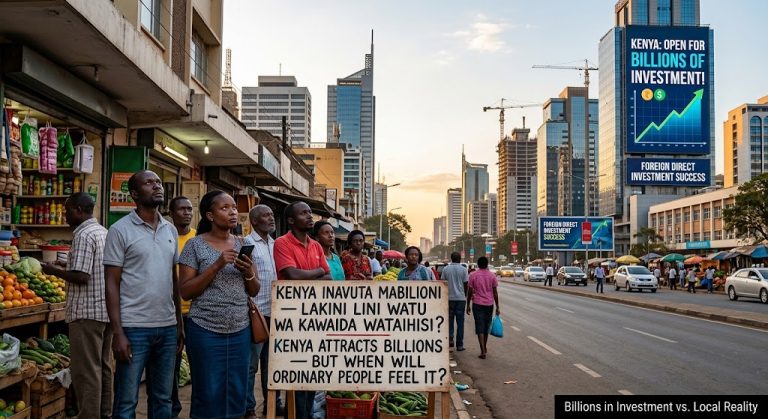
Here is the stark fact that should shame every conscience still capable of shame: in Kenya, the richest 125 individuals hold more wealth than 77 percent of the population more than 42 million people. Between 2019 and 2023 the richest 1 percent captured nearly two-fifths of all new wealth created, thirteen times more than the bottom half. This is not an accident of markets. It is the deliberate, cyclical outcome of a political system whose two most reliable mainstays are the industrial-scale manufacturing of hope during elections and the quiet, systematic accumulation of wealth once the ballots are counted.
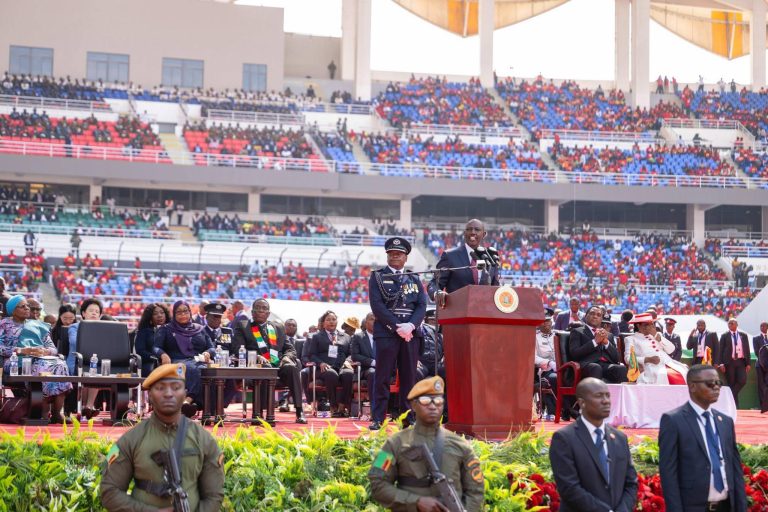
Every five years the same theatre opens. Candidates arrive with catalogues of salvation. Jobs for the youth. Lower cost of living. Affordable housing. Healthcare that does not bankrupt families. Roads that do not kill. They speak the language of the mama mboga and the boda boda rider with practiced fluency. They brandish manifestos thick with numbers and timelines. The 2022 cycle was no different. One leading contender alone issued hundreds of distinct pledges. Four years later independent tallies show only a handful fully delivered, a few more inching forward, and the vast majority abandoned, delayed, or quietly rewritten. The pattern is older than the current occupants of power. It is the pattern itself that has become the nation’s most consistent product.
This is not mere broken promise. It is manufacturing. Hope is produced the way factories produce soap: mass, fragrant, and designed for rapid consumption. The raw materials are real grievances youth unemployment, food prices that outrun wages, public hospitals that demand cash before treatment. The machinery is the campaign rally, the carefully staged walkabouts, the selective memory of past failures, the sudden discovery of empathy for the poor. The finished product is a temporary belief that this time the system will bend toward justice. Once the product is purchased with the vote, the factory gates close. The real business begins.
History is the unblinking witness. From the first post-independence redistribution of the former White Highlands, political office has been the most efficient instrument of private enrichment. Land that was meant for the landless found its way into the hands of those already connected to power. Under successive regimes the state itself became the primary site of accumulation. Contracts, licences, tenders, land allocations, and later the vast flows of devolved funds have all served as pipelines. The names change; the logic does not. A cabinet secretary’s declared wealth can swell by tens of percent in less than two years. County officers on modest salaries emerge with unexplained hundreds of millions. The presidency’s own offices have set new records in recurrent spending even while austerity is preached to the citizen. These are not aberrations. They are the system functioning as designed.
Consider the correlation that never lies. The cost of winning office routinely exceeds the legitimate salary attached to that office over an entire term. Senatorial campaigns have required averages approaching four hundred thousand dollars. Parliamentary races exceed two hundred thousand. Even ward-level seats demand sums that ordinary citizens cannot imagine. Who underwrites such expenditure if not those who expect returns once the winner is installed? The campaign is an investment. The post-election period is the harvest. Public resources become private capital through the familiar routes of inflated procurement, selective enforcement, and the quiet redirection of policy toward connected interests. The citizen who queued under the sun to vote for lower prices discovers that the same political class that promised relief now presides over the very mechanisms that extract more.
The emotional cost is not abstract. It is the mother who believed the promise of free secondary education and still sells her last goat to keep a child in school. It is the graduate who heard the pledge of jobs and now measures time in unpaid internships. It is the patient who was told healthcare would be protected and still chooses between medicine and rent. Each cycle of manufactured hope leaves a residue of cynicism thicker than the last. Voter turnout has fallen from the high eighties in earlier multiparty contests to the mid-sixties. Young people, who form the demographic majority, register in large numbers and then stay away in even larger ones. They have learned the script. They no longer confuse the performance with the substance.
However, the manufacturing continues because it works. It works for the manufacturers. The elite do not need the majority to believe forever; they need them to believe long enough to legitimize the next transfer of power. Once that transfer is secured, the instruments of accumulation procurement boards, regulatory agencies, county treasuries, state corporations are recalibrated. Allies are rewarded. Critics are isolated. Scandals multiply and then dissolve into selective prosecutions or withdrawn cases. The wealth gap widens. The same faces who once wept on podiums over the plight of the poor are later photographed in settings that mock the very poverty they claimed to champion.
This is not the inevitable result of African politics or of poverty. It is the result of a specific political economy that has been refined across generations. Colonial extraction taught that the state is a prize. Post-independence elites internalized the lesson and perfected it. Multiparty competition did not dismantle the prize; it merely multiplied the competitors and raised the cost of entry. Devolution, sold as the great democratization of resources, has in too many counties simply decentralised the plunder. The language of reform is itself co-opted. Anti-corruption agencies investigate some while others remain untouchable. Oversight institutions are captured or starved. The citizen is invited to watch the theatre of accountability while the real transactions occur offstage.
The demand that must now be made is categorical. First, to the political class currently in office and those already positioning for the next cycle: stop treating hope as a disposable campaign commodity. Publish full, verifiable wealth declarations before seeking office and after leaving it. Subject every major campaign pledge to independent, publicly funded tracking with clear consequences for serial non-delivery. Second, to the institutions charged with guarding the public purse the Auditor-General, the Ethics and Anti-Corruption Commission, Parliament’s oversight committees recover your independence or admit you have become decorative. Third, to the financiers and business networks that underwrite campaigns: your capital is not neutral. When it purchases access and tilts policy, it becomes complicity in the extraction that keeps millions poor. Fourth, to the citizenry itself: refuse the next round of manufactured hope without mechanisms of enforcement. Demand that manifesto promises be treated as contracts, not poetry. Register, vote, and then remain organised after the counting is done. The five-year cycle of amnesia is the elite’s greatest asset; sustained scrutiny is its greatest threat.
Kenya does not lack resources, talent, or democratic aspiration. It suffers from a political culture that has industrialised the production of false hope in order to protect the continuous accumulation of private wealth from public office. The richest 125 already own more than three-quarters of their compatriots. That fact alone should end the polite silence. The next election will again be framed as a moment of national renewal. It will again be, unless interrupted by deliberate collective will, another season of manufacturing dreams for the many so that fortunes can be secured for the few. The illusion has lasted long enough. The harvest of hope must end.
The writer is a social commentator
Similar Posts by The Mt Kenya Times:
- Statement win at the Gtech: Brentford outclass Chelsea to claim all three points
- When disability funds become a frontier for accountability: Kenya’s PWDs refuse to be invisible
- Public voices concerns over proposed education laws
- Review of the Novel Pride and Prejudice
- Making schools places learners want to be: Addressing chronic absenteeism through engagement and belonging
About the Author