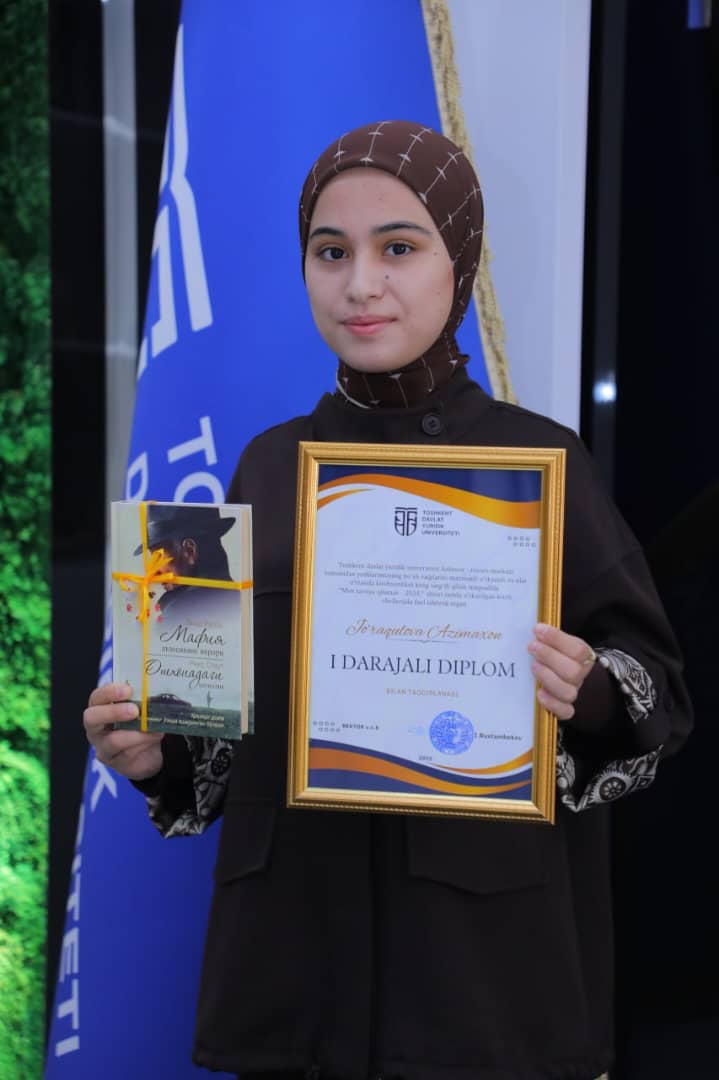
Jo’raqulova Azimaxon Baxtiyorovna
By: Jo’raqulova Azimaxon Baxtiyorovna
To appreciate every second, it is necessary to read at least once the poem “Time” by G‘afur G‘ulom, one of the representatives of Uzbek literature. The reason is that in this poem the author is not simply writing about ordinary clock hands, but is earnestly depicting the majesty of the great weapon called time, which can cure many ills, exalt some, and then bring them down to earth.
As is well known, G‘afur G‘ulom approaches each poem with a unique style and ideas. Likewise, every line of the poem “Time” has become an irreplaceable gem in the world of poetry. The writer Said Ahmad, who was considered the author’s closest friend and disciple, noted in his work “What I Lost and What I Found” that he was with the author on the eve of the poem “Time” coming into being.
Furthermore, according to the author’s close friend, an editorial had placed an order for a specific poem before the first lines of the poem were even conceived. However, as the poet found inspiration in freedom and independence, G‘afur G‘ulom kept postponing the task.
But one day, just before going to sleep, as he was taking off his watch, He looked at the watch, a gift from his nephew Hamidullo, and resolved to write a poem for it the next day. As a result, the world of Uzbek poetry welcomed another lifelong star.
In the poem “Time” the poet vividly demonstrates the great need for a person to value their time and life. Furthermore, in the poem, time is presented as a changing, fleeting, and rapidly changing phenomenon.
As you read each line, you begin to realize that how and in what way one uses a powerful weapon like time is entirely up to the individual. We can see the proof of this argument in the following lines:
There are those born and raised in half an hour,
who live and spend their whole lives;
The moment that passes in the blink of an eye is precious,
the meaning of a single instant is an entire spring.
Through this excerpt from the poem “Time”, we can instantly realize that the value of time should be asked of a person who is bedridden, counting the days, rather than a healthy one. The reason is that, in most cases, caught up in work, home, and household worries, we momentarily forget that it’s not just the clock’s hands but the river of our life—called the White River—that is flowing away.
In the above excerpt from the poet’s poem, these very ideas are put forward. At the same time, the poem states that a general could sign off on the start of the so-called black scourge called war in just three seconds. However, the idea that those who have suffered and lost loved ones because of this war could curse this general’s name for a thousand years is also presented as a direct counter-idea.
In conclusion, time is a just judge that has seen more of each of us than we can imagine, has punished the vile individuals who have shed the blood of their own children, and has rewarded those who deserve it. The poet, in his poem titled “Time” managed to put on paper emotions that an ordinary person cannot describe in their own words. As a result, a diamond-equivalent masterpiece was created, worthy of being read by the whole world.
Jo’raqulova Azimaxon Baxtiyorovna
Tashkent State University of Law, 2nd-year student of the Faculty of Criminal Justice
Similar Posts by The Mt Kenya Times:
- Breach at Vote 8: What the Attack on the Namibian Defence Establishment Means for National Security
- The use of digital educational technologies in the prevention of dental diseases
- Behind the visor: How Nairobi’s ‘Brayo Oyaah’ is redefining Kenya’s road safety culture
- Trauma, Friendship, Love, and the Search for Self-Worth in Hanya Yanagihara’s A Little Life
- Kenya’s scouting laws face overhaul: Kiarie leads push to align movement with devolved governance
About the Author