The 500-shilling robbery: How you were robbed without losing your wallet
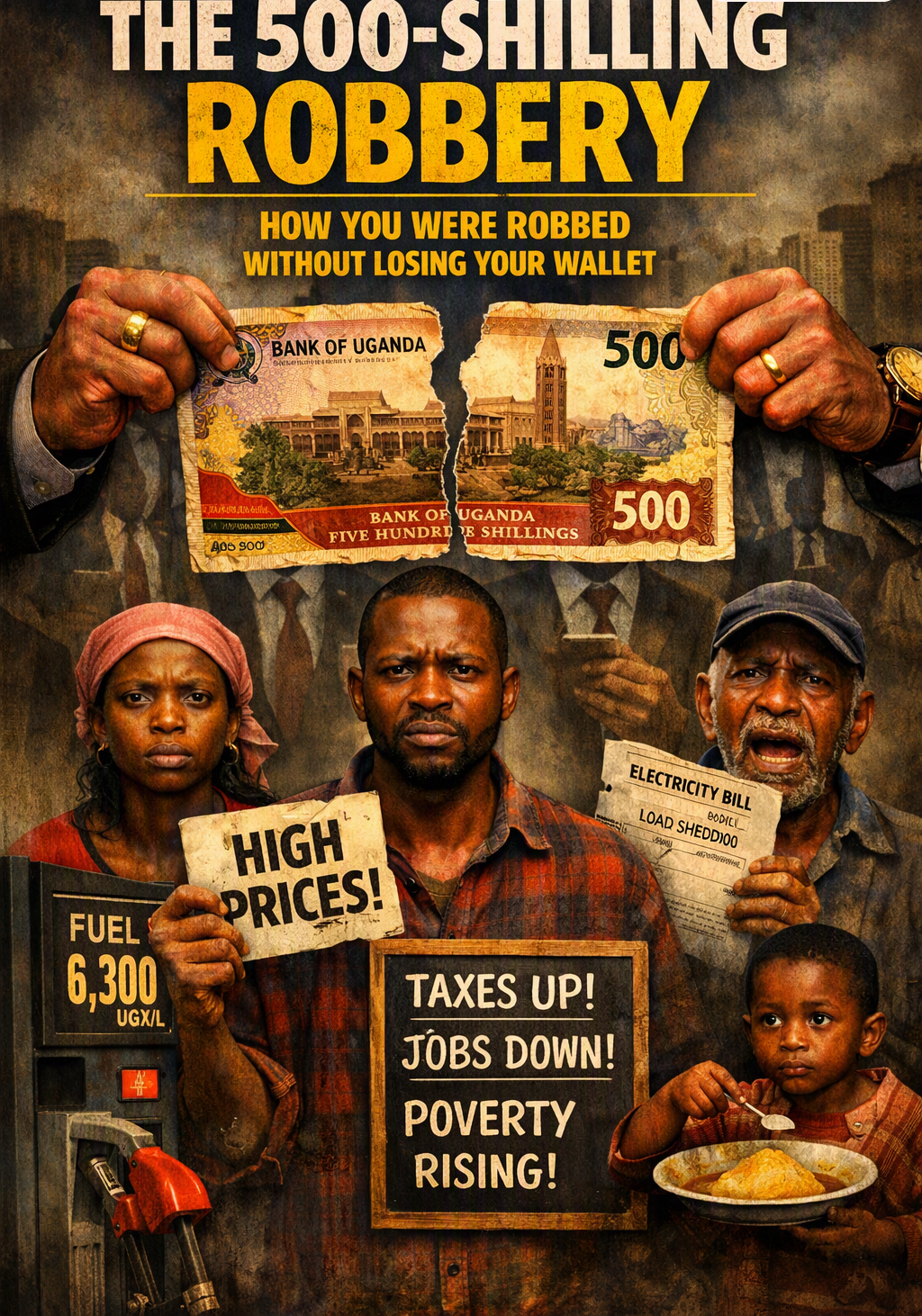
Nobody pointed a gun — they just raised the price of soap, and a Ugandan writer named that thief three decades ago
By Mukama Phillip Kahigiriza
No one broke into your house last week. No one stopped you on the road to Kyamuhunga and said, hands up. And yet you were robbed. Cleanly. Politely. Without a single witness.
You walked into the corner shop with 5,000 shillings folded in your palm — the same 5,000 that has always bought you a bar of soap. The shopkeeper did not smile. He did not look guilty either. He looked at you with the tired eyes of a man who has himself been robbed somewhere further up the chain, and said: “Soap is now 5,500.”
You thought he was joking. You counted the money again. He was not joking.
Just 500 shillings. In Kololo, that is what a wealthy man tosses to a car washer and forgets before he reaches his gate. In Bushenyi, in Ishaka, in Katanga, that same 500 shillings is a child’s lunch. It is a pencil. It is a chapati on a Sunday.
Nobody called a press conference. No Member of Parliament stood on the floor of the House and shouted about it. No television station ran a live report. Because the thief was too small to be seen. And that is precisely why the late Canon Mary Karooro Okurut — who died on 11 August 2025 — wrote a book thirty years ago and gave that thief a name. She called it The Invisible Weevil. Karooro was not writing a novel. She was writing a prophecy.
A weevil does not break into a granary like a thug. It enters like dust, like air. It does not devour the entire harvest in a single night. It takes one grain today, two tomorrow. You lock your store in July feeling rich, full and secure. You open it in December and find powder. The millet is gone — not carried away by lorry, but eaten slowly, patiently, while you were outside applauding politicians at a rally.
That 500 shillings on a bar of soap is a weevil. And it has entered every home in Uganda.
Set aside the language of growth targets for a moment. Forget the phrases they deploy in Serena Hotel workshops — middle-income status, inflationary pressures, supply chain disruptions. Those words were designed to obscure simple theft.
Think instead of Jennifer. Jennifer is 32. She lives in Mbarara. She washes clothes for wealthier families. She wakes at five in the morning, fetches water from a borehole that dries up every February, walks three kilometres to work and scrubs laundry until her knuckles crack and her fingers peel. At the end of a long day she is paid 7,000 shillings. On a bad day, 5,000.
From that money she must buy supper, paraffin for the lamp and soap. Soap to wash her own clothes. Soap to wash her three children’s school uniforms so they are not caned tomorrow for turning up dirty.
Last month, Jennifer could afford it. This month, she cannot. That extra 500 shillings is not merely extra. It is a choice. Do my children eat less, or do they go to school looking unkempt? In many homes across Uganda right now, the answer is unkempt. And then those same children are punished in government primary schools for dirty uniforms — without anyone asking why their mothers can no longer afford to keep them clean. We have quietly made cleanliness a luxury.
Now do the mathematics of the poor, because economics belongs to Jennifer too.
A family of six uses at least four bars of soap a month. That is an additional 2,000 shillings a month. Over a year, 24,000 shillings. That 24,000 was once a year’s worth of salt. It was two second-hand sweaters from Owino market. It was the clinic fee when the baby gets malaria.
Multiply Jennifer by ten million households. That is more than 20 billion shillings a year, quietly transferred from the poorest hands in this country into the accounts of perhaps three factories and four importers who sat in an air-conditioned boardroom and reached an agreement. On paper, no law was broken. In reality, a nation was quietly broken.
When you ask why, they perform the new national anthem of excuses: the dollar, fuel costs, the tax authority, standards agencies, levies, Ukraine, containers, freight rates. Ten reasons, offered so that you forget to ask the only question that matters: which one of these, exactly, added 500 shillings to a bar of soap in Ishaka? Show me the paper.
This is not a new film. In the 1970s, Uganda made its own soap. There was Kimbo. There was Mukwano, starting from a modest garage. There was domestic palm oil. Soap was Ugandan-made and Ugandan-priced. Then came the instruction to liberalise. Privatise. Open up. Competition will bring prices down, they said.
Competition arrived. But it arrived wearing the clothes of a cartel. Today, three companies control close to 80 per cent of the soap and cooking oil market. When those companies sneeze in Jinja, Jennifer catches pneumonia in Bushenyi. This is not inflation in the broad, textbook sense. Inflation is general — it touches everything. What this is, is extraction. It is what happens when a small group concludes that Ugandans will not riot over 500 shillings. So they take 500 on soap today, 300 on salt tomorrow, 700 on sugar next week. Each individual theft looks too small to fight. Together, they have become a second rent. The poor now pay a second rent simply to remain alive.
We call ourselves resilient. We are not resilient. We are exhausted. We have become accustomed to being cut slowly with a razor blade rather than struck with a machete — because the razor blade makes no noise.
Karooro saw this. That is why she wrote that the weevil is invisible, but its hunger is not. Look around and you will see the teeth marks. Children with jiggers because they cannot wash their feet. Girls missing four days of school every month because they cannot wash their bodies and uniforms during menstruation. Families who once bathed twice a day now bathing once. Skin rashes returning to villages that had long forgotten them. These are not merely health problems. They are economic crimes wearing a health mask.
So how does one kill a weevil? My grandmother in Bwatogo never killed weevils by beating the granary wall. She did something simpler and far more powerful. She spread the millet in the hot sun and exposed it. Sunlight is the most effective pesticide there is.
We must spread this 500-shilling story in the sun.
We must demand that the Ministry of Trade stop speaking in the abstract language of radio commentary and produce documents the public can read. Publish the full cost breakdown of a bar of soap. How much is raw material? How much is tax? How much is transport? How much is pure margin? If the same Ugandan-made soap sells more cheaply in Goma and Juba than in Gulu and Kabale, the problem is not the exchange rate. The problem is us — and our willingness to accept it without demanding an explanation.
We must also dismantle the lie of average income. You cannot take Jennifer’s daily earnings of 5,000 shillings, add them to a government minister’s monthly package of 50 million, divide by two, and announce that Uganda has achieved middle-income status. That is arithmetic without a conscience. It is mockery dressed in the language of economics.
Real middle-income looks like this: a motorcycle taxi rider who can wash his own shirt without borrowing from a neighbour. A Jennifer who can wash her children’s uniforms without having to choose between soap and supper.
Until that day arrives, every time you hand over that extra 500 shillings, remember what it is. It is not a rounding error. It is not inflation. It is a weevil. And it is eating your granary, one grain at a time, while you stand outside and applaud.
The day your granary is empty, no one will come to bring you soap.
Similar Posts by The Mt Kenya Times:
- Ghost jobs and fake internships: The hidden trap facing Kenya’s graduates
- The head teacher who turned a Trans Nzoia school into a community anchor
- SHA: Kenya’s medical monster that citizens were told to embrace
- Slogans are not enough: Kenya needs real answers, not catchy phrases
- Purpose, leadership & community impact — turning a crown into a platform for meaningful change
About the Author