Museveni says Uganda overpaid for fuel through Kenyan middlemen as new terminal breaks ground
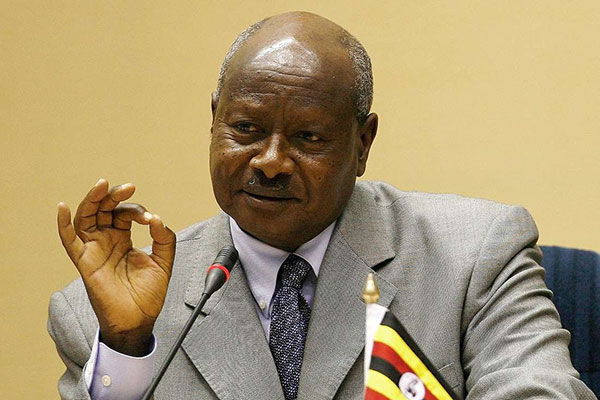
Ugandan President Yoweri Museveni
Uganda’s president reveals the scale of a long-running overcharge — and the numbers have ignited a fresh political storm in Nairobi.
By MKT Reporter
Ugandan President Yoweri Museveni on Friday broke ground for a new fuel terminal in Mpigi District and disclosed that Uganda had for years been overpaying for petroleum products purchased through Kenyan middlemen, with premiums that drove up costs for diesel, petrol and aviation fuel by between 42 and 59 per cent above direct sourcing prices.
The groundbreaking at Mpigi was more than a construction milestone. It was a pointed declaration of intent — the physical and political culmination of a decision Uganda made to cut out the brokers, go directly to refineries, and take control of its own fuel supply chain. That Uganda had been paying avoidable premiums for years was not entirely new information. But Museveni’s willingness to put precise numbers on the overcharge, in public, at a ceremony attended by officials and media, gave the revelation a weight it had previously lacked.
The figures he cited were striking. Under the arrangement with middlemen, Uganda paid $118 per metric tonne of diesel, compared with $83 from bulk suppliers — a difference of 42 per cent. For petrol, middlemen charged $97.50 per metric tonne against $61.50 from direct sources — a premium of 58.5 per cent. Aviation fuel told a similar story, with the middlemen rate standing at $114.25 per metric tonne against $79.25 through direct procurement. Across three critical fuel types, Uganda was consistently and significantly overpaying, and the overcharge was flowing — not to refineries, not to transporters — but to brokers operating within the Kenyan supply chain.
Museveni also revealed that a Kenyan senator had alerted him to the practice, a disclosure that added a layer of irony to the affair: it took a Kenyan lawmaker to tell Uganda’s president that his country was being overcharged by Kenyan traders. “Without my knowledge, our wonderful people were buying this huge quantity of petroleum products from middlemen in Kenya. A whole country buying from middlemen in Kenya or anywhere else! Amazing but true,” Museveni said. The decision, once he learned of it, was straightforward. “Why not buy from the refineries abroad and transport through Kenya and Tanzania, cutting out the cost created by middlemen? Those involved were not bothered by these issues,” he said.
Uganda imports an average of 2.5 billion litres of petroleum products annually, valued at roughly $2B. Under the new arrangement, the Uganda National Oil Company will buy the country’s entire fuel stock from Vitol Bahrain E.C before distributing it to oil marketing companies in Uganda, under a five-year contract that includes a working capital facility backed by Vitol’s global balance sheet. The Mpigi terminal, once complete, will serve as a critical distribution hub within that new architecture — receiving fuel transported through Kenya and Tanzania, storing it domestically, and supplying the broader region.
The disclosure has landed with considerable force in Kenya, where the government’s own fuel procurement framework is already the subject of an acrimonious and escalating political dispute. Kenya abandoned its Open Tender System in favour of a government-to-government arrangement in 2023, a move that was presented as a reform designed to stabilise supply and improve pricing. Critics have argued the opposite has occurred — that the framework has created opacity, entrenched politically connected intermediaries and produced prices that leave Kenyans paying more at the pump than comparable countries in the region.
Rigathi Gachagua, leader of the Democracy for the Citizens Party and Kenya’s former deputy president, has been the most vocal of those critics. He has described Kenya’s government-to-government fuel arrangement as, in his phrase, “Government to Ruto” — an allegation that the system channels benefits not to consumers but to politically connected entities. “The government-to-government arrangement has become a channel for opaque deals that ordinary Kenyans cannot scrutinise, and it must be dismantled immediately,” Gachagua said at a recent press briefing in Nairobi. He has called for the cancellation of the framework, its replacement with a fully open tender system, and the resignation of Energy and Petroleum Cabinet Secretary Opiyo Wandayi, whom he accuses of presiding over systemic failures in sector oversight.
For Gachagua, Museveni’s public disclosures have provided fresh ammunition. If Uganda — a landlocked country that receives its fuel through Kenya — was paying up to 59 per cent above direct sourcing prices to Kenyan brokers, the question of where that premium ultimately ended up is one that Kenyan politicians on both sides of the aisle are now asking aloud. The arrests earlier this year of senior petroleum sector officials, including the former Petroleum Principal Secretary, the former Kenya Pipeline Company managing director and the former director general of the Energy and Petroleum Regulatory Authority, had already put the spotlight on the procurement chain. Museveni’s testimony, however inadvertent, has sharpened that focus considerably.
Paul Muite, the veteran lawyer and former MP, has been among those arguing that brokers operating within Kenya’s fuel supply chain have for years inflated costs for consumers, with downstream effects on transport and farming — sectors that underpin the livelihoods of millions of ordinary Kenyans. Those arguments are now receiving more attention in light of Museveni’s confirmations.
Not everyone accepts the framing that the Ugandan premium proves systemic misconduct on the Kenyan side. Economist David Ndii has argued that the price differences Museveni cited are better explained by procurement model differences than by corruption or cartelisation. Uganda, under its new arrangement, is buying in bulk directly from refineries, a procurement model that naturally yields lower unit prices than a fragmented import system involving multiple licensed operators and a layered distribution chain. The comparison, Ndii contends, is not straightforward. “Procurement differences explain the gap,” he has argued — a position that invites reasonable scrutiny without dismissing the core concern.
That tension between structural explanation and political allegation sits at the heart of a debate Kenya cannot afford to avoid. Gachagua has warned that the current framework is “a recklessly managed sector where government officials have turned it into a wheeler-dealer paradise” and that “there is no genuine government-to-government fuel procurement because the entire arrangement is shrouded in private interests benefiting a few insiders.” The government disputes that characterisation. But with pump prices rising, public frustration mounting and a neighbouring president publicly attributing years of overcharging to Kenyan brokers, the pressure on Nairobi to provide credible answers has grown considerably harder to deflect.
Museveni, for his part, has signalled ambitions that extend well beyond Uganda’s own supply security, promising that competitive fuel from Uganda’s future refinery will benefit the whole of Uganda, north-western Tanzania, Rwanda, Burundi, western Kenya, South Sudan and eastern DRC. That is a regional energy vision in which Kenya features as a transit corridor rather than a price-setter — a subtle but meaningful shift in the balance of influence over East Africa’s fuel economy.
The Mpigi terminal is still to be built. The political consequences of what was said at its groundbreaking, however, are already very much under construction.
Similar Posts by The Mt Kenya Times:
- Court orders throw KPL season kickoff into doubt
- Can Kenyans abroad become the untapped force that transforms Kenya?
- Trump launches AI Force: A new front in the battle for global technology dominance
- From the runway to youth empowerment
- Breach at Vote 8: What the Attack on the Namibian Defence Establishment Means for National Security
About the Author