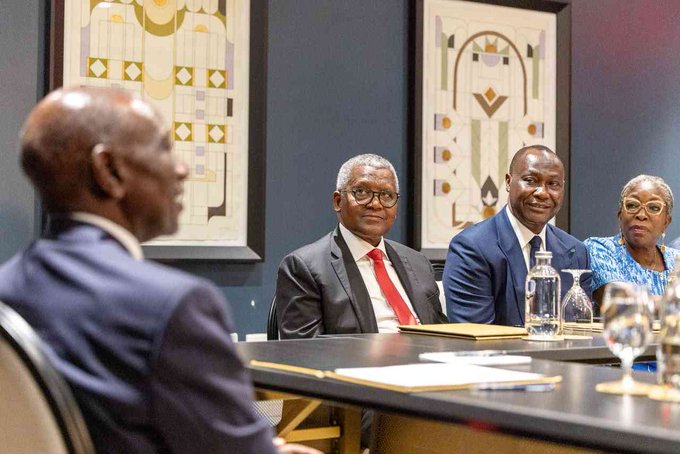
President William Ruto met Africa’s richest man, Aliko Dangote, on the sidelines of the 81st United Nations General Assembly in New York yesterday
In a significant sideline encounter at UNGA 81, the Kenyan president made a direct pitch to Africa’s wealthiest businessman — and the argument he deployed reframes how the continent’s investment story should be told
By Grace Wanja
President William Ruto met Africa’s richest man, Aliko Dangote, on the sidelines of the 81st United Nations General Assembly in New York yesterday, offering Kenya as a practical testing ground for dismantling the perception of African investment risk that he argues is costing the continent billions in capital it is fully capable of absorbing.
The meeting, one of several high-value bilateral and private-sector engagements Ruto conducted during the UNGA 81 week, carried significance beyond the usual diplomatic courtesy. Dangote, whose business empire spans cement, petrochemicals, sugar, flour and — most recently and ambitiously — Africa’s largest private oil refinery in Lagos, represents precisely the category of intra-African capital that Ruto has been arguing should be flowing more freely across the continent’s borders.
The pitch Ruto made was direct. Kenya, he said, offers a stable legal environment, a sophisticated financial services sector, a young and increasingly skilled workforce and infrastructure connectivity that makes it a credible gateway to East and Central Africa. More pointedly, he positioned the country as a place where the narrative of African risk could be empirically tested and, he argued, disproved.
“Africa is not a high-risk continent,” Ruto has said repeatedly this week, including in his main General Assembly address. “It is a continent that has been assigned risk ratings that do not reflect its actual fundamentals — and those ratings are costing us the investment we need to grow.”
The argument connects directly to a central theme of his UNGA 81 engagement: that the global financial architecture systematically overprices risk in African markets, raising the cost of capital to levels that undermine development projects that would be viable in almost any other region. Credit rating agencies, he contends, apply methodologies that penalise African sovereigns beyond what their economic data justifies.
Dangote, who has navigated those same systemic obstacles in building his own continental business presence, is a credible audience for the argument. His Lagos refinery, a 20-billion-dollar project that took more than a decade to complete, is itself a monument to what African private capital can achieve when it is deployed at scale and with patience — and equally a testament to the institutional, regulatory and financing obstacles that make such achievements so rare.
The Kenya-Dangote conversation sits within a broader strategic pattern that Ruto has pursued with notable consistency. He has repeatedly sought to attract not just Western institutional capital or multilateral financing, but intra-African investment — the kind that arrives with continental understanding, longer time horizons and fewer of the conditionalities that have complicated Kenya’s relationships with traditional development partners.
Whether that conversation produces concrete investment commitments, partnership frameworks or simply goodwill remains to be seen. Sideline meetings at international forums are frequently more consequential in political symbolism than in immediate economic outcomes.
But the symbolism here is itself significant. A Kenyan president and Africa’s most successful private investor, meeting at the world’s foremost diplomatic gathering, to discuss whether Africa can be its own most persuasive argument against the risk premium the world charges it — that is a conversation that would have looked very different a decade ago.
Kenya has volunteered itself as the proof of concept. The results will be watched closely.
Similar Posts by The Mt Kenya Times:
- Mt Kenya Times ePAPER September 22, 2026
- Gachagua demands fuel deal accountability, accuses Ruto of deception
- Azimio is dead. Long live the Ukombozi Alliance
- Court frees former presidents to play politics
- Ruto tells UN: Africa’s crisis is rigged rules, not empty coffers
About the Author