Ghost jobs and fake internships: The hidden trap facing Kenya’s graduates
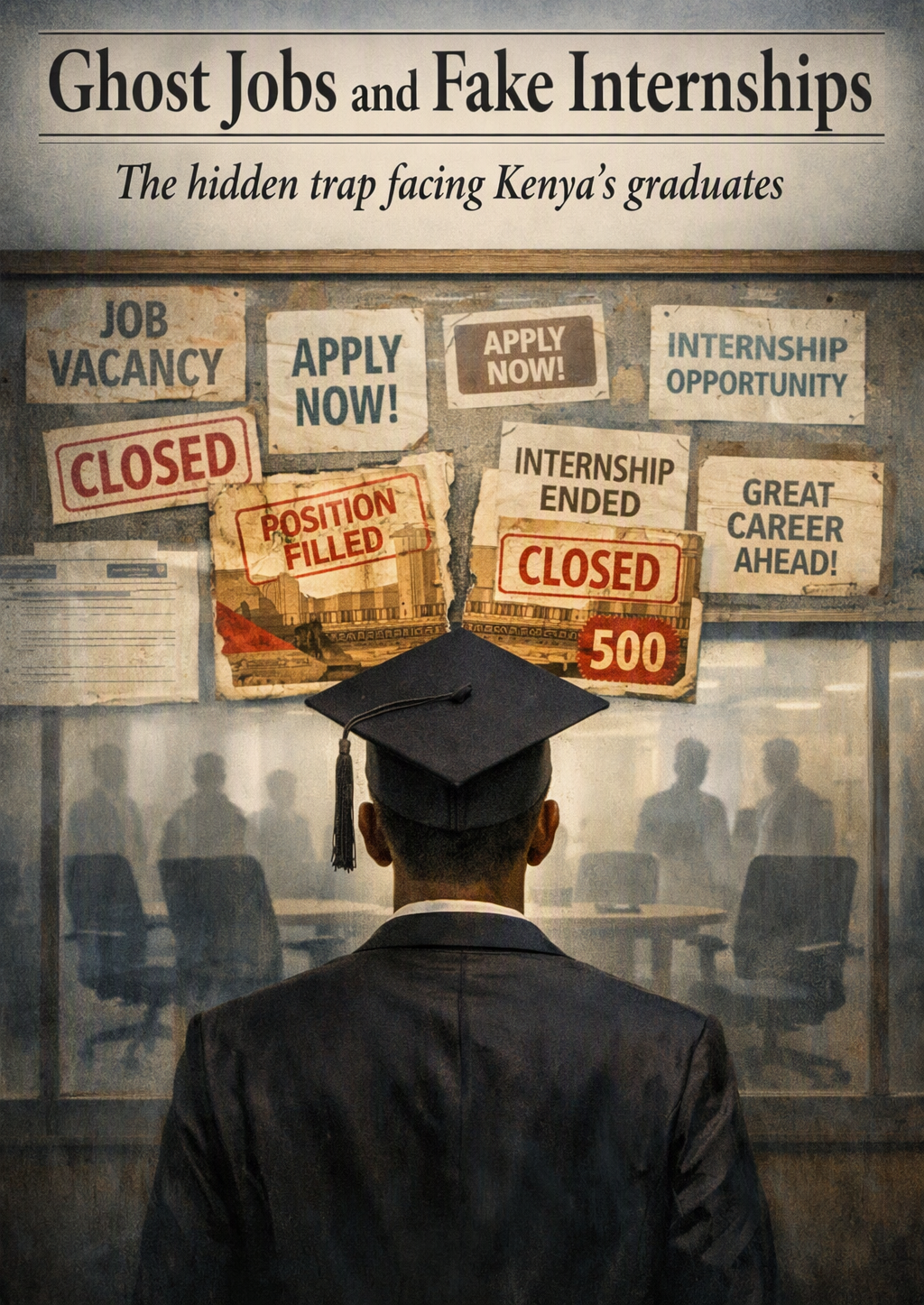
As online recruitment grows, so does a parallel world of fraudulent vacancies preying on desperate jobseekers
By Purity Benjamin
For a university student, few things carry the same charge as a job notification appearing on a phone screen. After months of refining a CV, drafting cover letters and scrolling through LinkedIn, a message reading “Congratulations, you have been shortlisted” can feel like the moment everything is about to change.
The excitement rarely lasts. The interview never materialises. The recruiter vanishes. The email address stops responding. What felt like a breakthrough turns out to be nothing at all.
Across Kenya, students and recent graduates are navigating an online employment landscape where legitimate opportunities sit alongside ghost vacancies, fraudulent recruitment advertisements and fake internships designed to exploit the very people who can least afford to be misled. The question is no longer simply where to find a job. It is increasingly: how do you know the job you have found is real?
The scale of the challenge is visible in the numbers. According to the Kenya National Bureau of Statistics Economic Survey 2025, university enrolment grew by nine per cent to 631,300 students in the 2024/25 academic year. Kenya’s economy generated 782,300 jobs in 2024, but only 78,600 were in the formal sector. Africa Check has reported that more than 800,000 young Kenyans enter the job market every year, while those aged between 20 and 24 record the country’s highest long-term unemployment rate, at 9.9 per cent. That gap between the number searching and the number of formal opportunities available is precisely the environment in which a convincing fake vacancy becomes dangerous.
Samuel, a fourth-year actuarial science student, says the online job search has become an education in caution. He had been applying for positions advertised on LinkedIn when he encountered what appeared to be a standard vacancy. It was only when several friends independently reported the same experience — application submitted, silence returned — that the picture became clear. What had looked like a genuine opportunity was not what it claimed to be. More troubling was the realisation that it was not an isolated case. It was a pattern.
The documented cases in Kenya confirm that fraudulent recruitment does not confine itself to obscure names. In 2025, a fake advertisement claimed the Kenya Ports Authority was recruiting for 28 positions, directing applicants to a Gmail address rather than any official channel. KPA disowned it and warned the public to verify all recruitment information through its official platforms. A separate case involved the Kenya Institute for Public Policy Research and Analysis, where a fraudulent advertisement promised 1,990 job and internship opportunities and directed applicants to pay KSh300 through a third party. The institute disowned the advertisement immediately.
For a young Kenyan looking for work, both advertisements would have sounded worth pursuing. That is the psychology behind recruitment fraud. The advertisement does not need to deceive everyone. It only needs to deceive the person who genuinely needs the job.
Sandra, a third-year computer science student, says the damage extends beyond any single wasted application. Through conversations in an online technology community, she encountered concerns that some advertised positions were already earmarked for internal candidates, while others appeared to exist primarily to harvest CVs and personal data. The experience shifted how she reads job advertisements entirely. The question was no longer only whether she met the qualifications. It was whether the employer was genuinely looking for someone at all.
That shift in thinking is becoming common. Students grow guarded about sharing personal information. Some rely increasingly on personal recommendations rather than responding to unfamiliar advertisements. A generation of jobseekers is learning that finding a vacancy is only the beginning of the problem.
The speed at which content spreads online has made things considerably worse. An advertisement can appear on a student’s phone through LinkedIn in the morning, be forwarded across WhatsApp groups by midday and reach thousands more through Telegram and Facebook by evening. Every person who shares it in good faith becomes an unwitting part of its distribution. In 2025, a fake advertisement claiming the Kenya Wildlife Service was recruiting rangers circulated widely, instructing users to share the post with five WhatsApp groups before supposedly continuing their application. Africa Check identified it as an engagement-bait scam. KWS confirmed it was fraudulent.
The vulnerability of young jobseekers is not simply a matter of inexperience. It is rooted in pressure. The transition from university to employment is among the most uncertain periods of a young person’s life. A student approaching graduation may be managing tuition arrears, family expectations and the urgent need to build a professional record. An internship is not merely work experience in that context. For many, it is the difference between graduating with something on a CV and entering the labour market with nothing. The World Bank has noted that around 85 per cent of young Kenyans depend on informal work and that new entrants to the workforce outpace the economy’s capacity to absorb them into productive formal employment. In that environment, a message promising a formal position carries enormous weight.
Beyond the emotional toll, the risks are concrete. Fake recruiters have requested application fees, registration charges and document-processing payments. A CV submitted to a fraudulent recruiter typically contains a full name, telephone number, email address, academic history, physical location and identification details. The applicant believes they are applying for a job. The person receiving that information may have an entirely different purpose. In February 2025, the Communications Authority reported that Kenya’s cyberspace faced 3.5 billion detected threats in the previous financial year — a figure that illustrates the scale and hostility of the digital environment in which jobseekers are operating.
The starting point for protection is straightforward: check the official website. If the vacancy does not appear there, the advertisement demands scrutiny. A professional graphic is not evidence of legitimacy. Neither is a high share count. The safest approach is always to verify independently through the organisation’s own channels rather than treating an advertisement as proof that it is genuine.
The problem ultimately demands a collective response. Employers must remove outdated listings promptly. Universities must equip students with practical tools for verifying opportunities. Recruitment platforms must strengthen fraud-reporting mechanisms. Government agencies must respond quickly when their names are misused. And students must carry both ambition and scepticism into every application they make. The internet has made job hunting faster and more accessible — but access without verification creates a vulnerability that fraudsters have proved very willing to exploit.
Similar Posts by The Mt Kenya Times:
- Ruto’s Mt Kenya gamble: Can he win it twice?
- Samsung opens 24th experience store and first service centre in Kisii as regional market grows
- Mashujaa Day 2026: Let the people host the celebration, not just watch it
- Ruto leads nation in honouring Raila at Bondo mausoleum dedication
- Kang’ata courts Canada for Murang’a industrial city
About the Author