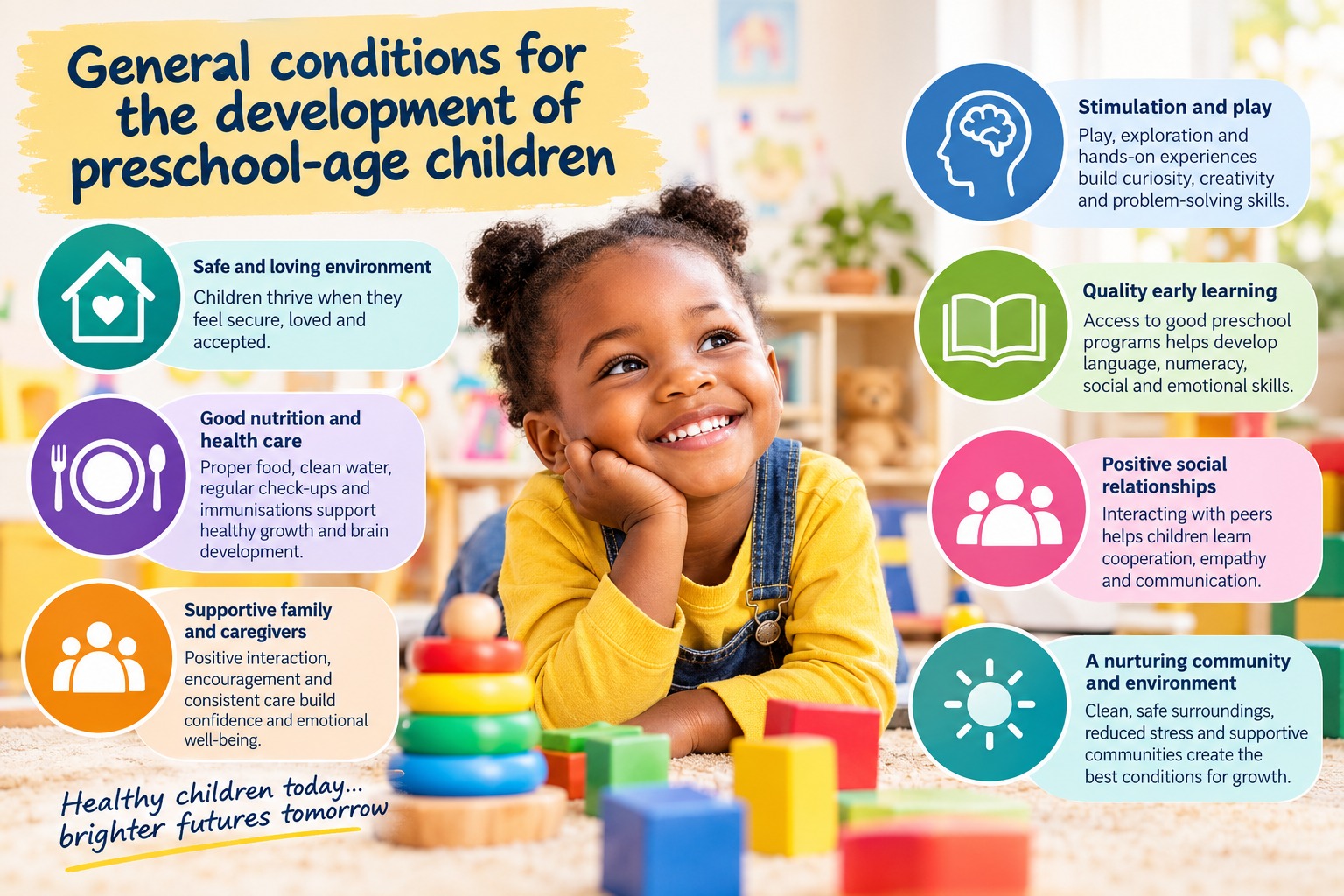
General conditions for the development of preschool-age children

By: Zokirjonova Zarina
Abstract: Pedagogical conditions created in preschool educational organizations (such as the educator’s expertise and modern teaching methods) ensure a child’s readiness for school. In the second half of the 19th century, the pedagogy of preschool-age children emerged as a distinct branch of general pedagogy.
Keywords: preschool education, junior group, middle group, senior group, preparatory group, poem, song, role-playing games, creative activity, behavior, richness of speech, special pedagogy, pedagogical system.
The preschool period is one of the most important stages of human life, as it is during this time that the foundations of an individual’s physical, psychological, and social development are established. Scientific literature emphasizes that a child’s early years play a decisive role in shaping their future learning processes, behavior, and personal qualities.
The preschool period is a crucial stage in a child’s comprehensive development, and the conditions created during this time directly influence the formation of their future personality. Properly categorizing age groups and applying a pedagogical approach suited to each stage are essential prerequisites for effective education and upbringing. In preschool educational institutions, children are grouped according to age. The physical, linguistic, cognitive, and social development of children in each age group unfolds progressively.
Therefore, it is important for the educator to conduct their work while taking into account the capabilities associated with each age group. In preschool educational institutions, children are grouped according to their age characteristics, and educational activities tailored to the children’s developmental level are carried out in each group. There are four age groups in preschool educational institutions.
The junior group consists of children aged 3 to 4. At this age, children can express their thoughts using simple sentences and begin to distinguish between colors and shapes. They actively participate in simple role-playing games and learn to interact with adults and peers. At the same time, basic self-care skills—such as eating and dressing independently—begin to develop. Children are also capable of memorizing short poems and songs.
The middle group encompasses children aged 4 to 5. During this period, children’s speech develops significantly, enabling them to express their thoughts clearly and understandably. They ask numerous questions and strive to explore their surroundings more deeply. Early elements of logical thinking begin to take shape, and cognitive processes such as comparing and generalizing start to develop. Children independently organize role-playing games, actively participate in creative activities—such as drawing, building, and crafting—and learn to follow simple rules.
The older group consists of children aged 5 to 6. Children in this age group are able to express their thoughts freely and develop the ability to recount events in a logical sequence. Their logical thinking strengthens, and problem-solving skills begin to take shape. They learn to work in a team, show an interest in reading and writing, and participate in more complex play activities.
The preparatory group comprises children aged 6 to 7. During this period, children develop the readiness for school education. They learn to sustain their attention, become familiar with letters and numbers, and master the fundamentals of reading and writing. Furthermore, they develop skills in independent thinking, drawing conclusions, and self-regulation, all of which lay the foundation for a successful transition to school.
In his speeches, the President of the Republic of Uzbekistan, Shavkat Mirziyoyev, notes that developing the preschool education system is a priority task in raising a well-rounded younger generation. Uzbek educators and scholars also place special emphasis on the importance of environment and upbringing in the development of preschool-aged children. In particular, according to Nodira Egamberdiyeva, personal qualities, cognitive processes, and social skills are effectively formed during the preschool years. Mavluda Rasulova highlights that it is precisely during this period that children’s speech, thinking, and social behavior develop rapidly, laying the foundation for subsequent stages of education.
Robert Owen (19th century): An English educator who first put forward the idea of providing social education to children from an early age and opened the first institution for the children of the proletariat. Friedrich Fröbel: As a theorist of preschool education, he created a specialized pedagogical system for children of this age group. In Uzbekistan: The first kindergartens began to be established in 1919. The preschool education period generally covers the ages of 3 to 7 and is divided into several sub-stages: 3–4 years (Early preschool age): The child’s sense of self (“I”) forms, and the drive for independence intensifies. 4–5 years (Middle preschool age): Vocabulary expands, the “Why?” phase begins, and imagination and creativity develop rapidly. 6–7 years (Senior preschool age): Voluntary attention develops, and the child becomes psychologically and physically ready for school education. General conditions of development. Physiological changes: This period is one of the times of most rapid physical growth for the human body (particularly regarding height growth, starting from ages 1–2 and continuing thereafter). Leading activity – Play: For children aged 3–7, play is not merely a source of enjoyment but the primary means of acquiring social experience. Growth rates: The preschool years (ages 3–7) represent a period of rapid physical growth and changing body proportions (such as the lengthening of the legs). Physical activity: Physical exercises, active games, and sports activities not only enhance a child’s movement capabilities but also positively influence their emotional stability. Daily routine: Proper nutrition, hygiene, outdoor walks, and a schedule ensuring sufficient sleep are essential for the child’s overall physical conditioning and the healthy functioning of their nervous system.
The directions for improving the general conditions for development are as follows: Infrastructure and material-technical base: Establishing “development centers” (corners for play, construction, art, and nature) in modern preschool educational organizations. This provides children with the opportunity to make independent choices. Implementation of varied programs: Applying a competency-based approach—moving beyond standard lessons—based on the “Ilm Yo‘li” (Path of Knowledge) and “Ilk Qadam” (First Step—revised in 2018) state programs. Creating conditions conducive to psychological well-being and active engagement. Inclusive conditions: Creating an environment where children with developmental disabilities are educated alongside their typically developing peers—a crucial prerequisite for social adaptation. Regarding the development of preschool-age children, and in accordance with the State Requirements approved in 2018, development must proceed across five key areas (domains of conditions):
- Physical development and the formation of a healthy lifestyle.
- Socio-emotional development (interaction with adults and peers).
- Speech, reading, and writing skills (preparation for literacy).
- Cognitive processes (understanding the world around us,
elementary mathematics).
- Creative development (music, art, drama).
The improvement of this sector in Uzbekistan has reached a new stage: September 30, 2017 – The Ministry of Preschool Education was established, laying the foundation for managing the sector as a distinct system. December 16, 2019 – Law No. ZRU-595 “On Preschool Education and Upbringing” was adopted, guaranteeing a child’s right to development at the state level. 2020–2025 – Under the concept for developing the preschool education system, the goal is to raise the child enrollment rate to 80%. Modern improvement methods involve the following technologies:
STEAM educational technology (Science, Technology, Engineering, Art, Math) is being implemented for children aged 5–6 to foster critical thinking. Digitalization involves maintaining a child’s development record (monitoring) through the “Kindergarten” management information system. The preschool period is not merely a stage of preparation for school; it is a strategic phase during which the foundation of human capital is laid. Analyses and international experiences (such as Montessori, Reggio Emilia, and STEAM) demonstrate that the conditions created for child development must extend beyond mere material infrastructure.
The environment serving as the “Third Educator”—a key factor in the overall development of preschool-age children—must evolve from a mere collection of fixtures and equipment into a “living mechanism” that encourages exploration. It is significant for granting children the freedom of choice, which in turn fosters independent decision-making skills in young children. Personnel Transformation: A crucial prerequisite for progress is the transformation of the educator’s role.
The modern educator must no longer be merely a “tutor” who imparts knowledge, but rather a “facilitator” who supports a child’s interests. The strategy for 2024–2030 identifies enhancing educators’ creativity as a key factor in further improving the system. An integrated approach: a child’s physical, cognitive, and emotional development cannot be viewed in isolation. Further improving the preschool education system requires strengthening the “triangular” partnership among the family, the *mahalla* (local community), and the educational institution through digital technologies (such as monitoring systems).
Conclusion – In summary, the more flexible and child-centered the conditions created for the development of preschool-age children are, the greater the intellectual potential of the generation society will possess. 2017–2018: A fundamental reform of the preschool education system began in Uzbekistan, and the network of organizations with legal status within the system expanded. Current status: More than 7,000 preschool education organizations are operating in Uzbekistan; approximately 79 percent belong to the public sector, while 21 percent belong to the non-state sector. The reforms being implemented in Uzbekistan (the post-2017 phase) are gaining international recognition precisely because they focus on supporting each child’s individual developmental trajectory.
Zokirjonova Zarina was born on October 6, 2007, in Pop District, Namangan Region, Uzbekistan.
She is currently a second-year student in the Preschool Education program at the Faculty of Pedagogy, Psychology and Art Studies of Fergana State University.
Similar Posts by The Mt Kenya Times:
- The triple squeeze: how EPRA’s fuel price hike is reshaping the survival equation for the common mwananchi
- Zelenskyy accuses Trump of rewarding Putin as Pope pleads for peace from a hospital bed
- Mashujaa Day 2026: What does Kenya owe the heroes it exports?
- My Mother Tongue — The Most Sacred Voice Of My Heart
- The Poet’s Silence, The World’s Noise: Who Needs Literature Today?
About the Author