Light at last: How electricity is reshaping Nandi and Uasin Gishu
 The Mt Kenya Times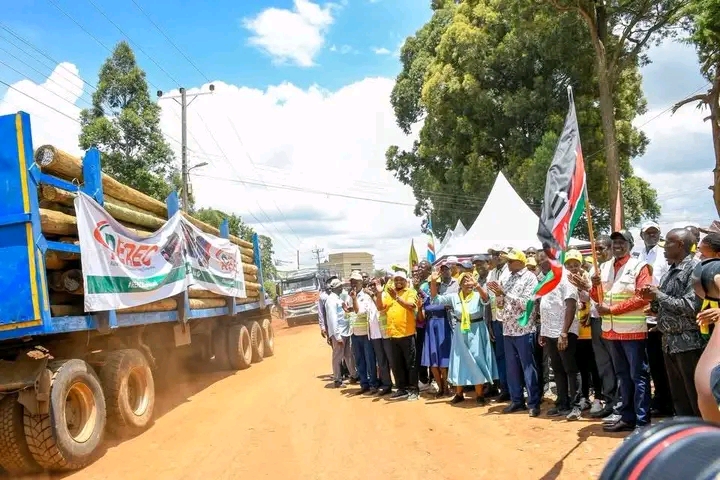
President William Ruto flagging off electrification program. Photo courtesy Opiyo Wandayi Facebook page

President Ruto’s development tour puts power at the heart of Kenya’s bottom-up agenda — but delivery will decide everything
By James Kilonzo Bwire
President William Ruto’s recent development tour of Nandi and Uasin Gishu counties, accompanied by Energy and Petroleum Cabinet Secretary Opiyo Wandayi, placed electricity access squarely at the centre of Kenya’s conversation about economic transformation. The flagging off of Last Mile Connectivity Programme projects in Mosop, Nandi Hills and Pioneer in Eldoret was not simply a ribbon-cutting exercise. It was a statement of intent: that communities which have historically been left outside the national grid must now be brought into the mainstream of national development — and that the government is prepared to act on that commitment in person.
Electricity is not an ordinary public service. It is the foundation on which households, schools, health facilities, farms, markets and small businesses depend in order to function and grow. When power reaches a home, families can study after dark, preserve food, access information and carry out daily tasks with greater safety and dignity. When it reaches a school, it enables digital learning, laboratory work and modern administration. When it reaches a clinic, it powers refrigeration for medicines, runs medical equipment and extends the hours during which staff can serve patients effectively. These benefits may sound straightforward — but they are transformative for communities that have been managing without them.
The Last Mile Connectivity Programme is one of Kenya’s most important tools for achieving universal electricity access. Its logic is simple and compelling: many rural and peri-urban households are not far from existing grid infrastructure but remain unconnected because of the cost and technical requirements of that final link. By closing that gap, the programme removes a practical barrier that has kept families and enterprises in the dark — sometimes literally for generations. It ensures that public investment in generation and transmission actually reaches the people who need it most, rather than stopping short at the edge of town.
The economic case for these connections is equally powerful. Small businesses — salons, welding workshops, milk cooling centres, grain mills, bakeries, tailoring enterprises and agro-processing units — all depend on reliable power to operate efficiently, extend working hours and create employment. Farmers can use electricity for irrigation, cold storage, poultry production and the processing of agricultural produce, adding value to what they grow and reducing post-harvest losses. The African Development Bank has consistently noted that access to electricity for households and businesses is one of the most reliable drivers of economic growth at the local level. In Nandi and Uasin Gishu, the potential is real and largely untapped.
The electricity projects were not launched in isolation. They were accompanied by road construction linking Turbo, Kaiboi, Kimondi, Chepterit, Mugundoi, Nandi Hills, Kosiage and Cheptulu; development of student hostels and university facilities; commissioning of affordable housing units; rehabilitation of Kerita Dam; establishment of modern markets; and support for women entrepreneurs through the Women Enterprise Fund. Taken together, these interventions reflect a coherent understanding of what development actually requires. Roads move people and goods. Water serves households, farms and institutions. Markets provide space for trade. Education facilities prepare the next generation. And electricity connects all of it — providing the energy without which roads remain dark at night, markets cannot refrigerate produce and schools cannot run computer labs.
This matters because development delivered in isolation rarely sticks. A road without electricity can improve transport but cannot support cold storage or processing plants. A market without reliable power can shelter traders but cannot support refrigeration, electronic payments or value addition. The combination of all these interventions, delivered together, is what turns a government tour into a genuine development moment.
The Bottom Up Economic Transformation Agenda is built on the belief that growth must begin with ordinary people — small enterprises, farmers, traders and workers in local communities. Electricity access is central to that philosophy. A country cannot credibly claim to be transforming its economy from the bottom up while large sections of its population remain off the grid. Connecting communities to power gives ordinary people the tools to participate — a small trader who can extend business hours, a farmer who can chill produce before it spoils, a young person who can access digital skills after sunset.
That said, the true value of these projects will depend entirely on what happens after the flags are waved. Announcing a programme is only the beginning. Connections must be completed within a reasonable timeframe, to the required standard, and without hidden costs that price out the very households the programme is meant to serve. Maintenance must be taken seriously, because communities that receive electricity only to suffer constant outages will quickly lose faith in the promise behind the connection. Affordability must be protected, because a power line that nobody can afford to switch on delivers nothing.
Beyond connection, productive use must be actively supported. A live cable does not automatically create jobs or raise incomes. Households and businesses need access to affordable appliances and equipment, training in how to use power productively, and pathways into markets where their output has value. Women, who form a significant part of Kenya’s informal business sector, deserve particular attention — they face additional barriers in accessing capital, technology and markets, and the Women Enterprise Fund cheque issued in Eldoret is a welcome recognition that enterprise development requires both energy and financing together.
Kenya has committed to achieving universal electricity access by 2030. The projects in Nandi and Uasin Gishu are a practical piece of that national effort — not an abstract policy objective but a programme being implemented in specific villages, trading centres and households. If the delivery follows through on the promise, the people of these counties will not merely receive electricity. They will receive a genuine opportunity to improve their lives, build stronger enterprises and participate more fully in the country’s future.
That is what inclusive development looks like when it works. The task now is to make sure it does.
Similar Posts by The Mt Kenya Times:
- Diaspora Times Global Oct 17 – Oct 23, 2026
- Is social media a blessing or a curse for university students?
- The triple squeeze: how EPRA’s fuel price hike is reshaping the survival equation for the common mwananchi
- Zelenskyy accuses Trump of rewarding Putin as Pope pleads for peace from a hospital bed
- Mashujaa Day 2026: What does Kenya owe the heroes it exports?
About the Author