Why the schools that build genuine human connections consistently leave fee-chasing institutions behind
By Ashford Kimani
One of the greatest mistakes many private schools make today is reducing education to a purely commercial activity. In some institutions, everything revolves around invoices, outstanding balances, admission targets and headcount. Parents are treated like customers. Learners are treated like statistics. Teachers are treated like grade-producing machines. In such an environment, education loses its soul.
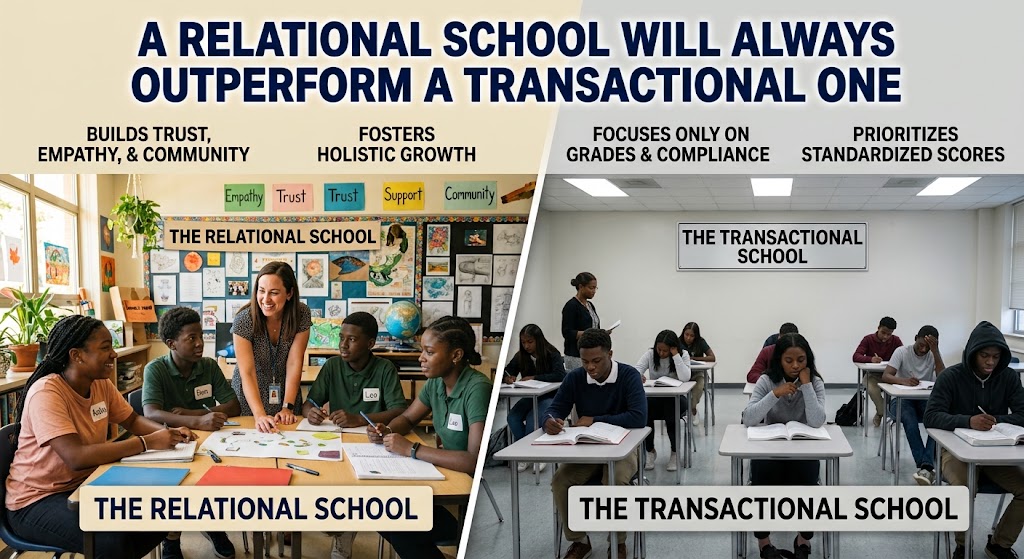
Yet the most successful schools rarely operate this way. They understand a powerful principle: a relational school will always outperform a transactional one.
A transactional school focuses on exchange. Parents pay fees; the school delivers lessons. Once payment is delayed, the relationship turns cold and mechanical. Communication becomes hostile. Learners feel unwanted. Every interaction feels like a business transaction.
A relational school operates differently. It understands that education is fundamentally human. It prioritises relationships before transactions. It sees parents as partners, not merely sources of revenue. It sees learners as individuals with emotions, fears, talents and dreams. It sees teachers as mentors, not just employees.
That difference changes everything.
Parents are naturally drawn to environments where they feel respected and emotionally connected. They may initially choose a school because of its facilities or academic record, but they stay because of relationships. When parents feel known, heard and appreciated, loyalty deepens.
Many school administrators underestimate the emotional dimension of schooling. They assume parents care only about grades. Academic performance matters greatly, of course, but parents also pay close attention to how their children are treated each day. They notice whether teachers are approachable. They observe whether school leaders communicate warmly or dismissively. They assess whether the institution genuinely cares about their child beyond the next fee deadline.
A transactional school often reveals itself during difficult moments. When a parent falls behind on fees, the child is humiliated in front of peers. When a learner struggles academically, the school is quick to label them weak. When a parent raises concerns, the administration becomes defensive. Policies are enforced without empathy. Communication feels threatening rather than supportive.
Such schools may survive for a time — particularly if their academic results hold up — but families begin leaving emotionally long before they leave physically.
Relational schools handle difficult situations differently. They understand that every family experiences hardship at some point. They balance firmness with humanity. They communicate with respect even during disagreements, and they seek solutions rather than confrontations.
This does not mean schools should abandon structure or ignore policy. It means that systems should be guided by wisdom and compassion. Parents are far more cooperative when they feel respected rather than cornered.
Children, too, perform better in relational environments. Learners thrive where they feel emotionally safe and genuinely valued. A child who knows that teachers care develops confidence. They participate more actively, build discipline from within rather than through fear, and come to associate school with belonging rather than pressure.
In transactional schools, fear becomes the primary management tool. Learners comply because they fear punishment. Teachers perform because they fear the administration. Parents cooperate because they fear embarrassment. Such environments may appear orderly on the surface, but beneath that surface lies emotional distance and quiet resentment.
Relational schools build community instead. They celebrate birthdays, achievements and milestones. Teachers know their learners personally. School leaders move freely among students. Parents feel welcome on the school grounds. Communication is open and respectful, and families develop a genuine emotional attachment to the institution.
That emotional attachment becomes a significant competitive advantage.
In today’s education market, many schools offer similar facilities, similar curricula and similar promises. What truly sets schools apart is culture — and specifically, how a school makes families feel. A parent may forget the speech delivered at an academic clinic, but they will never forget how the school stood with them through a difficult family moment. They may forget examination statistics, but they will remember the teacher who patiently encouraged their struggling child. Relationships create memories that no marketing budget can manufacture.
Teachers also stay longer in relational schools. Staff turnover is one of the most persistent challenges facing private institutions. Many teachers leave not simply over salary, but because of toxic environments. Transactional institutions drain staff emotionally, focusing entirely on output while offering little personal or professional support.
Relational leadership transforms workplace culture. Teachers feel valued. Their opinions are heard. Their welfare is considered. Collaboration improves, morale rises, and when teachers are emotionally healthy, learners benefit directly.
Relational schools also enjoy stronger reputations within their communities. Parents naturally recommend schools where they feel genuinely connected. Word-of-mouth referrals grow because families trust the institution deeply. Such schools build long-term stability because their growth rests on relationships rather than aggressive advertising.
This principle matters most during economic hardship. Families are far more likely to remain loyal to schools that treated them with dignity in difficult times — schools that listened, supported and communicated honestly. Transactional schools, by contrast, often lose families quickly when challenges arise, because there was never any genuine emotional connection to fall back on.
Ultimately, schools must decide what kind of institution they want to be. It is entirely possible to run a school efficiently while remaining humane. It is possible to maintain rigorous standards while still nurturing warmth and empathy. These are not opposing values.
Education is not merely the transfer of content. It is the shaping of human beings — a process that requires relationships, trust, patience and emotional intelligence.
The schools that will thrive in the years ahead are not necessarily those with the grandest buildings or the loudest advertising campaigns. They will be the schools where learners feel genuinely cared for, teachers feel truly valued, and parents feel deeply respected.
In education, relationships are not a soft extra. They are the foundation of lasting success.
Similar Posts by The Mt Kenya Times:
- The blind lady’s dagger: When “social justice” sharpens Kenya’s laws into political blades
- Kenya’s anti-corruption war needs stronger pointmen at the grassroots
- Raphinha cuts Brazil duty short after muscle scare
- Gordon and Kane fire England to victory in Prague
- KEMSA advances digital traceability for safer medicines
About the Author