Arrest the sponsors, not just the foot soldiers, Kalonzo tells police
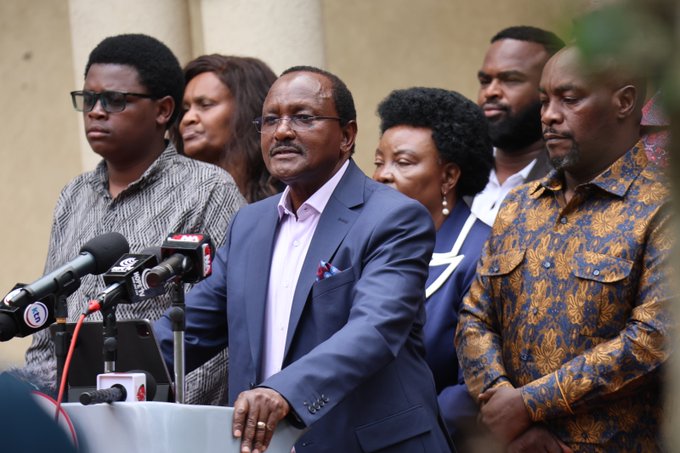
Wiper Democratic Movement leader Kalonzo Musyoka
The Bondo memorial attack exposes a pattern of political violence that Kenya’s security forces have consistently failed to prosecute to its source.
By David Kimani
Wiper Democratic Movement leader Kalonzo Musyoka yesterday demanded that police move beyond arresting low-level perpetrators and pursue the financiers behind the machete attack on mourners at the memorial service for former Prime Minister Raila Odinga’s brother, Oburu Oginga, in Bondo, Siaya County.
Writing on social media after attending the service at Migwena, Kalonzo said the attack was premeditated and organised. “Nobody carries weapons to a memorial by accident,” he wrote. “My message is to the sponsors, not the foot soldiers: we know who you are. I call on the Inspector-General and the DCI to follow the money and the vehicles, and arrest the financiers, not just the young men holding the weapons.” Five suspects were arrested at the scene, with a machete, a sword and a knife recovered. But for Kalonzo and a growing number of opposition figures, five arrests mean nothing if the architects of the violence remain untouched.
The attack at Bondo is not an isolated incident. It is the latest episode in a pattern of organised political violence that has shadowed Kenya’s public life for years and that the state has shown a consistent and troubling reluctance to prosecute beyond its most visible and most expendable participants. Hired young men are arrested, charged, occasionally convicted. The businessmen, politicians and fixers who recruited, transported and paid them are rarely named in court, rarely charged and almost never convicted. The architecture of impunity has been constructed carefully and maintained deliberately.
Kenya’s history with political violence and accountability is long and largely dishonourable. The post-election violence of 2007 and 2008 killed more than 1,300 people and displaced hundreds of thousands. The International Criminal Court eventually opened cases against six Kenyans, including the men who would become President and Deputy President. All cases collapsed, partly through witness intimidation and partly through what the court’s own prosecutors described as interference with the process of justice. Not a single individual was convicted in a Kenyan court for the orchestration of that violence. The foot soldiers bore what little legal consequence there was. The sponsors walked free and back into public life.
The years since have produced variations on the same theme. Political rallies disrupted by hired gangs. Opponents’ vehicles stoned. Journalists assaulted while covering protests. In nearly every case, the response from Kenya’s security establishment has followed an identical script: swift arrests of visible perpetrators, statements of condemnation from senior officials, promises of thorough investigation, and then silence. The investigations rarely produce charges against anyone of political consequence. The silence is the point.
What makes the Bondo attack particularly significant is its timing and its symbolism. Mourners had gathered to honour a member of one of Kenya’s most prominent political families. Raila Odinga, whose brother was being remembered, is a figure of continental stature who recently concluded his campaign for the African Union Commission chairmanship. His family opened their grounds to the nation in grief. That violence should intrude on that occasion, in that place, sends a message that is difficult to read as anything other than deliberate provocation — and one directed not merely at a family but at the political constituency that family represents.
Kalonzo’s appeal to Inspector-General of Police Douglas Kanja and the Directorate of Criminal Investigations to follow the money and trace the vehicles used to transport attackers reflects a sophisticated understanding of how organised political violence actually works. Machetes do not appear at memorials spontaneously. They are purchased, transported and distributed. The young men who carry them are recruited through networks that have identities, bank accounts, mobile money records and vehicle registration numbers. Every tool of modern financial investigation is available to Kenyan law enforcement. The question has never been capability. It has been will.
That will has been conspicuously absent across successive administrations. The current government came to power partly on the strength of promises to break with the impunity of the past. President William Ruto’s administration has spoken repeatedly about the rule of law and the protection of constitutional rights. Those commitments are now being tested in Bondo in a manner that is direct, documented and very public. The weapons have been recovered. The vehicles, by Kalonzo’s account, are known. The financial trails exist. What happens next will say more about this government’s actual commitment to accountability than any speech delivered from a podium.
Kalonzo himself struck a careful dual note in his statement, addressing not only the security establishment but the young people who participate in political violence directly. “The Constitution protects your right to speak and to assemble, and no government can take that away,” he wrote. “But a freedom that silences others is not freedom. Criticise us, argue fiercely, but join the Ukombozi movement, not the goons.” It is a message worth amplifying. The young men arrested in Bondo are themselves victims of a system that recruits the economically desperate to do the dangerous work of the politically powerful.
Kenya is 295 days from what Kalonzo calls “Wantam” — a term his movement has used to signal the general election due in August next year. The political temperature will not fall between now and then. It will rise. The parties are positioning, the alliances are forming and the competition for power is intensifying by the week. In that environment, incidents like Bondo do not remain isolated. They escalate. They normalise. They invite retaliation. And they erode, incrementally but fatally, the public confidence in democratic processes that Kenya can least afford to lose.
The Inspector-General and the DCI have been named. The call has been made publicly and on the record. The question is whether this time, the answer will be different.
Similar Posts by The Mt Kenya Times:
- Mt Kenya Times ePAPER October 20, 2026
- Ruto rallies Kalenjin elders in Rift Valley unity push
- Sonko bid to nullify impeachment judgments fast-tracked in court
- Police and politics shut down Kitale’s busiest market
- Bikeke students benefit from charity support
About the Author