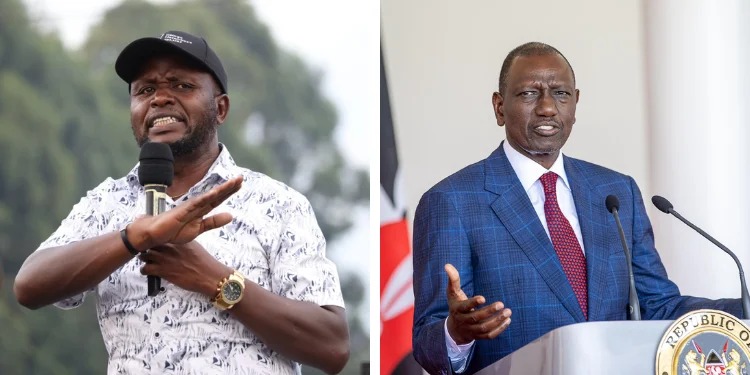
President William Ruto and Governor George Natembeya
The Ruto-Natembeya standoff has moved from rhetoric to roadblocks — and it is traders who are paying the price.
By Joakim Wekesa
Heavy police deployment at Kitale’s newly commissioned Masinde Muliro Market yesterday shut down business across Trans Nzoia’s central business district as tensions between President William Ruto and Governor George Natembeya boiled over into a direct confrontation on the streets of the county town.
General Service Unit officers and anti-riot police moved into position around the market from midnight, ahead of a planned prayer service organised by Natembeya at the facility. The security presence — roadblocks, armed units and riot equipment deployed in a commercial district at the start of a trading week — was enough to keep traders away from stalls they depend on for their livelihoods. By morning, one of Trans Nzoia’s busiest economic hubs had been reduced to a tense standoff between state power and a governor who has made his defiance of the presidency a defining feature of his political identity.
Businessman Anthony Masika captured the mood plainly. “Businesspeople are not operating because there is tension. Police officers are everywhere, and even as we speak, there are roadblocks preventing traders from accessing town,” he said. His words were not dramatic. They were simply accurate.
The planned prayer service did not proceed at the market. Natembeya held a brief gathering at his county offices instead, before police arrived and dispersed even that. Later in the afternoon, officers reportedly attempted to arrest the governor at his Milimani residence. The operation did not succeed. By evening, Trans Nzoia had become the most visible theatre of a political conflict that has been building for months between a county boss who has aligned himself firmly with the opposition and a president heading into the final stretch before the August 2027 general election.
The business community’s response was immediate and unambiguous. Trans Nzoia Kenya National Chamber of Commerce and Industry chairperson Titus Kilongi appealed directly to the President to step back from confrontation and engage through dialogue. “I am appealing to our President. We know you are a good man. Sit down and reason with us. Maybe if you had involved the business community leadership and the Chamber of Commerce, this matter could have been put to rest,” Kilongi said. It was a plea wrapped in the diplomatic language of commerce, but the frustration beneath it was clear.
Trader Martin Waliaula was less measured. “We have never experienced this kind of tension affecting business in Trans Nzoia. If it is politics, conduct your politics at the national level, but do not bring it into business,” he said. It is a distinction that political actors rarely observe when their disputes become personal enough, and the Ruto-Natembeya conflict has long since crossed that threshold.
The immediate trigger is the Masinde Muliro Market itself — its commissioning, its management and who gets to claim credit for it. But the market is merely the latest flashpoint in a wider confrontation. Natembeya has been among the most outspoken governors in his criticism of the national government, aligning himself with opposition movements and positioning himself as a voice for a region that has historically been part of the political calculations of whoever seeks to consolidate western Kenya ahead of an election.
With 295 days to the next general election, that calculation is now urgent. The Linda Mwananchi movement, in a statement issued by its head of communications Pauline Njoroge, framed the episode in the starkest political terms. “Ruto’s determination to attach himself to the market exposes his evident lack of national government projects to launch,” Njoroge said, adding that the deployment of security agencies confirmed what the movement described as a government increasingly reliant on state force as a political survival mechanism. “His dwindling political fortunes have reached a point where he increasingly relies on state force as a survival mechanism,” the statement read.
The government has not issued a detailed public response to the events in Kitale. That silence will be noted in a county watching closely.
What happened at Masinde Muliro Market yesterday was not, at its core, about a market. It was about the contest for Trans Nzoia’s political soul ahead of an election that both the President and the governor understand will be decided, in part, by who controls the narrative in counties like this one. The traders caught between them did not choose this contest. They simply paid for it — in a day’s lost business, in roadblocks that kept customers away and in the creeping realisation that the political season has arrived in Trans Nzoia whether the county was ready for it or not.
Markets exist to trade. When they become battlegrounds, everyone loses — except the politicians.
Similar Posts by The Mt Kenya Times:
- Mt Kenya Times ePAPER October 20, 2026
- Ruto rallies Kalenjin elders in Rift Valley unity push
- Sonko bid to nullify impeachment judgments fast-tracked in court
- Arrest the sponsors, not just the foot soldiers, Kalonzo tells police
- Bikeke students benefit from charity support
About the Author