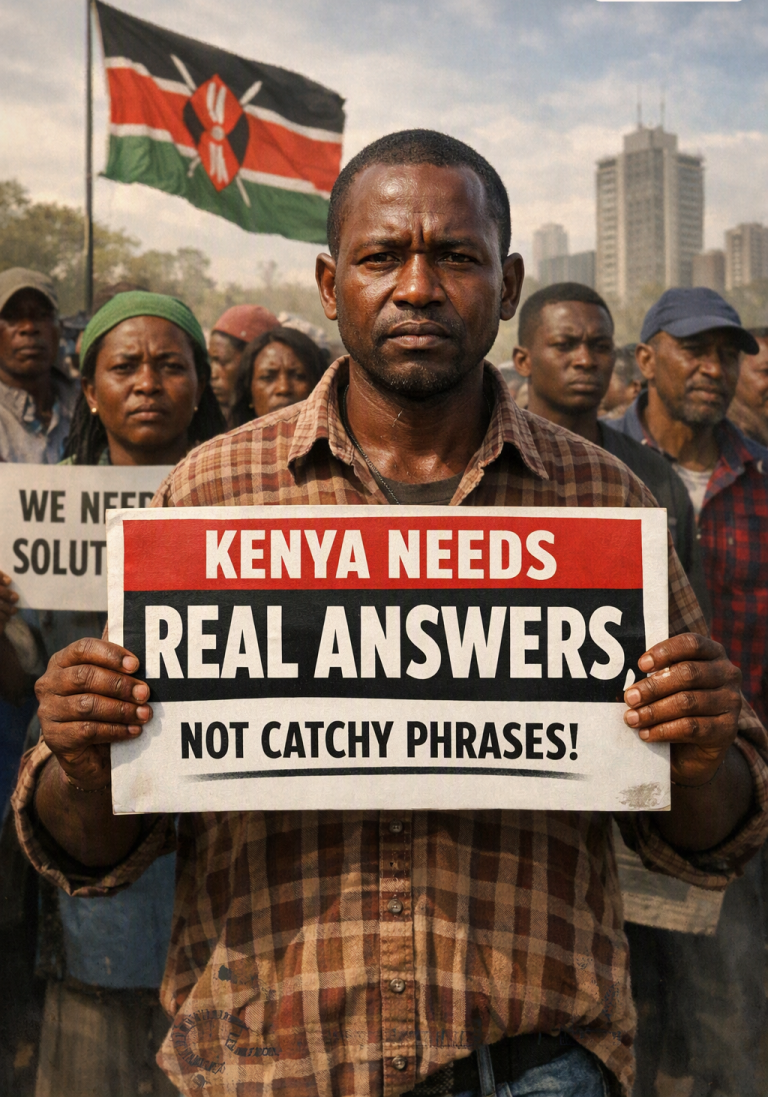
When the appetite for more begins to destroy the very system that sustains us
By Levis Wangamati
There is nothing wrong with wanting more. Ambition is one of the forces that pushes human beings to build, create, compete and improve. A farmer wants a larger harvest, a student wants a better career, a business owner wants a bigger enterprise and a leader wants to leave a greater mark. Without ambition, much of what humanity celebrates as progress would never have existed.
But there is a point at which ambition quietly crosses a line. It stops being about building something better and becomes an appetite that must be fed, regardless of what it consumes along the way. That is where ambition begins to resemble greed.
The difficult part is that greed rarely announces itself. It does not always arrive looking like wrongdoing. Sometimes it comes disguised as survival. Sometimes it calls itself opportunity. Sometimes it wears the language of family, loyalty, success or even public service. A person may convince themselves they are only taking what they deserve, while another person sees the same action as exploitation. In a society where almost everyone is competing for something, the line between legitimate ambition and destructive appetite can become remarkably thin.
Consider something as ordinary as a farmer producing milk. He works the land, feeds his cattle and delivers his product to a buyer. Suppose he has promised a full container but his production falls short. Instead of accepting the smaller quantity, he adds water to make it appear full. The buyer, concerned about his own margins, does the same. The retailer repeats the process. By the time the milk reaches the person ordering tea in a restaurant, it has been diluted several times over. The customer complains that the tea barely tastes of milk. Yet somewhere at the beginning of that chain was the very same farmer who may later sit in another restaurant and make precisely the same complaint.
That small story carries a much larger lesson. Problems rarely remain where they begin. Dishonesty travels. Greed travels. Favouritism travels. Once one person decides that a small compromise is harmless, the next person finds it easier to make another. Eventually, what began as one person’s shortcut becomes a system in which everyone expects everyone else to cut corners. The milk becomes diluted, the service becomes weaker, institutions become less trusted and the economy pays the price. By the end, everyone is complaining about a problem that almost everyone has helped reproduce.
This is where Kenya’s challenge runs deeper than corruption statistics and political speeches. The Constitution gives us a remarkably clear moral and institutional framework. Article 10 places values including integrity, transparency, accountability, equality, human dignity and the rule of law at the centre of public life. Yet the existence of good rules does not automatically produce good behaviour. A constitution can tell us what should happen; it cannot force every person to want what is right. That gap between what we have agreed to and what we are willing to practise is where many of our problems begin.
We have become remarkably skilled at adjusting the meaning of wrongdoing depending on who benefits from it. When someone else receives a favour, we call it corruption. When the favour reaches us, we call it connection. When another person employs relatives, we call it nepotism. When our own relative gets the position, we call it helping the family. When someone takes what belongs to us, we call them a thief. When we benefit from something that was never fairly ours, we find explanations.
That contradiction is dangerous because it makes morality dependent on advantage. We no longer ask whether something is right in itself — we ask whether it has worked in our favour. The same behaviour can be condemned in the morning and celebrated in the afternoon simply because the person on the receiving end has changed. In such an environment, corruption does not need to disappear. It only needs to become useful enough for people to tolerate it.
Perhaps this is why abnormality can eventually become normal. Imagine Kenya waking tomorrow to find public money being used exactly as intended, graduates finding opportunities without needing connections, government services delivered without favour and officials treating citizens equally. Would we simply accept it as the way things should be? Or would some of us wonder what had suddenly changed? When dysfunction persists long enough, functioning properly begins to look unusual. The abnormal becomes familiar, and the familiar becomes difficult to challenge.
The same principle applies to the way we talk about ambition. We admire the person who rises, but rarely stop to ask what was stepped on during the climb. We celebrate wealth without always asking how it was accumulated. We praise political influence without asking what compromises produced it. We admire connections when they open doors for us, then condemn the same connections when they close doors in our faces. Somewhere along the way, success becomes separated from the methods used to achieve it.
This is where the metaphor of the hyena becomes instructive. The hyena is often described as greedy because of its appetite. But an animal feeding itself is not necessarily greedy — it is surviving. The problem begins when the appetite exceeds what survival requires and becomes destructive. Human beings have something animals do not have to the same degree: the ability to examine our own appetites and decide whether they are justified. We can ask not only, “Can I take this?” but also, “Should I take this?”
That distinction matters enormously. Ambition asks, “What can I build?” Greed eventually asks, “What else can I take?” Ambition can create value. Greed can consume it. Ambition can make a person work harder. Greed can make a person believe that everyone else exists merely as an obstacle or a resource. Ambition seeks growth; greed loses the ability to recognise a stopping point.
And perhaps that is the true meaning of enough. Enough is not the absence of ambition. It is the presence of restraint. A farmer can seek a better harvest without destroying his soil. A business can pursue profit without deceiving its customers. A politician can seek power without treating public resources as personal property. A successful person can accumulate wealth without believing that another person’s poverty is the price of their success.
The tragedy is that greed eventually harms the greedy as well. The farmer who dilutes milk does not only cheat the customer — he helps create a market in which nobody trusts the product. The official who steals public resources does not only hurt strangers — he weakens the roads, hospitals, schools and institutions that his own family will one day depend on. The person who uses connections to bypass a fair process may celebrate today, only to discover tomorrow that the same system has become so compromised that it can no longer protect anyone.
In that sense, greed is almost self-defeating. It consumes the very foundation on which its own success depends.
This is why leadership should not be measured only by how much a person can acquire, control or influence. The deeper test is what someone does when they have the power to take more. Anyone can appear principled when there is nothing to gain. Character becomes visible when something valuable is within reach and nobody seems capable of stopping you from taking it.
A leader who understands this does not confuse public office with personal ownership. A businessperson does not confuse profit with permission to exploit. A citizen does not confuse opportunity with entitlement. A family does not confuse loyalty with the right to demand privileges. In each case, ambition remains — but it is restrained by responsibility.
Kenya does not need a society without ambition. Such a society would stagnate. What we need is a society where ambition understands its limits — people who can pursue success without believing that somebody else must lose for them to win, institutions strong enough to make fairness more rewarding than manipulation, and citizens willing to condemn wrongdoing even when that wrongdoing happens to benefit them.
Because the greatest danger is not simply that bad people exist. Bad choices will always exist. The greater danger is when ordinary people begin defending bad choices because those choices have finally become useful to them. That is the moment corruption stops being someone else’s problem and becomes part of the social fabric.
Perhaps, then, the question Kenya should be asking is not simply, “Who is stealing from us?” It should also be, “What are we willing to steal from one another in order to get ahead?” The answer may reveal more about the country than any political speech ever will.
Ambition becomes greed at the point where getting more matters more than what getting more destroys. And when enough people cross that line, the damage is no longer individual. It becomes national.
We dilute the milk, then complain that it has no taste. We weaken the system, then wonder why it cannot serve us. We reward shortcuts, then complain that nobody respects the rules.
Perhaps the first step towards changing Kenya is not demanding that everyone become perfect. It is simply learning to recognise the moment when enough should finally be enough.
Similar Posts by The Mt Kenya Times:
- Mt Kenya Times ePAPER October 7, 2026
- Ruto signs KSh389B electric vehicle deal at State House
- Kenya mobilises KSh70B to fight Ebola as US and World Bank step in
- High Court freezes law school admissions over disputed entry rules
- Grade 11 textbooks head to schools as CBC transition gathers pace
About the Author