Beyond the Tape: Turing Machines and the Computational Armor of Cybersecurity
 The Mt Kenya Times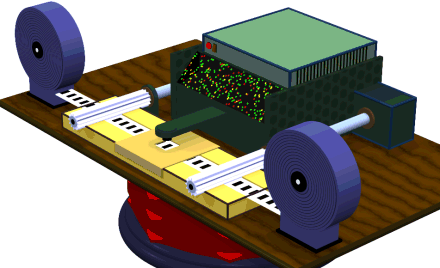
Turing Machines
By: Danstan Akwiri
Worth Noting:
- One of the key contributions of Turing machines to cybersecurity is the concept of undecidability, famously demonstrated by the Halting Problem.
- Turing machines play a crucial role in the study of algorithmic complexity, which is central to the design and analysis of cryptographic algorithms. Cryptography, a cornerstone of cybersecurity, relies on the mathematical foundations of computational complexity to ensure the security of communication and data.
- By leveraging the principles of Turing machines, researchers and cybersecurity professionals can create formal models that represent the behavior of systems. These models can then be subjected to rigorous analysis, employing mathematical proofs to verify their correctness.
Introduction
Cybersecurity can as well be described as an infinite discipline; the battle between attackers and defenders is a constant struggle for supremacy. As technology advances, so do the threats that exploit vulnerabilities in digital systems. One theoretical concept that has significantly influenced the field of computer science and, by extension, cybersecurity is the Turing machine. In this article, we will explore the foundations of Turing machines, their relevance to cybersecurity, and how they contribute to the development of robust defense mechanisms in the digital realm.
Understanding Turing Machines
The Turing machine, conceptualized by the British mathematician and logician Alan Turing in 1936, is a theoretical model of computation. It consists of an infinite tape, a read/write head, and a set of states. The tape is divided into cells, each capable of holding a symbol. The read/write head can move left or right along the tape, read the symbol at the current cell, write a new symbol, and change its internal state based on predefined rules.
Turing machines are instrumental in the study of algorithmic computation, providing a theoretical framework for understanding the limits and capabilities of computing devices. Although not a physical machine, the Turing machine serves as a powerful abstraction that helps researchers analyze the fundamental aspects of computation.
Relevance to Cybersecurity
The connection between Turing machines and cybersecurity lies in the fundamental principles of computation and algorithmic complexity. As cybersecurity professionals strive to secure digital systems, they grapple with the challenge of identifying and mitigating vulnerabilities in software and hardware. Turing machines provide a theoretical foundation for understanding the concept of computability, which is essential in designing secure systems.
- Undecidability and the Halting Problem:
One of the key contributions of Turing machines to cybersecurity is the concept of undecidability, famously demonstrated by the Halting Problem. The Halting Problem states that it is impossible to create an algorithm that can determine, for every possible input, whether a given Turing machine will halt or run indefinitely. This inherent limitation has implications for cybersecurity, as it underscores the difficulty of developing foolproof methods for detecting all possible security threats. The undecidability of certain problems highlights the need for probabilistic and heuristic approaches in cybersecurity, as absolute certainty is unattainable.
- Algorithmic Complexity and Cryptography:
Turing machines play a crucial role in the study of algorithmic complexity, which is central to the design and analysis of cryptographic algorithms. Cryptography, a cornerstone of cybersecurity, relies on the mathematical foundations of computational complexity to ensure the security of communication and data. The study of polynomial time algorithms, as introduced by Turing machines, helps researchers assess the strength of cryptographic schemes and identify potential vulnerabilities.
Moreover, Turing machines contribute to the development of encryption algorithms, key exchange protocols, and digital signatures. The complexity theory, rooted in the principles of Turing machines, guides the selection and design of cryptographic primitives that form the backbone of secure communication in the digital age.
- Formal Verification and Security Protocols:
Turing machines are instrumental in the field of formal verification, a process that involves mathematically proving the correctness of a system or a software program. In the realm of cybersecurity, formal verification is employed to ensure that security protocols and critical software components operate as intended without vulnerabilities.
By leveraging the principles of Turing machines, researchers and cybersecurity professionals can create formal models that represent the behavior of systems. These models can then be subjected to rigorous analysis, employing mathematical proofs to verify their correctness. Formal verification helps identify potential flaws in security protocols before they are deployed, reducing the risk of exploitation by malicious actors.
Applications of Turing Machines in Cybersecurity
- Intrusion Detection Systems (IDS):
Turing machines inspire the design of intrusion detection systems that aim to identify and respond to unauthorized access or malicious activities within a computer system. The undecidability of certain problems, such as the detection of all possible intrusion attempts, necessitates the use of heuristic and machine learning-based approaches in intrusion detection. Turing machines provide the theoretical underpinnings for developing adaptive and intelligent IDS that can evolve to detect new and previously unseen threats.
- Vulnerability Analysis:
The complexity theory associated with Turing machines guides cybersecurity professionals in conducting vulnerability analyses. Understanding the computational complexity of different algorithms helps prioritize security patches and updates based on the potential impact of vulnerabilities. Additionally, the concept of undecidability underscores the need for continuous monitoring and adaptive defenses, as new vulnerabilities emerge and evolve over time.
- Secure Software Development:
Turing machines contribute to the field of secure software development by emphasizing the importance of rigorous testing, formal verification, and adherence to secure coding practices. The undecidability of certain problems serves as a reminder that achieving absolute security is unattainable, but through careful design and verification processes, developers can significantly reduce the attack surface of software applications.
summary
In cybersecurity, the influence of Turing machines extends beyond theoretical abstractions to practical applications that shape the way we defend against digital threats. The undecidability inherent in certain computational problems reminds us of the inherent challenges in achieving absolute security. However, by leveraging the principles of algorithmic complexity, formal verification, and the theoretical foundations laid by Turing machines, cybersecurity professionals can develop robust defense mechanisms that adapt to the evolving threat landscape.
As technology continues to advance, the principles derived from Turing machines will remain relevant, guiding the development of innovative cybersecurity solutions. The synergy between theoretical concepts and practical applications underscores the importance of a multidisciplinary approach in securing the digital frontier. In the ongoing battle between security and threat actors, the legacy of Alan Turing’s theoretical contributions continues to serve as a beacon, illuminating the path toward a more secure digital future.
Author: Danstan Akwiri, Msc, computer Science, Bsc, Computer science, CISSM, CEH.
Director of cybersecurity and IT Infrastructure.
Similar Posts by The Mt Kenya Times:
- Mt Kenya Times ePAPER October 12, 2026
- Gachagua’s party storms Kikuyu from afar as 2027 countdown begins
- Counties caught: The KSh100B payroll scandal Kenya can no longer hide
- CS Ogamba: tree planting could generate carbon credit millions to fund education
- Farouk Kibet calls for unity and development as leaders rally behind Ruto’s 2027 re-election bid
About the Author