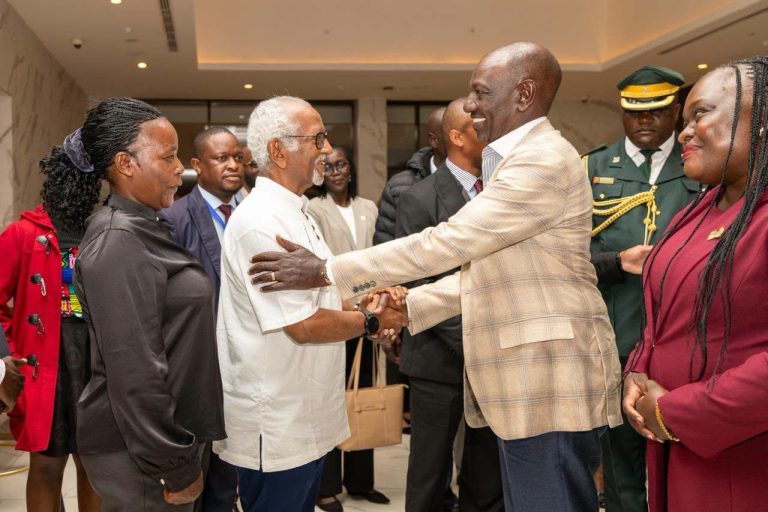
NCCK upper Easter Region vice chairman James Kimathi (in white shirt seated) reads a statement on behalf of NCCK upper Eastern region

By Dennis Dibondo
The National Council of Churches of Kenya (NCCK) has raised concern of increased cases of non communicable diseases (NCDs) in the country.
NCCK upper Eastern region vice chairman James Kimathi who read a statement on behalf of the clergy said the Non communicable diseases have become a pandemic with a prevalence rate of 27 per cent.
The officials addressed the media on Friday at Gitoro conference center in North Imenti Meru County.
“They are now the most threatening diseases in Kenya the account for 39 percent of deaths in the country and are responsible for 50 percent of all cases of hospitalization. The financial burden of these conditions is equally huge with patients with just one NCD condition spending more than Sh150,000 per year on outpatient care alone,” he said.
Kimathi urged the government to increase funding towards the fight of Non communicable diseases and said the government does not spend much on a strategic plan to counter the diseases.
“The government promised only Sh.8 billion to finance the national strategy on non communicable diseases in 2022 and 2026 against a budget of Kenya Shillings Sh.377 billion; this is not considering the suffering of Kenyans living with NCDs,” he said.
Kimathi said in Kenya there is no family that does not have a person suffering from non communicable disease like cancer, hypertension, diabetes, cancer, heart disease and others.
He said the conditions take away meagre savings of Kenyans to pay for healthcare.
“We call on the ministry of health to spearhead a national campaign to deal with threats posed by non communicable diseases,” Kimathi said.
He recommended that the government declare NCDS a national emergency to mobilize maximum stakeholders resources.
“In the past the government has spearheaded a massive campaign to address disease conditions when they reach threatening prevalence rates, examples include malaria in 2010,HIV/AIDS in 1990s,” Kimathi said.
Kimathi added that all food with saturated fats sugars sodium and other put warning labels in their packets.
“The warning labels should products should have clear and have same size colour and consistency,” he said.
He lauded the ministry of health for completing the development and adaption of nutrient profile model and urged KEBS and Competition Authority of Kenya to apply the model to protect Kenyans.
He said the number of children diagnosed with non communicable diseases is worrying and there is need of nation wide campaign and regulate child target foods that are high in sugar, salt and saturated fats.
The clergy said that Kenya institute of curriculum development and Kenya National Examination council should include nutrition as part of syllabus.
Kimathi said the ministry of health should reform the Taifa care and make it meaningful or else revert to NHIF.
He urged the politician to focus of service delivery instead of early campaign.
Kimathi said they will ensure that politicians do not turn church into political rallies.
“We call upon our fellow clergy to adhere to guidelines issued by the NCCK executive committee which states the following any politician will be treated the same as all other worshippers and should not get any special treatment, all monitory contributions to be treated as offerings and shall not be announced and no political leader will address congregants inside the church but should address them outside,” Kimathi said.
Similar Posts by The Mt Kenya Times:
- Mt Kenya Times ePAPER October 23, 2026
- Ruto’s parting COMESA call: Remove the barriers, honour the commitments
- Direct hospital access to KEMSA cuts drug delays, says PS
- Africa can’t wait: Continent seeks $1 trillion for climate adaptation
- Ruto passes the baton as Africa’s trade bloc faces a fragmenting world
About the Author