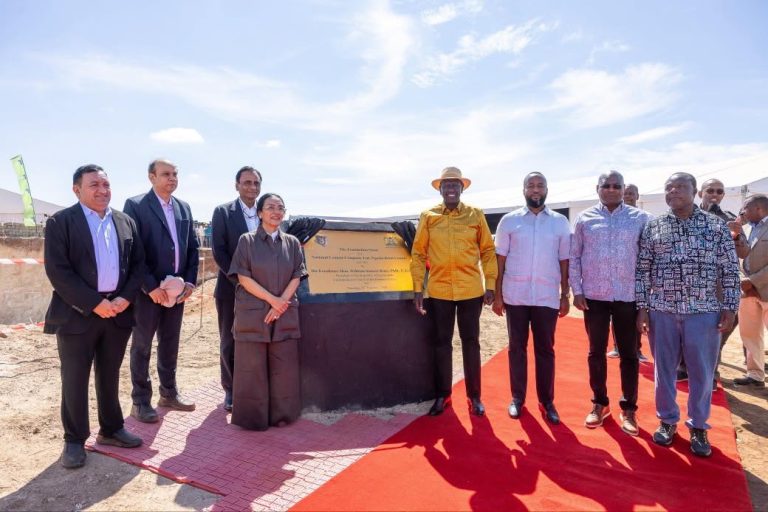
Cabinet Secretary Moses Kuria when he appeared in the Senate yesterday

By William Muchiri
Worth Noting:
- Mohamed Chute: Could the Cabinet Secretary state how many Companies were awarded business, those currently importing goods, the type and packaging of the commodities being imported during the FY 2021/2022 and FY 2022/2023
- CS Moses Kuria: KNTC engaged 11 suppliers for the various commodities in FY 2022/2023. Note: KNTC was not dealing with importation of commodities in FY 2021/2022
- Mohamed Chute: Could the Cabinet Secretary disclose the financial state of KNTC, and also indicate how much has been paid to the respective suppliers and how much is outstanding?
- CS Moses Kuria: The Corporation relies on internally generated revenue to finance its operations.

Cabinet Secretary Moses Kuria yesterday appeared before the Senate where he fielded various questions.
Kuria disclosed that to address the rise in the cost of living, Kenya Kwanza Cabinet approved a framework to position the Kenya National Trading Corporation (KNTC) as the anchor of State initiatives to create a price stabilizer for essential household food items.
Responding to the questions, Kuria who is in charge Investments, Trade and Industries used the opportunity to appraise the Senate in respect to KNTC procurement of imported commodities.
Below is the excerpt of the session.
Sen. Mohamed Chute: Could the Cabinet Secretary state the type and quantity of goods being imported by corporation and individuals prequalified by the Kenya National Trading Corporation (KNTC)?
CS Moses Kuria: KNTC is currenty dealing with importation of 4 types of products namely; Fertilizers, Rice, Beans and Cooking oil. The corporation has pre – qualified the following suppliers for the supply of various commodities as stipulated below; KNTC has prequalified 22 suppliers for the various commodities ie; Lamar
Commodities Trading DDMC supplying NPK 23:23:0,NPK 17:17:17; Standard Petroleum supplying Rice, Beans, Cooking Fat and Urea; Makram Imports and Export Ltd supplying Rice; Purma Holdings supplying Rice, Edible Oil and Beans; Multi Commerce FZC supplying Edible oil and Rice; Shehena Commodity supplying Edible Oil; Charma Holdings Ltd supplying Edible Oils and Beans; Evertec general Trading supplying Edible Oil; Enterprise Supplies Ltd supplying Edible Oil; Lone Trading F2E supplying Edible oil and Rice and First Quality supplies Ltd supplying CAN fertilizer.
Sen. Mohamed Chute: What is the procedure used by KNTC to identify and prequalify companies which import the goods?
CS Moses Kuria: In accordance with the timelines indicated by the clients. The Manager, sales division shall raise and sign Purchase Requisitions to initiate the procurement process, The Manger, sales division with the support of SCNM Division shall at the same time prepare specifications for the items to be procured,
The Purchase Requisition and the specifications shall be forwarded to the Head of Finance for commitment of funds; Upon commitment of funds by Finance, the PR and specifications shall be submitted to the MD for approval; The PR shall be submitted to the SCLM Division to commence the procurement process; Quotations/bids will received, opened, evaluated and an opinion prepared in line with profit margin analysis recommendation for the accounting officer’s approval;A purchase Order or a Contract Agreement shall be executed and issued expeditiously; The Manager,SCLM shall liase with suppliers and on the delivery schedule(s) for purposes of ensuring smooth working of the ad hoc Inspection and Acceptance Team; Only trading items that mmets the Corporation’s requirements will be accepted and taken on charge and; All invoices for Procurements Inspection and Acceptance Certificates and Certificates of Payments must be officially received at the SCLM Division.

Sen. Mohamed Chute: Could the Cabinet Secretary state how many Companies were awarded business, those currently importing goods, the type and packaging of the commodities being imported during the FY 2021/2022 and FY 2022/2023
CS Moses Kuria: KNTC engaged 11 suppliers for the various commodities in FY 2022/2023. Note: KNTC was not dealing with importation of commodities in FY 2021/2022
Sen. Mohamed Chute: Could the Cabinet Secretary disclose the financial state of KNTC, and also indicate how much has been paid to the respective suppliers and how much is outstanding?
CS Moses Kuria: The Corporation relies on internally generated revenue to finance its operations. As a coloration that relies on generated funds from selling goods at a minimal profit, we are constantly trying to balance between maintaining low prices for our customers while generating enough income to cover our administrative costs. The financial status of KNTC reflects this delicate balance, as we strive to keep our prices affordable without compromising the quality of our products or the financial sustainability of the Corporation. KNTC has procured imported commodities valued at Ksh 22.2 billion. As at 30th April 2023, commodities worth 4.8 billion had been delivered. No payments have been made to the suppliers since the Letters of credit are yet to mature.
Sen. Mohamed Chute: There is a list of prequalified suppliers for the supply of gooods, if you look at 22 prequalified entities, there is a supplier by the name First Quality Supplies Ltd who supplied 25, 000MT of fertilizers not listed in the 22 prequalifed suppliers, how did he end up giving contracts of 25,000 MT to this supplier without prequalification.
CS Moses Kuria: I beg to deffer that question until he next round of questions so that I can be able to make some consultations.
Sen. John Kinyua: Can Kindly the Minister elaborate to this house the interest of the impoters on this issue, and the connection to the same to the media of this country
CS Moses Kuria: Over the last six months or so, this country has allowed through a gazzette notice importation of 1,400,000 MT of maize to address the issue of maize shortage and the skyrocketing price of unga which was as high as 250 by September last year. This country has also allowed importation of 1,200,000 tonnes of rice despite the fact that we have got rice in Mwea, Kirinyaga County, Ahero in Kisumu County but it was necessary because of the drought situation, the famine, the food shortage that was there to make that move to and also to manage the cost of living. At the same time, we got approval from the cabinet to import 1,25, 00 MT of edible oil, you notice that of all the three products the one with the least amount that was allowed to be imported was edible oil. 1,400,000 maize, 1,200,000 rice, only 100,000 MT of edible oil yet the attention out there is not about rice, and farmers from Mwea and Ahero don’t have a voice, they don’t have deep pockets, they don’t have the money, they don’t have the kind of cheque books as would be required to create the kind of noise that is been heard in the media. Only this item, 125, 000 out of which the amount of edible oil that has landed in this country is only 3000 MT, that is close 170, 000 jerrycans of 20 liters that are used in our homes. So only 170,000 families have benefitted from what has been imported by KNTC. When we started this importation, there were even cartoons in the media; there were a lot of jokes and memes going around in social media about the price of edible oil. It was said to be among the most expensive things to buy, by that time one liter of edible oil around first week of December when I addressed the Kenya Union of Manufacturers about this issue, it was 400 shillings per kilo. And that time, on my first day of work, I told the edible oil industry that this is not acceptable and this is not sustainable, I asked them to do whatever it takes to ensure that we have a level playing field and also to ensure that the price of edible oil comes down. I instructed KNTC to import edible oil with a target that 1 kilo of edible oil retail at 250 shillings. Because of only 170,000 jerrycans, the price of edible oil today has dropped to 218 shillings per liter. That is despite the dollar which by the time I gave that instruction, the dollar was going for 125 shillings, today, the dollar is hovering in the region of 140, yet the price of edible oil has dropped to 218 shillings to the relief of so many Kenyans.
The problem with the edible oil industry is that 55 million Kenyans depend on 5 companies. These 5 companies are BIDCO, KAPA, Pwani Oil, Menengai and Golden Africa. These companies engage in what they call their own version of value addition.
Sen. Aaron Cheruiyot: What was the consideration for closing this market to only five or is it 4? Are there any practices or any government policy interventions that will allow a more even playing field for other players?
CS Moses Kuria: On the number of companies, there are actually 5. Why they enjoy the preferential treatment is because previously, the definition of value addition which they purpot to do were supposed to be importing crude oil from mostly Malasyia from one company called Wilmar in Malasyia. A big element of what they do is actually importing refined products though some very little value addition, create very few jobs then that becomes a ticket to lock out all the SMES out there. This government believes that effective value addition must be based on Value Chain Approach within our bottom up economy transformational agenda.
Sen. David Wakoli: Have you, as a CS ever sat with manufacturers and players in the sugar, maize and edible oils industry to discuss how to adress the high prices of commodities? When and how many minutes?
CS Moses Kuria: As a matter of fact, I have sat with all the 13 sectors under the Kenya Association of Manufacturers.
Sen. Esther Okenyuri: Give a status of all Kenya National Trading Corporation branches on their functionalities if they are funtional and existing as it used to be
CS Moses Kuria: We have head office in Nairobi and six other depots in Nakuru, Eldoret, Kitale, Kisumu, Machakos and Meru, all of them are functional and we are in the process of refurbishing them which we opt to do in the coming financial year.
Sen. Veronica Maina: Whether the procurement that was done on the edible oils was done competitively or it was single sourced and ave you moved your offices to Two Rivers?
CS Moses Kuria: There is no distinction or exemption on how we treat edible oil in terms of procurement framework from other commodities.
Sen. Samson Cherarkey: How many Metric Tonnes of maize have been imported into the country, and what is the projection of consumption and whether the moratorium of maize is still extended upto harvesting period?
CS Moses Kuria: We did not, as KNTC import any maize.
Sen. Mohamed Chute: Why only allocate many and huge supplies to this particular person and companies?
CS Moses Kuria: We advertise publicly for suppliers, it is a public process. We have no control absolutely over who applies; we do not ask them to give details of the owners. We look for the best deal and the price that enable us carry out our statutory mandate of managing the cost of living. So, I am not aware of the names or the shareholders but I take notice of what Senator Chute has said.
Similar Posts by The Mt Kenya Times:
- Mt Kenya Times ePAPER October 28, 2026
- Ruto breaks ground on KSh70B cement plant that will create 3,000 jobs in Kitui
- Ruto orders Magadi soda ash monopoly broken as new investors set to enter
- Ruto heads to Moscow seeking trade deals and investment as Kenya eyes Russia partnership
- Waititu begs for mercy as Sh588M corruption sentencing looms
About the Author