FBI traces Minnesota Medicaid fraud proceeds to luxury Nairobi apartment

A broken leg, a balcony leap, and a wire transfer to Kileleshwa — how Muhammad Omar’s alleged $3.6 million fraud scheme left a trail that stretched from Minneapolis to the heart of one of Nairobi’s most desirable postcodes.
By Diaspora Times Team
The Federal Bureau of Investigation has traced a portion of the proceeds from a sprawling Minnesota Medicaid fraud scheme to a luxury apartment development in Nairobi’s upscale Kileleshwa neighbourhood, after suspect Muhammad Abdulqadir Omar, 32, wired more than $74,000 to purchase units at the Blossom Ivy Residence — a high-rise development marketed for its rooftop amenities and panoramic city views — before his dramatic arrest following a fourth-floor balcony leap in Roseville, Minnesota, on 22 May 2026.
The case against Omar sits at the intersection of two stories that, on the surface, could not appear further apart: a federal crackdown on Medicaid fraud in the American Midwest, and the booming luxury real estate market in a leafy Nairobi suburb where diplomats, expatriates, and professionals compete for off-plan apartments in developments that promise elegance and breathtaking city views. That intersection is now the subject of an active FBI investigation that has already resulted in Omar’s detention pending trial and raised pointed questions about the vulnerability of Kenya’s real estate sector to the laundering of criminal proceeds from abroad.
Omar is one of 15 individuals indicted on 21 May 2026 in what the Department of Justice described as an unprecedented federal crackdown on Medicaid fraud in Minnesota, targeting schemes that prosecutors say defrauded seven state-managed Medicaid programmes of more than $90 million in taxpayer funds. Federal officials announced the indictments at a news conference in Minneapolis attended by top Trump administration appointees, including Health and Human Services Secretary Robert F. Kennedy Jr. and Centers for Medicare and Medicaid Services Administrator Dr. Mehmet Oz. The gathering was itself a statement of political intent: that the federal government was treating Minnesota’s fraud crisis not as a bureaucratic anomaly but as a national emergency demanding the most senior levels of attention.
The targeted programmes included Minnesota’s Housing Stabilization Services, the state’s autism programme, Integrated Community Supports, Individualized Home Supports, and the Child Care Assistance Programme. The numbers behind the scandal are staggering in their trajectory. Minnesota’s Housing Stabilization programme — designed to help homeless residents find and keep housing — started with a budget of $2.5 million. By 2024, that figure had ballooned to $104 million, nearly fifty times the original amount, before the state ultimately terminated the programme. The explosive growth, prosecutors argued, was not driven by genuine demand but by systematic fraud that treated public funds as a personal revenue source.
Omar’s alleged role in that system was specific and calculated. Court records show Omar worked with Ibrahim Bashir Abdi to create North Home Health Care, and separately opened South Home Health Care — both companies registered with Minnesota’s Housing Stabilization programme. The men allegedly falsified and inflated service hours provided by North Home. Some of the patients they claimed to serve were hospitalised at the time. Others were dead. Omar and Abdi pocketed $3.2 million on those false claims. Omar collected an additional $480,000 through South Home Health Care, bringing his alleged total take to approximately $3.68 million. He is charged with one count of conspiracy to commit health care fraud and four counts of health care fraud.
It was what Omar allegedly did with a portion of that money that drew the FBI’s attention to Nairobi. On 5 February 2025, more than three million Kenyan shillings — the equivalent of $26,356 — were wired to a real estate company in Nairobi, with the transfer earmarked for “Blossom Ivy Residence A802.” Three months later, on 13 May, Omar wired another six million Kenyan shillings — $48,372 — to purchase a further villa in the same development. In total, $150,000 in allegedly fraudulent proceeds found its way into the Kenyan property market. Federal authorities also said Omar used $60,000 of the money to lease a Mercedes-Benz.
 The Blossom Ivy Residence is a new-build luxury high-rise development located on Gatundu Road in Kileleshwa, offering one to four-bedroom apartments with a rooftop clubhouse, fully equipped gym, swimming pool, and panoramic views of the Nairobi skyline, with completion expected in December 2026. Marketing materials for the development advertise what one promotional video described as “elegance, comfort and breathtaking city views.” Units range in size from 78 to 260 square metres, with prices starting at Ksh 7.5 million for a one-bedroom apartment. The development is marketed primarily at diplomats, expatriates, and professionals — precisely the demographic profile a foreign national seeking a discreet, high-value property investment in Nairobi might wish to inhabit.
Kileleshwa has long occupied a particular position in Nairobi’s residential geography. Bordered by Lavington to the west and Westlands to the north, it is one of the capital’s oldest and most established middle-to-upper-class neighbourhoods — leafy, relatively quiet, and increasingly the site of high-rise apartment developments catering to the city’s expanding professional class and its growing international population. Real estate analysts note that the neighbourhood’s appeal to foreign buyers has increased significantly in recent years, driven by proximity to international schools, private hospitals, and the diplomatic enclave in Gigiri. It is, by any measure, an ideal location for an individual seeking to park money in a stable, appreciating asset while maintaining the appearance of legitimate investment.
The question of how that money arrived in Kenya undetected — and what systems were in place to flag it — is now as important as the question of how it was stolen in the first place. Kenya’s Anti-Money Laundering law requires financial institutions and real estate agents to conduct due diligence on the source of funds for property transactions, particularly those involving foreign buyers. The Financial Reporting Centre, which sits within the National Treasury and operates as Kenya’s financial intelligence unit, is mandated to receive and analyse suspicious transaction reports from obligated entities, including real estate developers and agents. Whether such a report was filed in connection with Omar’s wire transfers — and what, if any, action followed — is a question that Kenyan authorities have not yet publicly addressed.
The case lands at an uncomfortable moment for Kenya’s property sector, which has in recent years attracted significant scrutiny over its vulnerability to money laundering. Prosecutors cited Omar’s overseas investments in Kenya as a primary motivation for potential flight, with prosecutor Matthew Belz telling the court: “He went to extremes to flee.” The argument was persuasive. Magistrate Judge Elsa Bullard ordered Omar detained pending trial, ruling she could not trust that he would not flee the country given his overseas assets.
The circumstances of his arrest added an almost cinematic dimension to a case already rich in detail. When FBI agents knocked on his door to execute the arrest warrant on the morning of 22 May, Omar leaped from the fourth-floor balcony of his apartment, sustaining a broken leg, before hobbling to a relative’s home in Blaine, Minnesota. Surveillance footage captured him fleeing, hopping on one foot and carrying a shoe in his hand. FBI Co-Deputy Director Christopher Raia played the video at the subsequent press conference, where it was received as something between evidence and parable. Omar was arrested within two hours. Those relatives — brothers Anwar and Asad Adow — had already pleaded guilty to federal wire fraud charges brought after KARE 11 investigations exposed a scheme to steal millions from Minnesota’s Housing Stabilization Services programme. The family connections in the case run deep.
FBI Director Kash Patel announced the arrest on X that evening, posting alongside a photograph of Omar barefoot and in custody. “After today’s interagency press conference announcing 15 public healthcare fraud indictments in Minnesota, the below subject who was on the run — Muhammad Omar — has now been arrested,” Patel wrote. “No matter how many shell companies you have, no matter how clever or how brazen your schemes are, if you steal money from taxpayers and people in need, the FBI and our partners will pursue you relentlessly,” FBI Co-Deputy Director Raia said at the press conference. “We will find you and ensure you feel the power of American justice.”
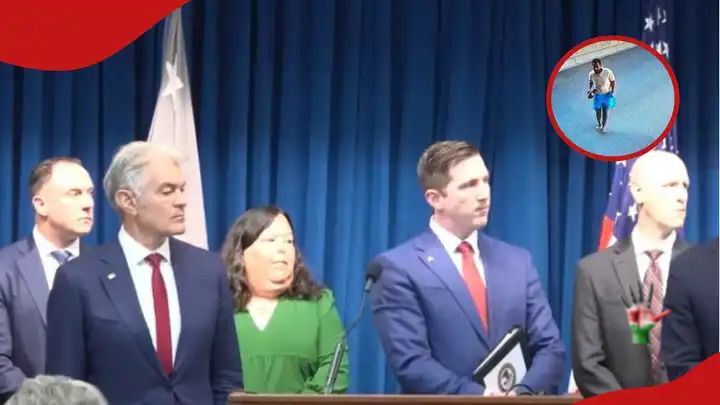 Colin McDonald, the Trump administration’s national fraud enforcement chief, used the occasion to deliver a broader warning. “Let me be clear upfront about something: This is not the end of our work in Minnesota. This is the beginning. The fraud here in Minnesota is shocking,” McDonald said, describing those responsible as having treated taxpayer-funded programmes as “their personal piggy bank.” The DOJ has since announced the expansion of the healthcare fraud Midwest strike force and the deployment of 15 additional prosecutors dedicated to combating Medicaid fraud nationwide, with 11 prosecutors already on the ground in Minnesota.
For Kenya, the implications extend well beyond the criminal record of a single suspect. The Omar case is a reminder that Nairobi’s growing real estate market — attractive to international investors precisely because of its dynamism, its relative political stability, and the ease of cross-border capital movement — can also be attractive to those seeking to convert criminal proceeds into legitimate-appearing assets. Federal prosecutors have estimated the broader fraud scandal in Minnesota could top $9 billion — a figure disputed by the state’s governor but indicative of the scale at which public money has been allegedly misappropriated. Even a small fraction of that sum, if directed toward foreign real estate markets, represents a significant anti-money laundering challenge for recipient countries.
Kenya’s Financial Reporting Centre and the Assets Recovery Agency will face pressure in the coming weeks and months to demonstrate that they have been engaged with American investigators and that the appropriate legal mechanisms are in place to freeze or recover assets linked to the fraud. The mutual legal assistance framework between Kenya and the United States provides a pathway for exactly that kind of cooperation, but its effectiveness depends on the speed and willingness with which both sides act.
In Kileleshwa, the Blossom Ivy Residence continues to rise from its foundations on Gatundu Road, its promotional videos still advertising elegance, comfort and breathtaking city views. Unit A802 — the first property Omar allegedly purchased — is part of a development that will, by December 2026, offer its residents rooftop amenities, high-speed lifts, and panoramic views across a city that, for one Minnesota fraud suspect, seemed to offer something else entirely: distance, discretion, and a place to put the money.
The FBI followed it there anyway.
Similar Posts by The Mt Kenya Times:
- AI Curse or boon: The Future of Intelligence: Artificial or Emotional?
- Dr. Ekrah Ndung’u wins TVET advocacy award after 12 years
- Mt Kenya Times ePAPER October 17-18, 2026
- Ruto bets billions on Kerio Valley — with one eye on 2027
- Ruto’s health ministry kills Murang’a’s digital hospitals
About the Author