From Lamu to the region: What the Dangote Refinery could mean for Kenya’s energy economy

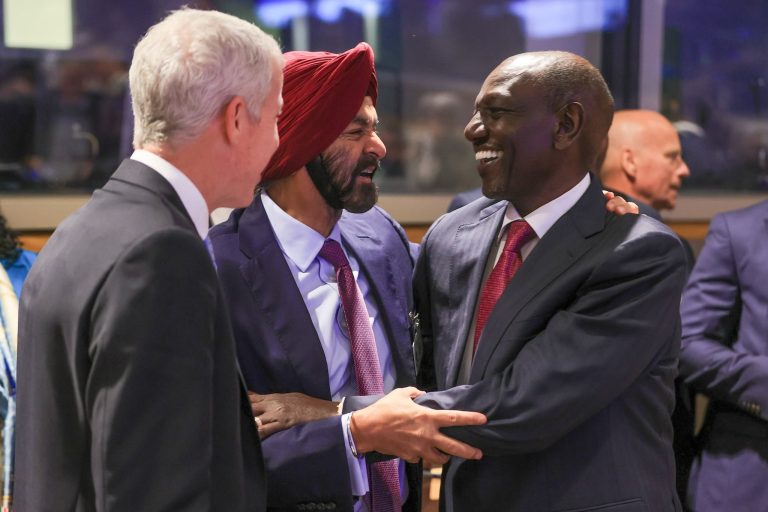
President William Ruto and Nigerian industrialist Aliko Dangote
By Oduor Rosequillet Nabwire
In Kwasasi village, on Lamu’s mainland, life has long revolved around activities that sustain the local community. Homes, farms and small businesses sit within a landscape that is now being drawn into one of Kenya’s biggest industrial developments.
A few kilometres away, construction on the Dangote East Africa Petroleum Refinery and Petrochemicals project at Lamu Port has begun. The investment is valued at about 16 billion US dollars and is expected to create jobs, drive demand for goods and services and support infrastructure development.
For some residents, the refinery is not just something being built on the coast. It is shaping how they think about the businesses they could build around it.
Sobana Aidarus is already planning for a refinery that has yet to produce a single drop of fuel. The local entrepreneur is thinking about the thousands of workers expected to arrive and what they will need once they get there.
Food is one of his answers.
Aidarus is considering setting up an industrial catering business to serve the refinery workforce. In an interview with the Daily Nation, he said he was looking beyond fuel and direct employment to the smaller businesses that could grow around the investment.
It is a modest business idea beside a 16 billion US dollar investment.
But it captures a question being asked across Lamu: when a development this big arrives, how much of the activity around it will reach the people who already live and work there?
For Aidarus, the answer may start with a kitchen, a workforce and a business of his own.
For Kenya, the implications extend far beyond Lamu.
At the groundbreaking ceremony on September 30, 2026, the scale and timeline of the facility were outlined. It is designed to process up to 700,000 barrels of crude oil a day, with completion targeted within about 40 months.
The wider development is planned to include petrochemical facilities and up to 1,000 megawatts of power generation. What is taking shape in Lamu is therefore an industrial complex, not simply a place where crude oil is turned into fuel.
But the refinery’s impact will not end at its gates.
Thousands of workers will need food, accommodation, transport and other services. Contractors will also need local suppliers, creating opportunities for businesses involved in logistics, technical services and manufacturing as construction progresses.
The project is expected to create more than 60,000 jobs, while Dangote Group has also announced plans for a training school in Lamu that is expected to train 1,000 people.
The training is important because the longer-term issue is not only how many people will find work during construction, but whether local workers will gain skills they can use beyond the project.
And that brings the refinery to the port.
Lamu Port is part of the Lamu Port-South Sudan-Ethiopia Transport (LAPSSET) Corridor, which links the coast with northern Kenya and neighbouring countries. The refinery will give the port another major role.
President William Ruto has also linked the refinery to Lamu Port and the wider LAPSSET Corridor, pointing to opportunities for transporters, engineers, contractors, service providers and manufacturers.
Lamu’s deep-water berths provide the access needed for large vessels carrying crude and other cargo. The refinery is expected to source crude from outside Kenya, including other African producers, and supply refined petroleum products to Kenya and markets across the region.
Kenya currently imports refined petroleum products to meet much of its domestic demand.
President William Ruto said the country spent KSh530 billion on petroleum product imports over the previous year. He also cautioned that a refinery would not make that expenditure disappear overnight. Kenya would still need to buy crude, refine it and get the finished products to consumers at competitive prices.
The issue is what happens to the value created along that supply chain when more refining takes place in Kenya.
More of the processing would happen locally, while storage, transport, manufacturing and engineering could grow around it.
But the story does not stop at Kenya’s borders.
Uganda is pursuing its own 60,000-barrel-per-day refinery at Hoima. President Yoweri Museveni has said Uganda will continue with the facility while supporting the Lamu investment, arguing that East Africa needs more refineries to process its resources and create jobs.
As refining capacity expands in the region, another issue comes into view: how will petroleum products move between countries and markets, and what will this mean for regional trade?
For Kenya, the ambition extends beyond producing fuel for domestic consumers. Its significance will also depend on how effectively the country connects the refinery to regional markets and trade routes.
Dangote Group’s Aliko Dangote has placed the investment within that wider industrialisation agenda, describing it as “Africa coming together to build Africa.”
But those benefits remain projections until the facility is built and operational. Its eventual impact will depend on how competitively it performs and how efficiently its products move across borders.
For some people living closest to the development, however, the immediate concern is the land on which the refinery is being built. For Kanywa Kamunde, the issue is what happens to the land his community says it has called home for generations.
Kamunde is among 133 Chandavai residents who have filed a case over LR No. 13061, the parcel at the centre of the dispute. The residents have raised concerns about displacement, resettlement and compensation.
They say the disputed area includes homes, farms, livestock areas, mosques, shrines and family burial sites. For the residents, these are places tied to their livelihoods, families and community history.
These are claims made by the residents and remain subject to determination by the court.
The Malindi Environment and Land Court has ordered the parties to maintain the existing status quo on LR No. 13061 pending a hearing on October 14, 2026. The order came days before the refinery’s September 30 groundbreaking.
At the groundbreaking, President William Ruto addressed concerns surrounding land and the livelihoods of people living around the development.
His assurance was specific: “Land matters will be handled lawfully and fairly. Environmental and social impacts will be assessed rigorously.” He also said safeguards would be enforced during construction and operation.
For Aidarus, the months ahead will show whether the catering business he has in mind can become a reality. The workers he hopes to serve are still to come, and so is the market he hopes to build around them.
For Kamunde, the next step is the court process over LR No. 13061.
Construction has begun. What the refinery ultimately means for Lamu will become clearer as the project takes shape and the court process unfolds.
Similar Posts by The Mt Kenya Times:
- Mt Kenya Times ePAPER October 3, 2026
- Ruto puts Coast landlords on notice over squatter harassment
- Nairobi lights candles for Raila in Uhuru Park tribute
- Jambojet returns to Entebbe with daily flights and fares from KSh22,950
- Three Bikeke schools unite in prayer ahead of national exams
About the Author