


The DCP leader has warned President Ruto that his period of restraint is over, challenging Kenya’s Catholic bishops to confront the President directly over language he says is beneath the dignity of the office.
By Grace Wanja
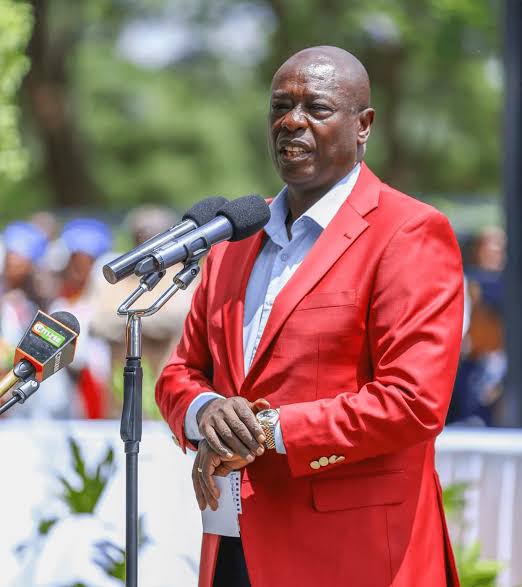
Democracy for the Citizens Party leader Rigathi Gachagua yesterday broke his silence over President William Ruto’s recent personal attacks, revealing that he had held back only because he was mourning the death of his sister — and warning that now she has been buried, any further insults from the President will be met with an immediate and full response.
Gachagua made the remarks during a church service on Sunday, one day after burying his sister, in what turned out to be one of his most carefully framed public addresses since his impeachment from the Deputy Presidency. The timing and setting were deliberate. By speaking from a church, fresh from grief, he positioned himself not as a combative politician spoiling for a fight but as a man who had shown restraint under provocation and was now simply and reasonably serving notice that the restraint had run its course.
His target was specific. Ruto had used a tour of Kisii County to describe Gachagua as a “master of hate,” a “hate man from Texas,” a “chronic liar,” a “conman” and a “fraud” — a sequence of personal attacks delivered from public platforms during official county engagements that drew criticism from several quarters, including the Catholic Church. Gachagua’s response on Sunday was measured in tone but unambiguous in substance. “This week you have been in Kisii, insulting Rigathi Gachagua and Uhuru Kenyatta. You were lucky I was mourning and did not get an opportunity to respond to you,” he said. “But now that I have buried my sister, if you insult us this week, we will respond.”
The statement carried a weight that went beyond political point-scoring. Gachagua was making two arguments simultaneously — one personal, one institutional. The personal argument was that he had shown the kind of human dignity in a moment of family grief that he believes his former principal has failed to demonstrate in public office. The institutional argument was more pointed: that the President of Kenya has a responsibility to protect the dignity of the office he holds, not merely for his own sake but for the sake of everyone who aspires to hold it in the future.
“He is undermining the dignity and the respect of the institution of the presidency,” Gachagua said. “We want to become presidents of Kenya, and we do not want the respect of the office of the President to go down.” It was a line that served double duty — a criticism of Ruto’s conduct and a quiet declaration of his own ambitions, framed as concern for the institution rather than personal grievance.
The Catholic Church had entered the fray days earlier. The Kenya Conference of Catholic Bishops, led by chairman Archbishop Maurice Muhatia, issued a statement on Thursday calling on presidential aspirants to avoid tribal, hateful and demeaning language as political exchanges intensified ahead of August 2027. The bishops’ appeal was directed broadly, but its timing — following Ruto’s Kisii remarks — left little doubt about the context in which it was issued.
Gachagua welcomed the intervention but redirected it with considerable precision. “I have seen Catholic bishops saying leaders should not use abusive language against each other. And that is right. But let me help them a little. It is not the other leaders who are using abusive language. The person using insults everywhere is the President of the Republic of Kenya,” he said. He then went further, issuing a direct challenge to the bishops to request a formal meeting with Ruto and address his conduct face to face. “We want to tell our Catholic fathers that they are right, but they should get an appointment with William Ruto, with our church leaders, go and sit him down and tell him what he is doing is not presidential,” he stated.
He extended the appeal beyond the Catholic Church, calling on bishops of the African Inland Church, the Anglican Church of Kenya and the Presbyterian Church of East Africa to intervene. His appeal to the AIC was particularly pointed, given that Ruto is a worshipping member of that church. “First, AIC, you are the bishops who should go and sit down with him. Tell him that he has embarrassed the church because of the insults coming from his mouth while he is the President of the Republic of Kenya,” Gachagua said.
The broader political context in which these exchanges are taking place matters enormously. Kenya is now less than a year from a General Election that is shaping up to be fiercely contested across every level of government. The opposition, however imperfectly, is consolidating — with Gachagua, Kalonzo Musyoka, Martha Karua, Ndindi Nyoro and others moving, however gradually, towards a common platform. Ruto, as the incumbent, faces the challenge of defending a record on the economy and governance that has drawn sustained criticism, while simultaneously managing the internal dynamics of a ruling coalition that has itself been tested by the Gachagua impeachment and its aftermath.
In that environment, the register of political speech matters. When a sitting president calls a former deputy president a conman and a fraud from public platforms in a county that he is visiting on what are ostensibly official duties, it sets a tone for political discourse that filters down through every level of public life. When that former deputy president responds from a church, a day after burying his sister, by challenging religious leaders to hold the President to account, the exchange has moved well beyond a personal quarrel.
Gachagua left one door open. “If he stops, we will return to policies,” he said. “If he gets into insults, we will meet him there. He is the one to set the agenda because he is the President.”
The agenda, for now, appears firmly set.