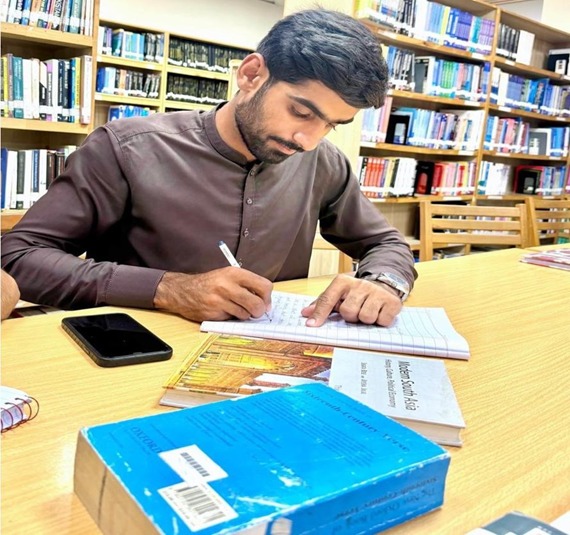
Our interviewee is Nasir Aijaz – editor of the literary website Sindh Courier in Pakistan, a prominent poet and journalist, recipient of international awards, and author of more than ten books.
—How do journalism and literature complement each other for you?
—For me, journalism and literature are two sides of the same coin—both rooted in the desire to understand and communicate human truths.
 Journalism keeps me grounded in facts, clarity, and the urgency of real-world issues. It trains me to be precise, objective, and responsible in my storytelling. Literature, meanwhile, allows me the freedom to explore the depths of human emotion, consciousness, and imagination. It offers a space for reflection, beauty, and nuance that often can’t be captured in a factual report.
Over the years, I’ve found that journalism informs the authenticity of my stories, while literature teaches me empathy, creativity, and the importance of narrative craft. Together, these fields help me serve both truth and art—balancing analysis with aesthetic and emotional depth.
—What does “truth” mean to you, and how should it be expressed in literature?
 —To me, truth is fundamentally about authenticity—about honestly representing life as it is, with all its contradictions, uncertainties, and imperfections. It’s not just about factual accuracy but about capturing the essence of human experience. In literature, truth can be expressed in the sincerity of voice, the depth of insight, and the fidelity to emotional life. Great literature doesn’t shy away from uncomfortable realities; instead, it bravely explores them through storytelling that resonates deeply with readers. True expression in literature involves careful observation, empathy, and integrity—telling stories that reflect the multifaceted nature of life, not just a simplified or idealized version of it.
I believe that honest storytelling has the power to foster understanding, spark change, and connect us across differences.
—What role do philosophy and spirituality play in your literary and journalistic style?
 —Philosophy and spirituality are like the moral compass and the soul of my work. Philosophy prompts me to question assumptions, seek underlying truths, and consider multiple perspectives—challenging my mindset and encouraging critical thinking. It pushes me to probe deeper into issues rather than settling for surface solutions. Spirituality, on the other hand, fuels my compassion and sense of interconnectedness. It reminds me that beyond the political, social, or cultural layers, there is a shared human experience—an intrinsic need for meaning, hope, and connection. Both influence my style by making my writing more reflective and humane. They inspire me to look for the moral and spiritual dimensions of stories, to listen more intently, and to communicate with a sense of empathy and genuine concern for others’ well-being.
—How should truth be understood and expressed in poetry or articles?
—In poetry, truth is often conveyed through metaphor, rhythm, and emotion—through an intuitive sense of what resonates beyond words. Poetry allows for ambiguity, layers of meaning, and a focus on the aesthetic and emotional truth of a moment or idea. It’s about capturing the essence of an experience in a way that touches the reader’s heart.In articles, truth demands clarity, accuracy, and fairness. It’s about investigating thoroughly, presenting multiple viewpoints, and avoiding bias. While journalistic truth seeks objectivity, I believe it also requires honesty in acknowledging what is unknown or uncertain. Both forms, however, aim to shed light on reality—whether through the lyrical power of poetry or the analytical rigor of journalism—and both serve the ultimate goal of fostering understanding and awareness.
—Is there a life philosophy that inspires you?
 —Yes, I am deeply inspired by the philosophy of humility—believing that no matter how much we know, there is always more to learn. Life, for me, is a continuous journey of growth, reflection, and service. I try to see every story as a chance to learn something new and every encounter as an opportunity for genuine connection. Compassion and integrity are central to my approach—not just in my work but in how I view the world.I believe that each of us has a responsibility to listen more than we speak, to seek understanding rather than judgment, and to realize that humility opens doors to empathy and wisdom.
— How would you evaluate the reading culture of the younger generation today?
—The reading culture among young people today is complex. On one hand, digital media has created an environment where attention spans are short, and many are drawn to quick, easily digestible content. This can sometimes lead to a decline in deep reading practices. However, I also see a passionate cohort eager for meaningful knowledge and storytelling—many are craving books that challenge, inspire, and broaden their horizons. There are thriving online communities, book clubs, and literary festivals that promote reading, even in the digital space. The challenge is in nurturing this curiosity and guiding it towards substantial literature that can influence their worldview positively. Encouraging critical thinking, providing access to diverse voices, and making reading more engaging and relevant are essential.
—Can translation be called “the second birth of creativity”?
 —Absolutely, I see translation as a kind of rebirth—an act of creative resurrection that allows ideas, stories, and cultures to live anew. When I translate, I am simultaneously a guardian and a creator—I must understand deeply the original text while also reimagining it in a new language and context. It’s a delicate balancing act that involves artistic sensitivity and cultural insight. Through translation, I gain new perspectives, learn different narrative styles, and experience the beauty of language as a living, evolving craft. It’s constantly enlightening—each translation feels like a new life infused into existing words, opening my mind to new possibilities and enriching my own creative voice.
—How do you assess the current literary environment in Pakistan?
—Pakistan’s literary scene is vibrant and resilient, full of diverse voices—from poetry and fiction to essays and cultural critique. Despite economic hardships, political challenges, and limited infrastructural support, writers here continue to produce powerful, provocative work that reflects our complex society.
There is a hunger for stories that challenge oppression, explore identity, and celebrate cultural roots. However, the environment also faces obstacles like censorship, limited publishing opportunities, and a need for broader platforms for emerging talents. Still, I remain optimistic because the spirit of creativity and resistance is strong. We are witnessing a new wave of writers who are using their voice to bring global attention to Pakistan’s rich cultural tapestry.
— What horizons have international literary projects opened for you?
—Participating in international projects has been eye-opening—it has expanded my understanding of global issues and introduced me to a wide array of literary traditions and styles. These experiences have fostered cross-cultural dialogue, broken down stereotypes, and nurtured friendships across borders. They’ve also helped me see the universality of stories and the unique ways different cultures express their truths. Such exchanges have made my own writing more nuanced, socially aware, and internationally connected. They’ve also shown me how literature can be a bridge for peace, understanding, and solidarity beyond political boundaries.
—Which award or recognition do you value most?
—All awards carry personal significance, but the ones that acknowledge my efforts to promote cultural understanding and amplify marginalized voices resonate most deeply with me. These honors affirm that storytelling can be a force for positive change—helping to build empathy across differences. They remind me that my work is part of a larger responsibility to listen, amplify, and advocate through words.
— Do you have creative plans or dreams yet to be realized?
—Yes, I dream of writing a memoir that captures not only my personal journey but also the broader social and cultural currents I’ve witnessed. I want to explore my experiences in journalism, literature, and intercultural exchange, sharing lessons learned along the way. I also dream of writing novels, based on history. It would be a mix of history and fiction.
Additionally, I hope to mentor young writers, especially from underrepresented backgrounds, to help them find their voices and navigate the literary landscape. I believe storytelling is a lifelong pursuit, and I look forward to contributing new works that challenge and inspire.
— In today’s global literary field, which directions or schools are most important?
—The future belongs to stories rooted in authenticity and diverse voices. I see great importance in supporting indigenous narratives, postcolonial perspectives, and experimental literary forms that push traditional boundaries. Without naming any particular country, I would say several countries are producing vibrant, energetic work that challenges dominant paradigms and broadens our understanding of human experience. I believe cross-cultural exchanges and collaborations will be key to shaping a more inclusive, innovative literary landscape—one that values local voices but speaks to global concerns.
Interview conducted by: Jakhongir NOMOZOV,
Member of the Azerbaijan Journalists’ Union.
Similar Posts by The Mt Kenya Times:
- Diaspora Times Global Sep 19 – Sep 25, 2026
- Tibet’s glacial catastrophe: Behind Beijing’s wall of silence, a climate disaster reshapes a region
- Museveni says Uganda overpaid for fuel through Kenyan middlemen as new terminal breaks ground
- Court orders throw KPL season kickoff into doubt
- Can Kenyans abroad become the untapped force that transforms Kenya?
About the Author