Great spiritual constructions of a small world: Ethical discourse, the poetics of man and fate in the prose of Zemfira Maharramli

Tarana Turan RAHIMLI
By: Tarana Turan RAHIMLI
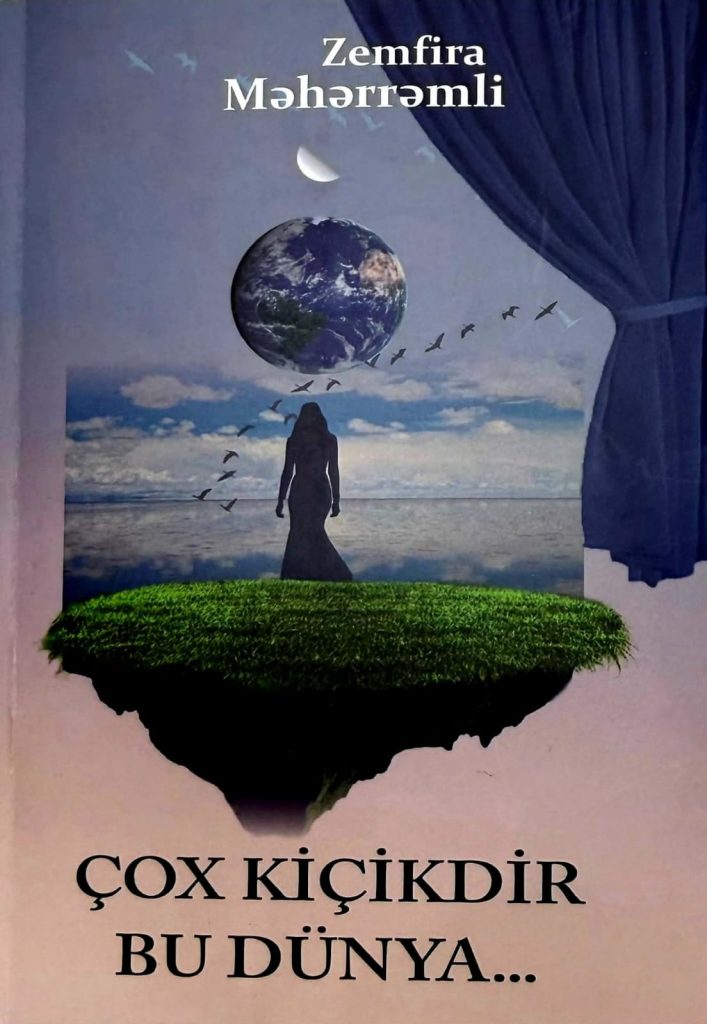 In modern Azerbaijani prose, the inner world of man, moral choices, and the ethical tension and drama created by fate in individual consciousness are increasingly coming to the fore. From this perspective, Zemfira Maharramli’s prose stands out as a set of artistic texts presented as a “small world”, formed on the level of an individual person, but essentially carrying broad philosophical and moral meanings. In the writer’s works, ordinary life situations, everyday details, and local human destinies become carriers of great moral constructs; a person’s attitude to conscience, a sense of responsibility, passive obedience to fate, or internal rebellion are presented within a poetic system.
The main creative merits that attract attention in Zemfira Maharramli’s prose are the features of the formation of ethical discourse, the possibilities of artistic and poetic expression of human-fate relations, and the aesthetic mechanisms that form the basis of moral problematics. The author’s collection of narratives and stories entitled “This world is so small…” is a system of artistic texts that arouses special scientific interest in terms of the consistent and deep development of ethical problematics within the narrative structure in modern Azerbaijani prose.
Here, the concept of “small world” carries not only metaphorical semantics, but also acts as an intratextual poetic principle and conditions the presentation of events, destinies, and human relationships in condensed spatial-temporal coordinates. In the writer’s narrative world, human destinies do not exist in isolation from each other, but in the unity of ethical and psychological relationships.
The artistic structure of each of the works included in the book is characterized by its anthropological focus, an aesthetic aspect that emphasizes the human factor. Here, not the event, but the person is in the foreground; more precisely, the person’s moral choice shapes the event. From this point of view, Zemfira Maharramli’s prose is not classically plot-oriented, but ethical-semantic. Events are driven by internal impulses of conscience rather than a chain of cause and effect.
It is precisely because of this quality that the poetics of the texts collected in the book “The World is So Small…” arise from the prism of ethical narrative principles.
The writer’s story “Why Didn’t My Mother Come?” is a central example of an ethical narrative. Here, the pandemic plays not only the role of a historical-social background, but also acts as a global factor deforming human relationships. The image of the main character of the story, Laman, is developed in a multilayered plan in terms of psychological realism. His internal monologues, hesitations, and decisions have a depth that can be explained by the concept of “internal conflict” of post-Freudian psychological literary criticism.
Laman is both a mother, a doctor, and a social subject, and the tension between these roles constitutes the main dramatic energy of the narrative.
In the work, the letter addressed by the protagonist to his daughter has a special function from a narrative perspective. The lines, written with inner anguish, are addressed to a 7-year-old girl: “When the number of deaths increases, there are such painful moments here that… Perhaps I am writing to you about all that has happened for no reason. Your heart, the size of your small fist, cannot withstand these sorrows. Even though I am broken, I blame myself as I write the letter.
We must not lose the love of life in such a sensitive period.” (Maharramli Z. This world is so small…, Baku: Vektor, 2022, p.7.) The letter, as an element of the epistolary genre, is not only an emotional tool in the text, but also a verbal manifestation of an ethical position. Here, the hero’s inner sense of responsibility, confrontation with conscience, and attitude towards fate are expressed discursively. The logic dictated by the letter, “I must be here because the sick are waiting for me,” clearly shows the hierarchy of values established between individual feeling and social responsibility. At this point, the author presents the individual tragedy in the context of shared, collective responsibility and invites the reader to a position of ethical empathy. One of the main features that attracts attention in Zemfira Maharramli’s prose is that ethical conflict acts not only as a plot event, but as an ontological principle that determines the structure of the text. Here, the ethical choice is neither episodic in nature nor is it resolved only in the finale; on the contrary, the ethical dilemma creates semantic tension in the text that continues from beginning to end. This feature distinguishes the author’s prose from classical realism and allows it to be characterized in the context of ethical realism.
In literary criticism, ethical realism is understood as a poetic system that analyzes human behavior in social reality with moral dimensions. This system is clearly observed in Zemfira Maharramli’s texts. Her heroes are not polarized into “good” and “bad”, “positive” and “negative”; on the contrary, they are presented as people making decisions in a state of ethical uncertainty. We also see this approach prominently in the story “Why Didn’t My Mother Come?” The image of Laman is not an idealized hero, but a morally responsible subject. The moments when he is torn between the desire “I want to hug my daughter” and the thought “the patients are waiting for me” demonstrate the fragmentation of the ethical subject.
While treating her patients, the young doctor-mother, Laman, who herself contracted the coronavirus, thinks about her patients and the nurse, Aunt Sara, who contracted the virus, while at the same time worrying about her young daughter: “What she remembered most was her dear child, whom her old mother had placed her hopes in. The little girl never left her mind for a moment” (Ibid., p.10). In the context of the pandemic, the thoughts of the young doctor-mother create a dramatic picture of a consciousness torn between professional responsibility and maternal feelings. This split is not only psychological, but also epistemological: the heroine herself cannot fully determine by what logic and what value system she makes her decision.
This very moment takes the text out of the didactic framework and makes it open to scientific interpretation.
The story “The Joy of Twelve Years” is notable for its shift in narrative perspective. The story begins with the sentence of a teenage boy looking with disdain at the empty vodka bottles rolling underfoot, “Dad, what’s wrong, drink less of this poison!” Although in this opening episode, domestic violence and social degradation are presented at the level of everyday detail, the empty vodka bottles acquire symbolic semantics and become the visual equivalent of the spiritual void and the ethical bankruptcy of the father figure. The teenage boy’s replica is not just a situational reaction, but a key textual unit that reveals the early maturity of a consciousness deprived of childhood and the traumatic narrative position formed against the background of the collapse of the family institution. Here, events are presented through the prism of the child’s consciousness, which creates a specific narrative model close to the concept of “unreliable narrator”, but containing high moral trust and confidence.
The hero of the story, who finds an expensive phone among the bushes in the park one day before his 12th birthday and at that moment is caught up in the thought of selling it, is suddenly shocked by the inscription “My mother’s call” appearing on the screen of the phone. Here, the child’s conscience, formed against the background of social poverty, is not idealized by the author, but, on the contrary, is presented in an internal struggle. The episode of the found phone turns into an ethical dilemma: material need is confronted with a moral choice. The appearance of the inscription “My mother’s call” on the phone screen acts here as a semantic detail. This detail is not accidental; the image of the mother here rises to the level of a visual symbol, an archetype of the child’s conscience. For a child, a mother’s voice is a stronger ethical call than material need. At this point, the author shows that the ethical decision is made not by a rational, but by an emotional-intuitive mechanism. The phone call of the mother, worried about her daughter, affects the decision of the main character and changes the course of the event as a whole. In general, the image of the mother in Zemfira Maharramli’s prose has a special semantic status. The mother is not only presented within the framework of the family institution, but also performs the function of an ethical archetype.
This quality can be clearly observed in the story “The Joy of Twelve Years”.
One of the interesting aspects of the semantic structure of the story is related to the time factor. Although the event takes place in a short period of time, the child’s internal monologues cause a psychological expansion of time. This is a narrative technique that resonates with Henri Bergson’s concept of “internal time”. For the child, a few minutes of hesitation turns into a whole spiritual experience.

In the story “Look how narrow the world is…”, the author brings the poetics of space to the fore. Here, geographical distances are compensated by spiritual closeness. Orphanages, foreign countries, different languages are presented in the text not as elements of separation, but as a background showing the general trajectory of human destinies. The narrative structure in the story is built on the intersection of destinies. This text corresponds to the “encounter narrative” model widely used in world literature. The problems of orphanhood, identity, and national belonging are presented here in the context of collective memory, not individual.
The fact that the character Dima, who comes to the house of an Azerbaijani family living in Moscow to repair a refrigerator, says in pure Azerbaijani, “Baku is also my native land,” does not only sound like a nostalgic expression, but also has a semantic key function that shows the transborder nature of national-cultural identity. The life story that Dima tells to a family where he comes as a refrigerator repairman and is warmly welcomed, the fact that his own parents threw him into an orphanage, but the Azerbaijani family – Uncle Niyaz and his wife Aunt Masuma – raised him with love, and his repeated visits to Azerbaijan reveal the roots of the character’s love for Azerbaijan. The impression that Dima creates about the spiritual connection between people from different geographical locations shows that the issue of identity is presented in the text not in a sentimental, but in an ontological aspect.
In this story, the intersection of destinies is explained not by chance, but by the principle of narrative determinism. The world is small here, human destiny cannot escape its past, because the past is an ontological component of man and is inseparable from it. This approach resonates with the motif of “returning memory” and structures built on chance encounters, which are common in 20th-century European and American prose. However, in Zemfira Maharramli, the encounter is not nostalgia, but the problem of identity. Here, the past is presented not as a sentimental memory, but as the ontological foundation of man. This approach distances her from the postmodern aesthetics of chance, removes the writer’s texts from the local topic and places them in a universal context.
The story “One Dark Night” demonstrates the synthesis of social realism with ethical discourse. The image of Guldaste, a widow who raises her children alone with a thousand and one sufferings after her husband dies in an accident, is taken to the center not in terms of gender, but in terms of her moral position. The weaker she is socially, the stronger she appears as a character due to her moral qualities. Her courage in the face of thieves who take her family’s only source of livelihood and her children’s sustenance from the stable in the middle of the night symbolizes the victory of this character’s maternal responsibility over social fear. The behavior exhibited by Guldaste is not instinctive, but value-based. The sentence “You can only take those animals over my dead body” is the narrative climax, and here it defines the boundary between fear and dignity, life and death, as the ultimate limit of the ethical position.
At this point, fear is no longer a biological instinct, but a moral barrier. The woman who takes her sheep back from thieves and walks towards the light in the darkness of the night has a symbolic character in the text and becomes a metaphorical expression of ethical choice. In this story, the image of a woman is not a passive victim, but an ethical subject.
The fact that female characters are in an active narrative position in all the texts in the book is an indicator of the author’s anthropological approach. Male characters are often presented in a state of inner weakness, hesitation and regret. This contrast is not ideological, but ethical in nature and shows that the author’s main criterion is the moral position of a person.
The writer’s style is characterized by minimalist poetics. He creates an emotional impact with the most concise means of expression. There are no superfluous words or random details in this prose. Each episode carries a moral burden. Internal monologues, letters, and short dialogues are the main narrative means that create psychological depth in the text. Although the flow of time is chronological, the semantic weight of events increases with retrospective reflection. Symbolism is not presented openly in the texts, but creates deep semantic layers. This feature brings the writer’s prose closer to postrealist poetics.
One of the important aspects that stands out in Zemfira Maharramli’s prose is the semantics of silence. The characters often speak not in long monologues, but in short sentences, even in silence. This creates a “poetics of silence” in the text and puts the reader in the position of an active interpreter. Silence here is not a weakness, but a form of ethical thought.
When evaluating Zemfira Maharramli’s prose in the context of world literature, it is observed that her texts are not a mechanical continuation of any specific literary school, but form an internal harmony with a number of leading poetic trends. This harmony is not manifested at the level of direct influence or intertextual quotation, but at the level of artistic organization of ethical problematics, narrative minimalism, and a point of view focused on human anthropology. For example, the economy of events observed in Zemfira Maharramli’s stories and narratives and the construction of the plot on internal tension are reminiscent of Anton Pavlovich Chekhov’s principle of “plot without plot.” However, this similarity is not formal. If in Chekhov’s prose the relegation of the event to the background is more related to existential emptiness and the inner passivity of man, in Zemfira Maharramli the brevity of the event is conditioned by the foregrounding of ethical responsibility. Here, silence and pause do not express the indifference of man, but, on the contrary, the gravity of the moment of internal decision. In this sense, Maharramli’s “poetics of silence” carries moral tension, unlike Chekhovian neutrality.
On the other hand, in the story “Why Didn’t My Mother Come?”, the human destinies presented against the backdrop of a pandemic create certain parallels with the motif of collective disaster in Albert Camus’s novel “The Plague.” However, while in Camus, disease acts more as a means of expressing philosophical-absurd thought, in Zemfira Maharramli the pandemic carries the function of social reality that sharpens ethical choices. Although the image of Leman can be compared to Camus’s Dr. Rieu type, here the silent responsibility of conscience, rather than the idea of heroism, is brought to the fore. This difference brings Z. Maharramli’s prose closer to the level of ethical realism than to existential philosophy.
The artistic presentation of small but fateful decisions made in everyday life in the writer’s stories is reminiscent of the prose aesthetics of Canadian writer Alice Munro. As in Munro, events here develop not with large dramatic explosions, but with psychological turning points. However, while Munro’s texts focus more on the transformation of individual female experience over time, in Zemfira Maharramli, individual experience acquires a social and moral form. In the story “The Joy of Twelve”, the decision made by a child becomes not only an act of personal behavior, but an indicator measuring the moral state of society.
The clash of social environment and moral resistance in the story “On a Dark Night” can be compared with the classic examples of Russian realism, especially with the female characters of the stories belonging to the early period of Sholokhov’s creativity (Dunyatka – “Shepherd”, Nyurka – “Crooked Stitch”, Anna – “Two Husbands”, Marinka – “Galoshes”, etc.). However, while in Sholokhov the social conflict develops more on a historical-class basis, in Maharramli the conflict is localized in an ethical and human dimension. The image of Guldaste is the bearer of personal dignity, not ideological struggle, this feature directs Z. Maharramli’s prose from social realism to ethical realism.
Thus, the works collected in Zemfira Maharramli’s book “This world is so small…” are in dialogue with a number of leading aesthetic trends existing in world prose, but this dialogue is not imitative in nature. The author creates a unique ethical-narrative system by filtering global literary models through the filter of national spiritual experience. Her texts remain neither in a national framework nor in universal abstraction; they formulate universal spiritual questions through individual destinies.
Ultimately, the book “This World is Very Small…” is a successful synthesis of ethical discourse, narrative strategy, and human anthropology in modern Azerbaijani prose. In these narratives and stories, the world is small because a person’s moral choice has global consequences. Zemfira Maharramli creates open texts that encourage the reader to think not with ready-made answers, but with ethical responsibility. From this perspective, the book is interesting not only for its artistic, but also for its literary novelty with high scientific-analytical potential. These texts, which appear as an artistic embodiment of ethical thought in modern Azerbaijani prose, confront the reader not with emotional impact, but with moral responsibility. The world is small here, because every decision a person makes affects the life of another person. Zemfira Maharramli presents a person not in the shadow of events, but at the center of ethical choices, thereby creating an important aesthetic model for modern literature.
Tarana Turan RAHIMLI,
Doctor of Philology Sciences, Professor.
Similar Posts by The Mt Kenya Times:
- Mt Kenya Times ePAPER October 9, 2026
- Ruto claims farming revolution as election season dawns
- China grants Kenya $2M for drought and Ebola response
- High Court upholds KSh2.5M IEBC fine against Gikaria
- Kenya’s opposition fractures with 11 months to the ballot
About the Author