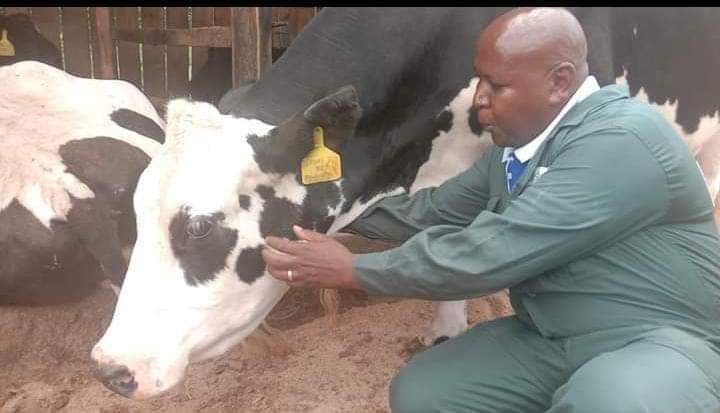
Alex Gathii tending a cow

By Alex Gathii
Worth Noting:
- Other requirements are acess to continuous fresh air, Air: all cows should continuously breathe fresh air, be in a place where it is should be able and willing to lay down for between 14 and 16 hours per day, have enough space where it is able to walk around comfortably and also ensure that you group dairy herd according to segments.
- Protein is expensive and therefore cheaper sources are preferred. However, high levels of proteins may lead to low fertility. Plant tissues contains less than 60% dry matter content while cereal grains contains more than 80% dry matter content.
- A cow requires on a daily basis, dry matter content 3% of its body weight which is about 2.5 – 4.0 percent intake per day.
For a cow to reach maximum milk production, it requires to be with feeds which are rich in protein, energy, minerals, dietary fibre and water coupled with sound management and cow comfort.
There are four reasons for feeding a dairy herd with these combinations whose end results are; maintenance, growth, reproduction and production.
Feeding a dairy cow of 650kgs and produces about 50kgs of milk per day.
To maintenance Peak production, such a dairy requires a lot of Protein and energy which includes 4.6kgs of Protein (not Crude Protein) and 44 Megacalories. For maintenance purposes, she requires 10.30 Mcal and 0.428kg of protein. Also requires Calcium and Phosphorus respectively both for maintenance and milk production. Look out for Ca:P Ratio for peak milk production
The dairy cow needs a comfortable environment which will ensure that all Cowsignals parameters are met.
These parameters include access to palatable feed of the right composition and clean water for at least 22 hours per day.
Others are allowing cows access to enough light whose end result is their experience to a day-night rhythm.
Other requirements are acess to continuous fresh air, Air all cows should continuously breathe fresh air, be in a place where it is should be able and willing to lay down for between 14 and 16 hours per day, have enough space where it is able to walk around comfortably and also ensure that you group dairy herd according to segments.
Protein is expensive and therefore cheaper sources are preferred. However, high levels of proteins may lead to low fertility. Plant tissues contains less than 60% dry matter content while cereal grains contains more than 80% dry matter content.
A cow requires on a daily basis, dry matter content 3% of its body weight which is about 2.5 – 4.0 percent intake per day.
Ensure that you provide a deep dry soft material for cow’s bedding. A cow spending her 24 hours eating, drinking water and resting. A complete cycle takes 2-3 hours, repeated in 8-20times in a day.
Pregnant cows with no shelter have metabolic rates which were 18 – 36% higher than cows provided with shelter. Feeding costs takes about 60-80% of the total production costs.
Most dairy investors believe that having Boma Rhodes hay in store is feed security. What’s the nutritional value of Boma Rhodes hay? At what stage was it harvested? What’s the cost per dry matter content?
When feeding a dairy herd, we normally use 3 ratios;
Protein: Energy Ratio (depending on X1, X2, X3 and X4 – Growth, maintenance, reproduction and milk production). The more the X’s for any segment of the dairy herd, the more protein and energy you provide in the daily ration)
Forage: Concentrate Ratio (60:40, 50:50 and 40:60, ensure you provide protein and energy from diverse sources – forage and concentrates). American Dairy Association goes up-to 35:65 – a lot of care when you get to these levels.
Provide 20 kgs of good quality maize silage for a lactating cow, less Boma Rhodes (2.0 – 1.5kgs per cow per day, should have higher leaf; stem ratio, harvested at 30% flowering – highest Crude Protein).
Feed to Gain Ratio – bioavailability of the nutrients provided. A source could have higher levels of protein with reduced digestibility.
A cow takes in 3% dry matter of its body weight per day. Amount of dry matter could vary depending on stage of lactation, milk production and physiological status of the cow. Maize silage, sunflower silage and dairy meal contributes a greater percentage of the dry matter; hence their qualities must be guaranteed.
Quality maize silage has 3.5 times more nutrients than Boma Rhodes hay.
It costs 1.4 times higher than Boma Rhodes hay. For your cows to produce more milk, ceteris paribus, it requires more maize silage (15-20kgs/cow/day), more dairy meal (between 4-12kgs/cow/day) but less Boma Rhodes hay (1-2kgs per cow per day). A cow producing more milk takes in less Boma Rhodes hay, it is an inverse relationship.
4 kgs of wilted Sweet potato vines has a protein equivalent of 1kg of dairy meal, however do not provide more than 8kgs of sweet potato vines/silage.
Alex Gathii is a Dairy Consultant with Tanolope Consultancy Limited. He can be reached on 0723331611
Similar Posts by The Mt Kenya Times:
- Mt Kenya Times ePAPER August 26, 2026
- Mt Kenya Times ePAPER August 25, 2026
- Mt Kenya Times ePAPER August 24, 2026
- Diaspora Times Global Aug 22 – Aug 28, 2026
- Mt Kenya Times ePAPER August 21, 2026
About the Author