Jolly Phonics: Making early reading click for Kenya’s youngest learners
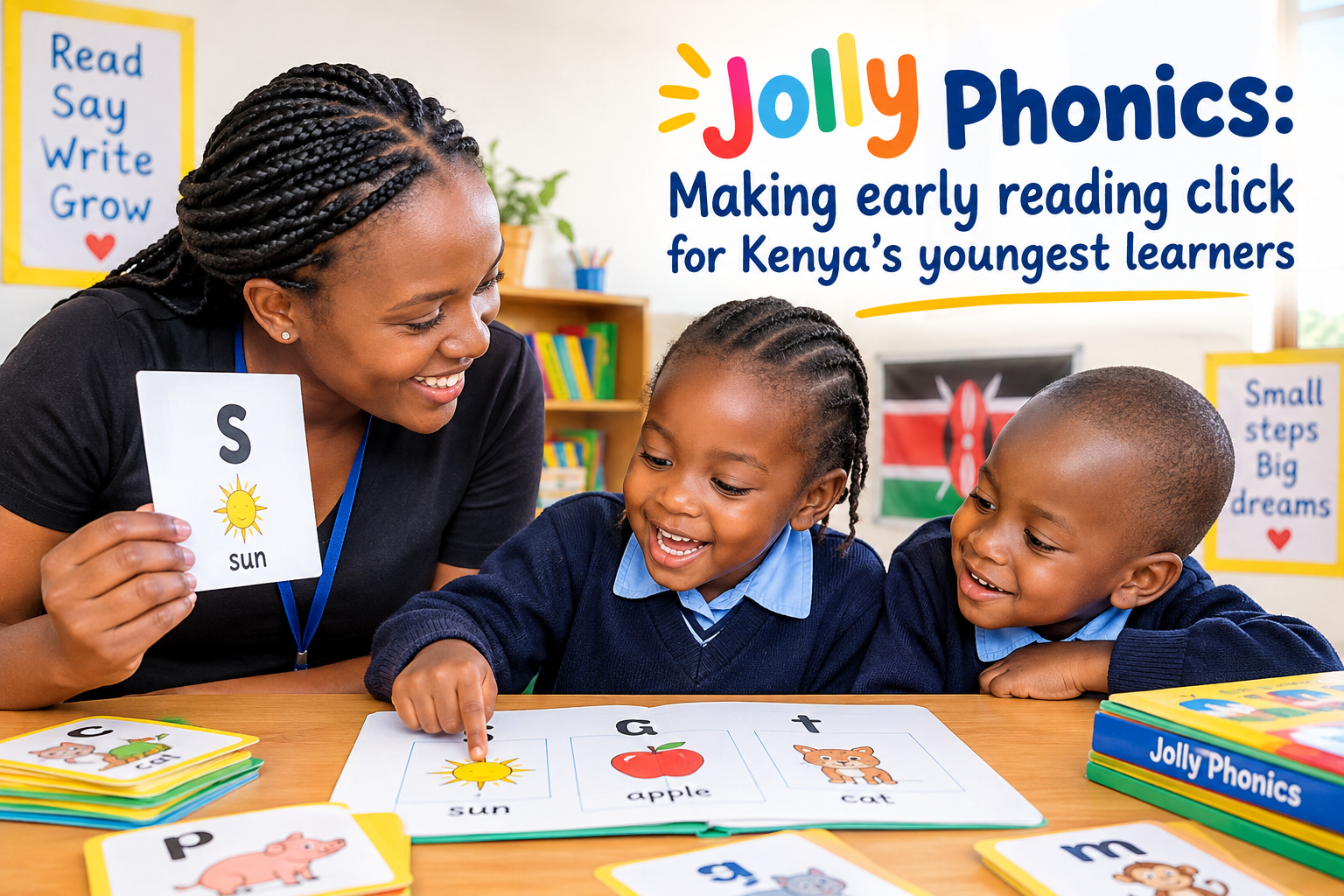
How a multi-sensory phonics programme is transforming literacy instruction in classrooms across Kenya
By Ashford Kimani
In the early years of schooling, few competencies matter as much as the ability to read and write. Literacy is not merely a subject — it is the gateway to all other learning. Among the most effective and widely adopted approaches to early literacy instruction is Jolly Phonics, a method that has transformed how young learners engage with language by making reading both accessible and genuinely enjoyable.
At its core, Jolly Phonics is a systematic, synthetic phonics programme that teaches children to decode words by learning the sounds that letters make. Unlike traditional alphabet instruction, which emphasises letter names — A, B, C — Jolly Phonics prioritises letter sounds: /a/, /b/, /c/. This enables children to begin reading simple words almost immediately. The shift from abstract naming to practical sound recognition is one of the principal reasons the programme works so well.
The methodology is built around 42 letter sounds, which include not only the basic alphabet but also digraphs such as “sh”, “ch” and “th”. These sounds are introduced in a carefully structured sequence, allowing children to start blending sounds into words early in the process. By learning just the first group — s, a, t, i, p, n — a child can already form and read words such as “sat”, “pin” and “tap”. That early success is crucial. It builds confidence and motivates learners to keep exploring language.
One of the programme’s most distinctive features is its multi-sensory approach. Children do not simply listen and repeat — they engage their whole bodies. Each sound is associated with an action, a story and often a song. The /s/ sound, for instance, is taught with a snake-like hand movement, while the /a/ sound involves pretending that ants are crawling up the arm. This integration of movement, sound and imagery strengthens memory retention and caters to different learning styles: visual, auditory and kinaesthetic.
The programme rests on five fundamental skills that together build full literacy. The first is learning the letter sounds themselves. The second is letter formation — teaching children to write each letter correctly. The third is blending, combining individual sounds to form words. The fourth is segmenting, breaking words into their constituent sounds, which is essential for spelling. The fifth is recognising tricky words — those that do not follow standard phonetic rules, such as “the”, “said” and “was”. By addressing all five areas comprehensively, Jolly Phonics ensures that children are not merely decoding words mechanically, but developing a genuine understanding of language.
In the classroom, Jolly Phonics introduces an element of play into learning. Lessons are dynamic and interactive, often resembling storytelling sessions rather than formal instruction. This matters enormously in early childhood education, where attention spans are short and engagement is everything. A child who associates reading with fun is far more likely to develop a lifelong love of books.
The programme’s relevance is especially pronounced in contexts where English is taught as a second language — as it is in many Kenyan classrooms. For learners with limited exposure to English at home, the structured and repetitive nature of phonics provides a clear pathway to mastery. Rather than memorising words by sight alone, learners acquire the tools to decode unfamiliar words independently. That autonomy is a powerful outcome: it shifts the child from dependence to self-sufficiency.
Jolly Phonics also aligns well with competency-based education frameworks, which emphasise skills acquisition over rote memorisation. Reading is treated not as an isolated academic exercise but as a practical skill that enables communication, comprehension and critical thinking. By equipping learners with the ability to read fluently at an early stage, the programme indirectly supports performance across all subjects.
Like any educational approach, however, effectiveness depends on implementation. Teachers must be adequately trained to deliver the programme with fidelity. The actions, songs and sequencing are not decorative elements — they are integral to the pedagogy. When delivered half-heartedly or inconsistently, the impact diminishes. When teachers fully embrace the method, the results can be remarkable.
Parental involvement also plays a significant role. When parents understand the phonics approach, they can reinforce learning at home through simple activities: reading aloud, practising sounds and encouraging children to blend words during everyday interactions. This home-school connection accelerates progress and strengthens a child’s confidence considerably.
Critics of phonics-based instruction sometimes argue that it may neglect comprehension in favour of decoding. The concern has some merit where programmes are poorly balanced, but Jolly Phonics is typically integrated with reading comprehension activities, storytelling and vocabulary development. The goal is not merely to produce children who can read words aloud, but learners who can understand and interpret what they read.
Jolly Phonics represents a pragmatic and effective response to one of education’s most fundamental challenges: teaching children to read. By focusing on sounds, incorporating multi-sensory techniques and building skills systematically, it demystifies the reading process and makes it accessible to all learners. For educators at foundational levels, it offers a structured yet flexible framework. For learners, it transforms reading from a daunting task into an enjoyable journey. And in the broader context of education, it lays the groundwork upon which all future learning is built.
Similar Posts by The Mt Kenya Times:
- Cartels in court, monopolies on thrones: The ironic economics of Kenya’s competition crusade
- Mt Kenya Times ePAPER October 9, 2026
- Ruto claims farming revolution as election season dawns
- China grants Kenya $2M for drought and Ebola response
- High Court upholds KSh2.5M IEBC fine against Gikaria
About the Author