Judicial Bench Book On Human Trafficking For Sexual Exploitation Launched
 The Mt Kenya Times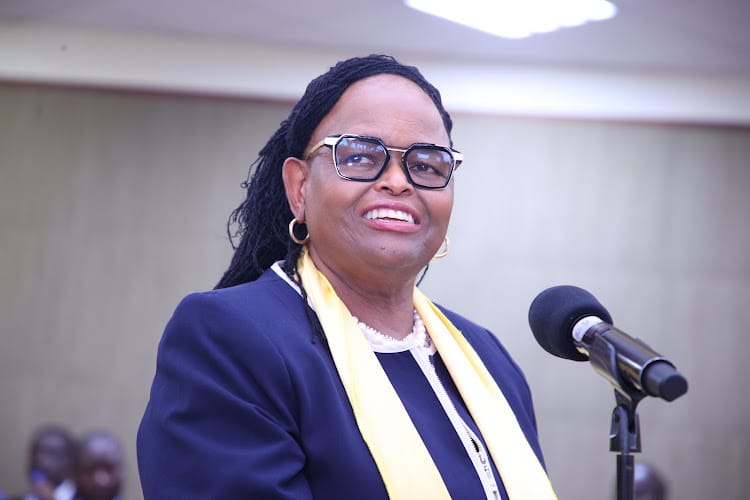
Honorable Chief Justice Martha Koome giving an address about the Judges launch first ever bench book to tackle sex trafficking in Kenya.
By Cynthia Masibo
Worth Noting:
- The bench book is designed to sensitize judicial officers, including judges, magistrates, and other court users such as prosecutors, advocates, and probation officers, on understanding the dynamics of trafficking for sexual exploitation. It aims to help them identify potential victims, be alert and responsive to their need for support and protection, and adopt responsive strategies for dealing with trauma.
- Additionally, it highlights the legal issues that arise in trafficking for sexual exploitation cases.
- The book includes special features such as unpacking common misconceptions related to sex trafficking that can impact the ability of the courts to prosecute and adjudicate effectively. It calls for all actors to adopt a human rights and trauma-informed approach when handling cases of sex trafficking.
Kenya continues to have one of the highest rates of human trafficking in Africa, with those for sexual exploitation being one of the most common forms. Despite the enactment of the Counter-Trafficking in Persons Act, prosecution and conviction rates for human trafficking cases remain low.
To address this challenge in the judicial system, the International Association of Women Judges in Kenya, in partnership with Equality Now, a non-profit organization using the law to address gender injustices globally, launched the “Kenya Judicial Bench Book on Trafficking in Persons for Sexual Exploitation” on World Day Against Trafficking of Persons.
Acknowledging the importance of this judicial bench book, Chief Justice Martha Koome said, “This Bench Book on trafficking in persons for sexual exploitation seeks to facilitate a greater understanding of this form of trafficking, further bringing attention to the elements of this crime, including the institutional barriers, to support access to justice for victims and survivors.”
The Kenya Judicial Bench Book on Trafficking in Persons for Sexual Exploitation is the first bench book on sex exploitation to be launched in Kenya but the second one on human trafficking in the country.
It complements existing Bench Books and other legal resources developed by and for the Judiciary in Kenya, including the Bench Book on Labour Trafficking (2022) and the Bench Book on Criminal Procedure (2018).
The bench book is designed to sensitize judicial officers, including judges, magistrates, and other court users such as prosecutors, advocates, and probation officers, on understanding the dynamics of trafficking for sexual exploitation. It aims to help them identify potential victims, be alert and responsive to their need for support and protection, and adopt responsive strategies for dealing with trauma.
Additionally, it highlights the legal issues that arise in trafficking for sexual exploitation cases.
The book includes special features such as unpacking common misconceptions related to sex trafficking that can impact the ability of the courts to prosecute and adjudicate effectively. It calls for all actors to adopt a human rights and trauma-informed approach when handling cases of sex trafficking.
It also cites 87 cases and judgments taken on sex trafficking in various countries, including Kenya, Uganda, South Africa, Malawi, Namibia, Australia, Canada, Seychelles, Netherlands, Philippines, and Romania.
Kenya is a signatory to the UN Protocol to Prevent, Suppress and Punish Trafficking in Persons Especially Women and Children (the Palermo Protocol), and has domesticated the treaty through the Counter-Trafficking in Persons Act (2010) among other legislation, thus providing a national framework for Kenya to effectively prevent and prohibit trafficking in persons, including for purposes of sexual exploitation.
The book is a welcome initiative to the numerous policy efforts the Government of Kenya has made to combat trafficking, including increasing investigations, prosecutions, and specialized anti-trafficking police units. For example, in February 2024,the Office of the Director of Public Prosecutions established a specialized unit dedicated to countering trafficking in persons where previously, the trafficking prosecutions unit was housed in the Gender-Based Violence Unit.
The Counter-Trafficking in Persons Act of 2010 criminalizes sex and labour trafficking and prescribes penalties of 30 years to life imprisonment, a fine of not less than KSs30 million or both.
Despite progress, systemic challenges persist. According to Marion Ogeto, Equality Now’s program officer, “We welcome the steps taken by the government; however, prosecution of human trafficking is dismal, especially trafficking for sexual exploitation despite Kenya’s robust legislative framework.”
In 2023, the government reported prosecuting 19 trafficking cases, including three sex trafficking cases. In 2022, 48 trafficking cases were prosecuted. Ogeto emphasized the need for enhanced law enforcement, specialized counter-trafficking police units, and a centralized data collection system to address underreporting and improve response to trafficking crimes.
The book also highlights the gendered nature of sex trafficking, with women and children being particularly vulnerable.
The National Crime Research Center reported in 2022 that women accounted for 41% and children for 33% of sex trafficking cases. The rise in online child sexual exploitation further complicates the issue.
The Kenya Judicial Bench Book on Trafficking in Persons for Sexual Exploitation marks a significant step towards a more effective judicial response to sex trafficking, bolstering efforts to protect the most vulnerable.
Similar Posts by The Mt Kenya Times:
- The public-private divide in competition law: Reconstructing rights-based private remedies for anticompetitive harm in Kenya and the East African Community
- The critical role of teachers in preventing examination malpractice
- SUPKEM calls for political cooperation over division
- Miano hails Sofy Unicharm launch as win for women and local industry
- Kenya’s clean energy push hinges on quality standards, says Kinyanjui
About the Author