Their versatility is also their vulnerability — understanding the risks behind the rotor blades
By Collins Kibet
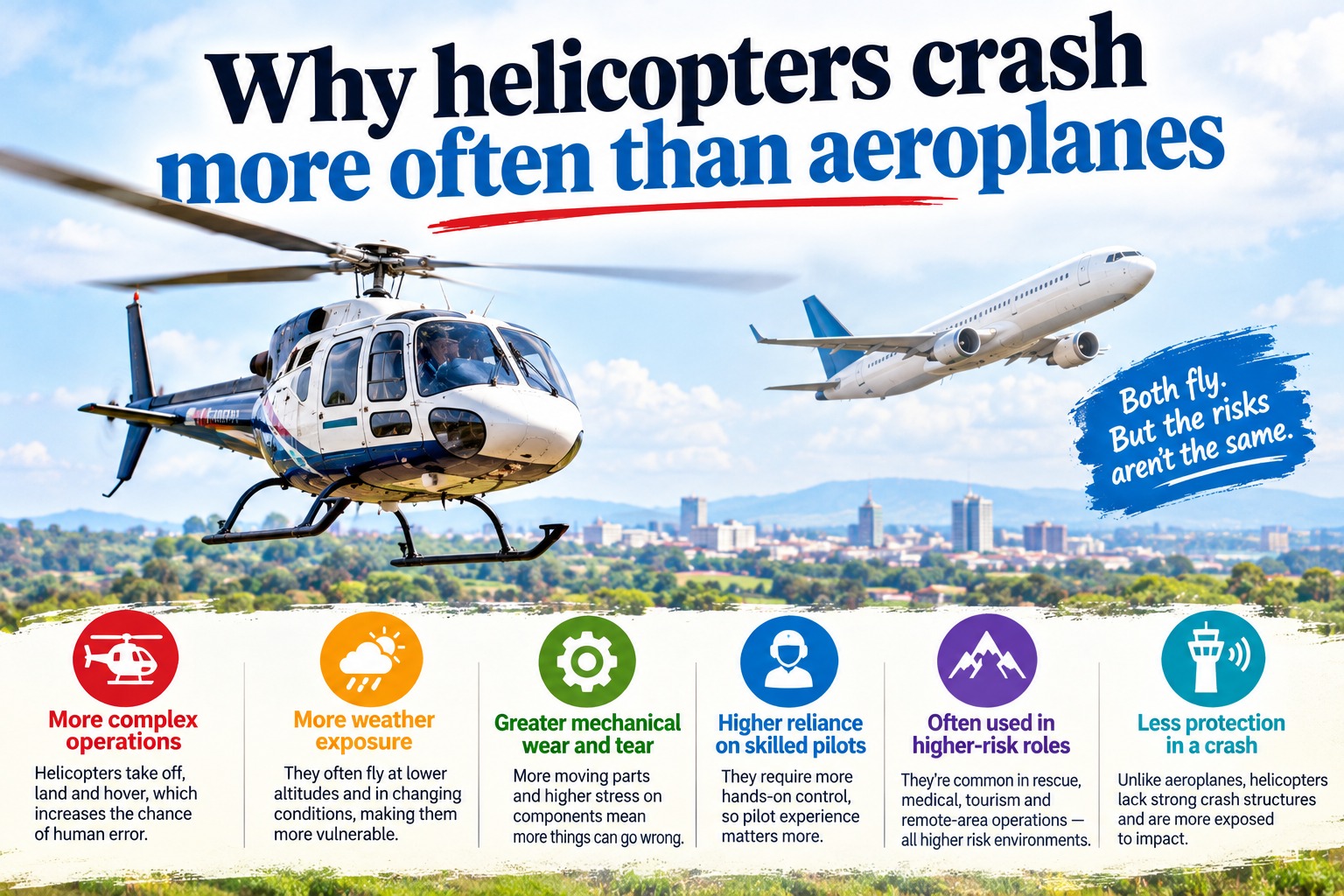
Aircraft accidents invariably prompt a familiar public question: why do helicopters appear to crash more frequently than aeroplanes? From emergency medical missions and military operations to private travel, tourism and search-and-rescue services, helicopters perform some of the most demanding tasks in aviation. When a helicopter accident occurs, it tends to attract significant attention — partly because of the severity of the impact and partly because the circumstances are often dramatic. Although the perception that helicopters crash more frequently is not universally accurate in every statistical comparison, differences in their design, operating environments and flight patterns help explain why they can face greater risks under certain conditions.
The most fundamental difference lies in how the two aircraft types stay airborne. Aeroplanes rely on forward movement to generate lift through fixed wings. As long as they maintain sufficient airspeed, they remain airborne with considerable mechanical simplicity relative to their size. Helicopters depend on rotating rotor blades to generate lift, which gives them the ability to hover, fly sideways and operate in confined spaces where no fixed-wing aircraft could function. That versatility is genuinely remarkable — but it comes with mechanical complexity and flight characteristics that introduce risks requiring specialised training, meticulous maintenance and continuous judgement from the pilot.
The complexity of a helicopter’s mechanical systems is one of the most significant contributors to its accident profile. The main rotor, tail rotor, transmission, engine and interconnected control mechanisms must all function in precise coordination to maintain stable flight. A pilot continuously manages several controls simultaneously to regulate altitude, direction and movement. A failure in any critical component can escalate rapidly, particularly when the aircraft is operating close to the ground with little margin for recovery. Modern helicopters incorporate engineering safeguards designed to reduce these risks, but mechanical failures can still occur, and when they do at low altitude the consequences are often severe.
Low-altitude operations are themselves a defining characteristic of helicopter flying — and a major source of risk. Helicopters are routinely deployed for search-and-rescue missions, medical evacuations, aerial photography, policing, power-line inspection and transportation to remote locations. These activities require pilots to fly near buildings, trees, hills, power lines and other obstacles, often with minimal clearance. At such altitudes, a developing emergency leaves the pilot far less time to recognise the problem and respond effectively than a commercial aircraft cruising at altitude would have. When power is lost suddenly, or control is compromised, the combination of low height and surrounding obstacles can be lethal.
Weather adds another layer of complexity. Helicopters often operate in environments where visibility is poor, winds are unpredictable or terrain is difficult to assess. Fog, heavy rain, strong crosswinds and darkness all make navigation significantly more dangerous. In mountainous areas, conditions can deteriorate within minutes, leaving a pilot with limited options and no safe escape route. Low visibility creates a particularly serious hazard known as spatial disorientation, in which a pilot loses the ability to accurately determine the aircraft’s position and attitude relative to the ground. Without visual reference points and without the instruments and training to compensate, disorientation can be fatal within seconds.
Human factors account for a substantial proportion of aviation accidents across all aircraft types, and helicopters are no exception. Pilot fatigue, inadequate training, poor risk assessment, distraction and the pressure to complete a mission all feature in accident investigations. A helicopter pilot conducting a rescue in deteriorating weather may feel intense pressure to push on — the knowledge that someone is stranded and waiting is not easy to set aside. But aviation safety depends fundamentally on the willingness to recognise when conditions have moved beyond safe limits and to delay, divert or abandon a flight accordingly. Safety cultures that allow pilots to refuse unsafe missions without professional consequence save lives. Those that do not have a poor record.
The environments in which helicopters operate further compound these challenges. Unlike commercial aeroplanes, which travel between established airports along carefully managed routes, helicopters routinely land and depart from hospitals, rooftops, farms, temporary construction sites and remote terrain. These locations lack the safety infrastructure of major airports — no instrument landing systems, no ground crew, no cleared approaches. Uneven ground, loose debris, unexpected obstacles and power lines all complicate operations. Offshore platforms, mountain ridgelines and flood-affected communities present conditions that are inherently demanding, and the missions undertaken in those environments are rarely routine.
The way accident data is reported and interpreted also shapes public perception. A dramatic helicopter crash in an accessible location tends to generate extensive media coverage, reinforcing the impression that such accidents are common. A meaningful statistical comparison, however, requires more than counting headlines. Analysts must account for the number of flight hours, the type of operations being conducted, aircraft categories, mission profiles and the severity of reported incidents. Comparing a commercial aeroplane carrying three hundred passengers on a scheduled intercontinental route with a helicopter conducting dozens of short, low-altitude missions daily produces a misleading conclusion unless differences in exposure, purpose and operating conditions are factored in carefully.
Fixed-wing commercial aircraft do benefit from structural advantages in certain circumstances. They typically operate with two trained pilots, established procedures for almost every conceivable emergency, sophisticated navigation and warning equipment, and rigorous maintenance programmes funded by large organisations. Their fixed-wing design allows many aeroplanes to glide for considerable distances if engine power is lost, buying time for the crew to manage the situation. Helicopters have an equivalent emergency capability called autorotation, which allows the rotor to continue spinning using airflow during a power loss. A trained pilot can use this technique to execute a controlled emergency landing — but its success depends critically on available altitude, airspeed, terrain and the pilot’s reaction time. The margin is narrow.
Preventing helicopter accidents requires commitment from every part of the system. Pilots must maintain rigorous standards and the professional courage to prioritise safety over schedule pressure. Operators must enforce maintenance schedules, invest in appropriate equipment and establish clear policies allowing flight crew to refuse unsafe missions. Regulators must apply standards consistently, investigate accidents thoroughly and ensure that findings are applied across the industry rather than filed and forgotten. Governments must fund the infrastructure and oversight mechanisms that make meaningful enforcement possible.
None of this should diminish the extraordinary value of what helicopters do. Their ability to reach isolated communities, deliver critically ill patients to hospital, support disaster response and conduct rescues in conditions that would ground any other aircraft makes them genuinely indispensable. The central lesson is not that helicopters are inherently more dangerous than aeroplanes, but that their unique capabilities expose them to demanding conditions that demand exceptional preparation, discipline and respect for the limits of both the aircraft and the people who fly them.
In aviation, the true measure of progress is not how far an aircraft can travel or how many lives it can reach. It is how consistently it brings its passengers and crew safely back to the ground.
Similar Posts by The Mt Kenya Times:
- Kenya’s budget watchdog flags record KSh209B in unplanned government spending
- Opposition cracks widen as Nyoro and Methu trade Ruto bribery claims
- Matiang’i tells critics: Leave Uhuru to do his continental work
- Strike pause, brooms out: Laikipia students clean up local market
- Kenya’s dairy crisis: Why the milk is running dry
About the Author