The Mt Kenya Times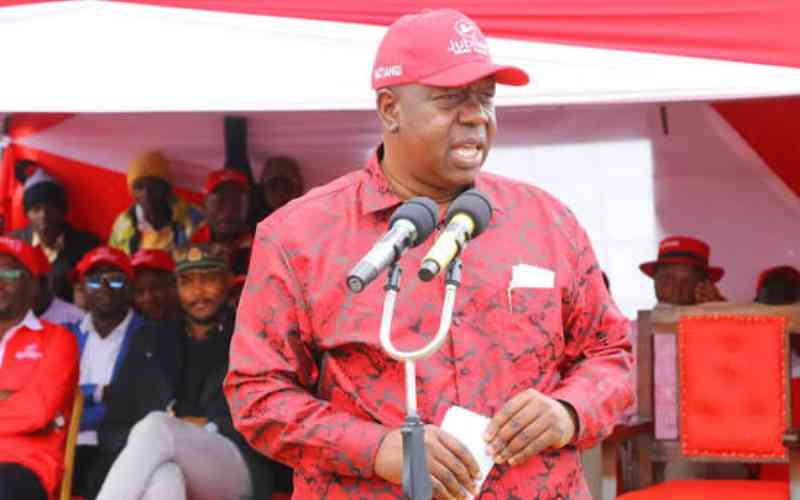
Former Interior Cabinet Secretary Fred Matiang’i
The former interior minister’s defence of the retired president raises a broader question about how Kenya treats leaders after they leave office
By Hadassah Karangu
Former Interior Cabinet Secretary Fred Matiang’i yesterday came to the defence of retired President Uhuru Kenyatta, arguing that the former head of state should be permitted to carry out his responsibilities at the continental level without being dragged into Kenya’s increasingly fractious domestic political competition.
Speaking at a rally in Kamana, Oloitoktok, Matiang’i maintained that Kenyatta had stepped away from active politics and should be free to concentrate on his work with the African Union and the East African Community. The remarks have reignited debate about the place of former presidents in Kenya’s political landscape and the expectations placed on leaders long after they vacate the country’s highest office.
At the heart of Matiang’i’s argument is a question that Kenyan politics has never resolved cleanly: when a president leaves State House, should the country allow that individual to step into a different chapter of public life without treating every appearance, association or engagement as a political manoeuvre? It is a question that goes well beyond the relationship between two political figures from a shared administration. It touches on democratic culture, the legacy of presidential leadership and the difficulty of separating political history from present-day public responsibility.
Kenyatta served as Kenya’s fourth president from 2013 to 2022. His tenure is remembered for substantial infrastructure investment and ambitious policy decisions, alongside persistent criticism over rising public debt and the cost of living. Those competing assessments ensure that his presidency remains alive in contemporary political conversation, even as he has, by all public appearances, stepped back from domestic electoral politics.
Yet stepping back has not meant disappearing. Former presidents rarely do in Kenya, and for understandable reasons. They carry institutional knowledge, diplomatic relationships and an understanding of regional and international affairs that does not simply expire when their term ends. That experience can be genuinely valuable — in mediation, peacebuilding, conflict resolution and multilateral cooperation. The African Union has historically drawn on experienced African leaders for precisely these purposes, and the East African Community remains an important vehicle for regional cooperation on trade, infrastructure, security and economic integration.
Kenya’s standing within both institutions makes this kind of engagement particularly relevant. As a country with considerable economic and diplomatic weight in East Africa, Kenya stands to benefit when its former leaders contribute constructively to regional affairs rather than being consumed by domestic political battles long after their time in office has passed.
Matiang’i’s defence rests on this distinction — between examining a former president’s record, which is entirely legitimate, and treating every subsequent public engagement as evidence of a political comeback. A former leader can be held accountable for decisions made in office while still being allowed to undertake recognised responsibilities after retirement. These are not mutually exclusive positions, even if Kenya’s political environment frequently treats them as though they are.
His intervention is also notable because of his own history. As a Cabinet Secretary who served in influential positions during the Kenyatta administration, Matiang’i is closely associated with that political era. His decision to speak publicly in Kenyatta’s defence places him within a broader conversation about loyalty, public service and how former governments are treated once power changes hands. That context matters, but it should not be allowed to obscure the legitimate principle his argument raises.
Defending a former president’s right to undertake public responsibilities is not the same as endorsing every decision that president made in office. Political leaders should be capable of agreeing on certain principles — among them, that public figures deserve evidence-based scrutiny rather than politically motivated harassment — even when they differ sharply on policies, personalities and electoral strategies.
Kenya’s political discourse, however, has a well-established tendency to collapse those distinctions. The country’s competitive environment is built around powerful personalities whose influence can stretch across electoral cycles. A former president possesses public recognition, established networks and knowledge of the state that does not simply vanish with the handing over of instruments of power. That continuing presence can be useful — or it can become a source of controversy, depending on how it is exercised and how it is interpreted by rivals.
The challenge is not to pretend that former presidents cease to matter politically the moment they leave office. They do not, and no serious person argues otherwise. The challenge is to insist that their influence be discussed honestly, judged according to their actual conduct and assessed against verifiable evidence rather than speculation or partisan assumption. Criticism grounded in specific actions serves the public interest. Criticism that reduces every public engagement to an alleged political plot does not.
There is also a broader cost to consider. When political conversation becomes dominated by questions about the intentions of former leaders, more pressing national concerns tend to receive less attention. Young people searching for employment, families managing the cost of living, farmers navigating difficult seasons, students uncertain about the continuity of their education — these concerns require sustained engagement from political leaders and the public alike. A political environment perpetually consumed by rivalries between prominent personalities leaves less room for the kind of deliberate, policy-focused debate that actually moves the country forward.
This does not mean that conversations about Kenyatta, Matiang’i or any other political figure are unimportant. It means they should be connected to meaningful questions about governance and public accountability, not reduced to exercises in political positioning.
Kenya also faces a structural question that Matiang’i’s remarks bring into sharper focus: how should the country manage the transition of its presidents from executive leadership to retirement and other forms of public service? Greater clarity about the responsibilities of former presidents, the nature of any official mandates they hold and the distinction between public service and partisan activity would reduce unnecessary controversy and help citizens distinguish established facts from political claims.
Former leaders should not be shielded from legitimate scrutiny, and retirement does not place anyone beyond accountability. The decisions made during a presidency can have consequences that extend for years, particularly in matters of public finance and institutional integrity. Democratic societies must preserve the freedom to examine those decisions and question the individuals responsible for them.
But accountability and respect are not opposites. A former president carrying out legitimate regional responsibilities deserves to have those duties assessed on their merits. Where concerns exist about specific conduct, they should be presented with evidence. What should be avoided, in the interest of both democratic health and national focus, is a political culture in which assumptions about personal motives permanently overshadow substantive issues.
Matiang’i’s defence of Kenyatta will be read differently depending on who is doing the reading. For some, it is a statement of political loyalty from a close ally. For others, it raises a principle worth taking seriously regardless of the personalities involved. Both readings can coexist. What matters is whether Kenya’s political class — and the public that watches it — can hold that complexity without reducing everything to yet another episode in an endless contest between rival camps.
A mature democracy should be capable of respecting the contributions of its former leaders while preserving the full right of citizens to question, scrutinise and hold them to account. Kenya is capable of that balance. Whether it chooses to apply it is a different question entirely.
Similar Posts by The Mt Kenya Times:
- Opposition cracks widen as Nyoro and Methu trade Ruto bribery claims
- Why helicopters crash more often than aeroplanes
- Strike pause, brooms out: Laikipia students clean up local market
- Kenya’s dairy crisis: Why the milk is running dry
- Ebola in Kenya: Are we really ready?
About the Author