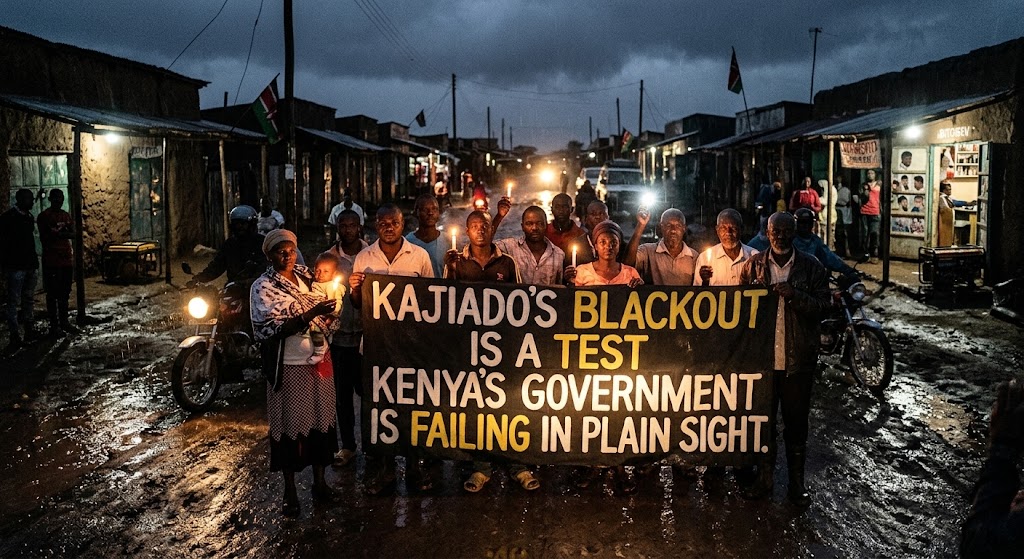
Kajiado’s blackout is a test Kenya’s government is failing in plain sight
When residents block roads over electricity outages, the state must ask not just how to restore power, but why patience ran out in the first place
By Levis Wangamati
On a road in Kajiado, darkness stopped being an absence of light and became a language of anger. Residents frustrated by prolonged electricity outages took their grievances to the streets, disrupting transport and forcing a problem that had been quietly endured inside homes and businesses into the public eye. Somewhere behind that roadblock was a shopkeeper watching business hours disappear, a student struggling to study after sunset, a family trying to preserve food and an entrepreneur counting losses that would never appear in a government report. The road was blocked, but the message was straightforward: when the lights stay off for too long, patience eventually runs out. Kajiado was not simply protesting a blackout. It was protesting what the blackout had come to represent.
For the people living through it, a blackout is never simply a blackout. It means the barber cannot run his machines, the small restaurant cannot preserve food reliably and the entrepreneur who depends on electricity cannot pretend that business can continue as usual. In Kajiado South, residents have reported that extended outages have disrupted domestic life, small businesses, health facilities and educational institutions. That is why the language of inconvenience is inadequate. What looks like a technical problem from a government office can become an economic emergency at household level, particularly for families whose survival depends on daily income.
Kenya has spent years celebrating electrification as a foundation of development — new connections, transmission lines, substations and rural electrification programmes have been regularly presented as evidence of progress. But connection is only half the promise. The other half is reliability. There is little comfort in telling a family it is connected to the national grid if electricity disappears repeatedly or remains unavailable for prolonged periods. Development cannot be measured only by the number of poles planted or households connected. It must also be measured by whether electricity is available when people actually need it.
That distinction matters because Kenya is trying to position itself as a modern, competitive economy. The national conversation is full of ambition — digital jobs, industrialisation, manufacturing, agribusiness, technology and a 24-hour economy. Yet beneath all those ambitions sits something remarkably simple: dependable electricity. A young Kenyan cannot build a digital enterprise in darkness. A small manufacturer cannot increase production by staring at an idle machine. A hospital cannot provide modern healthcare if essential infrastructure is unreliable. The grand language of economic transformation eventually meets the very ordinary reality of a switch that does not work.
Kajiado is not a forgotten corner of the country. It sits close to Nairobi, holds immense economic potential and is strategically positioned along important transport and commercial corridors. Proximity to the capital should not, however, determine whether a Kenyan enjoys reliable public services. Counties with growing populations and expanding economic activity should be receiving infrastructure capable of matching that growth. Development that arrives only after frustration has boiled over is development moving at the speed of crisis.
There is an important complication worth acknowledging. Kenya is not ignoring electricity infrastructure entirely. On September 3, a new 132kV Sultan Hamud–Loitoktok transmission line was commissioned, a 107-kilometre project intended to strengthen power supply across parts of Kajiado and Makueni, including a new substation at Loitoktok. Some villages that had endured outages lasting up to three days were expected to benefit. That investment matters. But it also raises a harder question: why should residents have to protest before the urgency of reliable electricity becomes impossible to ignore?
Infrastructure announcements are important. New substations are important. But the ultimate test of public investment is not the ribbon-cutting ceremony. It is what happens the following Monday when a mother switches on a light, a student sits down to study, a business opens its doors and a clinic needs power. The real measure of infrastructure is the quiet normality that follows — when people can finally depend on it. If a new power project is commissioned but citizens continue experiencing prolonged interruptions, government must be prepared to explain not merely what has been constructed, but what has failed between infrastructure and service delivery.
This is where Kenya’s electricity conversation needs to mature. Planned maintenance and prolonged unexplained outages are not the same thing. Citizens can prepare for a scheduled interruption. They cannot reasonably plan their lives around a system that becomes unpredictable. Reliability is not an optional luxury. It is part of the service citizens reasonably expect after paying their bills.
The cost of unpredictability is real and personal. It is paid by the trader who discards spoiled stock, the student who loses study hours, the salon owner who turns away customers and the family forced to spend money on alternatives simply to maintain ordinary life. These costs rarely appear in budget documents or GDP figures. Yet they accumulate quietly across thousands of households until frustration becomes anger. The economic damage of unreliable electricity is not always dramatic enough to make headlines, but it can be devastating over time.
The burden of weak infrastructure is also not distributed equally. It falls hardest on those with the fewest alternatives. A large corporation can absorb downtime with generators and backup systems. A small shopkeeper operating on narrow margins has no such luxury. For that person, electricity is not merely an operational convenience — it can determine whether the day’s sales become profit or loss. When policymakers discuss the cost of doing business in Kenya, electricity reliability should be central to that conversation, not an afterthought.
Kenya cannot simultaneously demand that young people create jobs, small businesses formalise, farmers add value and counties attract investment while tolerating infrastructure that makes basic enterprise unpredictable. If electricity is the engine of modern economic activity, reliability is the fuel. Without it, the language of transformation becomes another promise stranded somewhere between a policy document and lived reality.
When residents block roads because a basic service has failed them, that protest should not be automatically reduced to a law-and-order problem. Authorities should ask what brought people to that point. Protest is often the final language of citizens who believe quieter forms of communication have failed. If complaints are acknowledged early, problems can be resolved before they become confrontations. If every public grievance is addressed only after roads are blocked, institutions end up managing anger instead of preventing it.
The response to Kajiado should therefore include more than restoring power. It should include communication, accountability and measurable follow-through. Residents deserve to know what caused the prolonged outages, what is being repaired, what timelines apply and what mechanisms exist for reporting recurring failures. Citizens can tolerate problems. What they struggle to tolerate is the feeling that their problems do not matter.
Kajiado has given Kenya a clear picture of a much larger challenge. A power line that stays functional is more persuasive than a hundred development slogans. A repaired transformer is more meaningful to a struggling trader than a political declaration. And a government that responds before citizens take to the streets demonstrates something more valuable than political popularity — institutional competence.
The residents of Kajiado are asking a question every Kenyan should be asking: what does development mean if the basics cannot be relied upon? The answer cannot be another promise. It must be a functioning system, clear accountability and reliable service. Because when the lights go out, politics becomes very small. The speeches disappear. The slogans disappear. What remains is a family sitting in darkness, a business losing money and a citizen wondering whether anyone in power is listening.
Kenya should not wait for another county to block a road before finding out.
Similar Posts by The Mt Kenya Times:
- A comparative insight into Romantic and South Asian Poetic Heritage
- Kenya’s 2027 election is taking shape — and the early signs are troubling
- WhatsApp platform offers CBC career guidance at KSh 300 a report
- ‘We feel unwanted here’: Burundians weigh departure as 90-day amnesty deadline looms
- Night of Praise: Charambas and Cherayis lead Odyssey Gospel Concert in Zimbabwe
About the Author