KCSE 2026: Can Kenya guarantee credible, fair and stress-free examinations for every candidate?

As thousands prepare to sit their finals, the real test is whether the system is ready for them.
By Collins Kibet
As thousands of Kenyan students prepare to sit the 2026 Kenya Certificate of Secondary Education examinations, the country faces a question that goes to the heart of its education system: can Kenya deliver national examinations that are credible, fair, transparent and free from unnecessary anxiety?
For candidates, this is more than an academic exercise. It is a defining moment that may shape university admission, career opportunities and future ambitions. For parents, it represents years of sacrifice, school fees and sleepless nights, held together by the hope that education will provide their children with a better future. For the government, it is a test of whether the system can uphold integrity while protecting the welfare and dignity of every learner.
National examinations occupy a central position in Kenya’s education system, providing a mechanism for assessing academic achievement and determining readiness for further education and training. However, their importance also generates enormous pressure on students, teachers, parents and school administrators. When examinations become the sole measure of success, education risks being reduced to a competition for grades rather than a process of developing knowledge, practical skills, creativity and responsible citizenship. Kenya must therefore examine not only how examinations are administered but whether the system adequately prepares learners for life beyond the classroom.
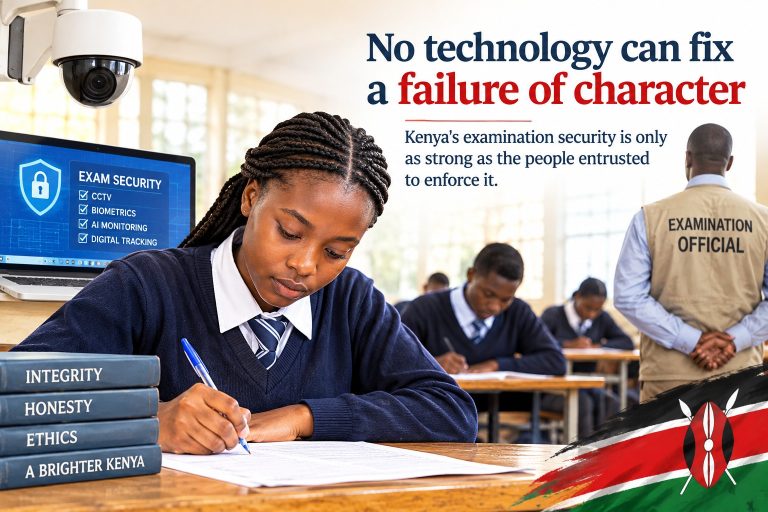
The Kenya National Examinations Council carries the primary responsibility for safeguarding examination integrity. Malpractice — leaked papers, impersonation, unauthorised assistance or attempts to circulate examination content — undermines the credibility of qualifications and punishes candidates who have prepared honestly. Every certificate awarded must represent genuine academic achievement rather than access to leaked materials, financial influence or dishonest assistance. Strong supervision, secure examination materials, clear reporting procedures and impartial investigations are essential to protecting the credibility of KCSE. These are not bureaucratic formalities; they are the foundations on which public trust in national qualifications rests.
Nevertheless, examination security must not be achieved through an atmosphere of fear and intimidation. Candidates deserve clear instructions, respectful treatment and confidence that rules will be applied consistently and fairly. School administrators, invigilators, supervisors and security officers must understand that their responsibility extends beyond preventing malpractice. They must also protect learners from unnecessary humiliation, discrimination and avoidable distress. A credible examination system is one in which discipline and fairness reinforce each other rather than compete.
Psychological pressure remains a serious and underappreciated concern. Across many households, KCSE is treated as a decisive judgment on a young person’s entire future. Students may fear disappointing their parents, losing opportunities or being compared unfavourably with their peers. Such expectations produce sleepless nights, heightened anxiety and reduced concentration, particularly among learners already navigating financial hardship, family difficulties or inadequate learning resources. While preparation and discipline are necessary, excessive pressure can actively undermine the very performance families hope to achieve.
Parents and guardians carry an important role in changing this culture. Encouragement, practical support and emotional reassurance help learners approach examinations with greater confidence. Parents should avoid threatening children with rejection or portraying poor results as the end of every opportunity. Teachers too should balance academic preparation with guidance on time management, revision techniques and emotional wellbeing. Schools should ensure counselling is available and that candidates understand clearly that an examination result, however important, does not determine their human worth or permanently close every door to future success.
The government must also confront the inequalities that shape examination performance long before a candidate enters the room. Candidates do not prepare under identical circumstances. Some attend well-equipped schools with laboratories, libraries, reliable electricity, sufficient textbooks and adequate teaching staff. Others study in overcrowded classrooms, face chronic shortages of learning materials or travel considerable distances simply to access education. Learners from financially disadvantaged households may lack quiet study spaces, nutritious meals or dependable access to digital learning resources. Expecting all students to compete under these conditions without addressing the underlying disparities risks confusing differences in opportunity with differences in ability.
Examination reforms must therefore be accompanied by sustained investment in public education. Adequate school funding, timely disbursement of capitation, teacher recruitment, improved infrastructure and reliable access to learning materials are essential to creating a fairer academic environment. The government must ensure that public schools can deliver the curriculum effectively rather than placing the burden of systemic shortcomings on teachers and learners. Examination integrity begins long before candidates enter the hall; it depends on whether schools have been adequately supported throughout the learning process.
Equally important is protecting candidates from disruptions that compromise preparation. Teacher shortages, prolonged industrial disputes, inadequate instructional materials and uncertainty over school finances interrupt learning and widen existing inequalities. Education stakeholders must prioritise constructive dialogue to resolve disputes before they damage learners’ academic progress. Teachers deserve fair working conditions and professional respect, while students deserve uninterrupted access to quality education. These interests are not contradictory; they are mutually dependent, and treating them as separate problems has repeatedly cost learners dearly.
Kenya must also reconsider its broader understanding of educational achievement. A single set of examination results cannot fully capture a student’s potential. The country needs graduates who communicate effectively, solve problems, use technology responsibly, demonstrate integrity and apply classroom knowledge to practical challenges. Technical and vocational education, entrepreneurship, professional training and other legitimate career pathways deserve the recognition they have long been denied. Students who do not achieve grades required for a particular university programme should be guided towards suitable alternatives rather than labelled failures and abandoned by a system that has not adequately served them.
As the 2026 examinations approach, transparency and accurate communication are critical. KNEC should ensure that schedules, regulations, reporting procedures and official announcements reach candidates through reliable channels. Students and parents must treat unverified social media claims about leaked papers, examination changes or guaranteed results with firm scepticism, and report suspicious activity through proper channels. Allegations of malpractice must be investigated fairly, with evidence guiding decisions rather than rumour or political pressure.
Ultimately, the credibility of KCSE cannot be measured by pass rates alone. It must be measured by the fairness of the process, the quality of preparation across all schools and the opportunities genuinely available after results are released. Kenya cannot claim to have an equitable education system if it demands excellent performance from learners while ignoring the unequal conditions under which they study and the unequal support they receive along the way.
The 2026 KCSE examinations should serve as a reminder that education is a shared national responsibility. The government must provide resources, KNEC must safeguard standards, teachers must support learning, parents must encourage their children and candidates must uphold honesty and discipline. Every learner deserves a fair opportunity to demonstrate their ability without intimidation, discrimination or preventable disadvantage. Examination results matter enormously. But fairness, integrity and equal opportunity matter just as much — and Kenya cannot claim to value its young people while ignoring the unequal ground on which they stand.
Similar Posts by The Mt Kenya Times:
- Bridging languages in tourism: A French-Uzbek perspective
- Amsons Group acquires Oryx Energies Tanzania business in a historic energy transaction
- Optimizing traffic flow at urban intersections and methods for reducing congestion
- Kenya as a global nation
- Hardship and peer pressure in universities
About the Author