The Mt Kenya Times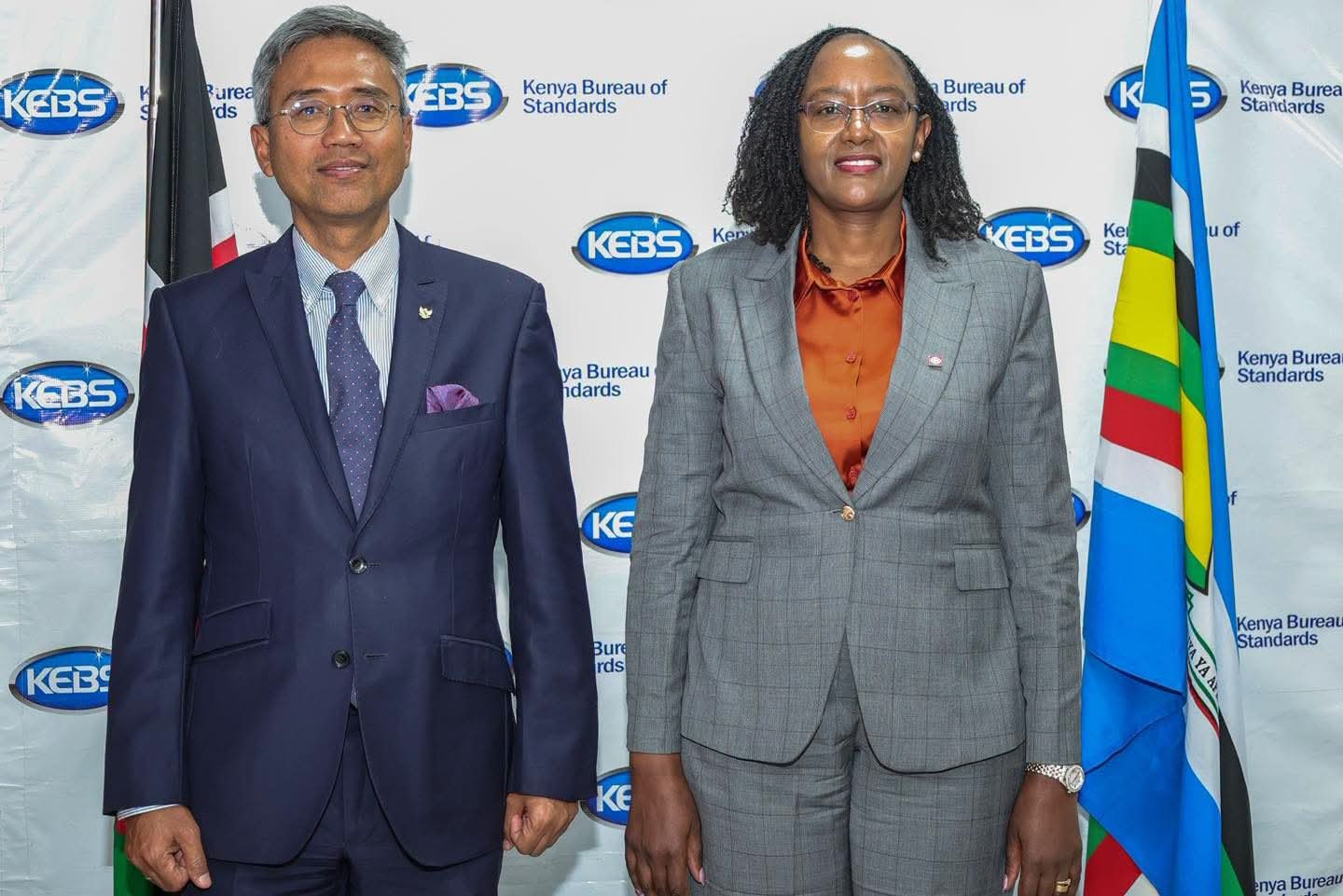
Kenya Bureau of Standards Managing Director Esther Ngari with Indonesian Ambassador Witjaksono Adji
The meeting signals Kenya’s push to deepen bilateral trade ties through mutual recognition of quality frameworks.
By John Kariuki
Kenya Bureau of Standards Managing Director Esther Ngari yesterday hosted Indonesian Ambassador Witjaksono Adji for talks centred on expanding trade cooperation between the two countries, with standards harmonisation and consumer protection at the heart of the discussions.
The courtesy call at KEBS headquarters in Nairobi covered practical frameworks for facilitating trade between Kenya and Indonesia while ensuring that quality assurance systems on both sides meet internationally recognised benchmarks. The two sides explored areas of potential collaboration in conformity assessment, standards recognition, and regulatory alignment — technical but consequential matters that determine whether goods move freely across borders or face rejection on arrival.
Ngari, who has led KEBS since her appointment, has increasingly positioned the bureau as an active participant in Kenya’s trade diplomacy rather than a purely regulatory body. Under her direction, KEBS has pursued bilateral engagements with trading partners as a deliberate strategy to expand market access for Kenyan manufacturers, whose exports depend on the credibility of the standards frameworks governing them.
“Standards are not barriers to trade,” Ngari has said on previous occasions. “When intelligently developed and mutually recognised, they become powerful enablers of trade.” That philosophy has shaped KEBS’s approach to international engagement, where technical discussions on quality assurance are framed within the broader context of economic competitiveness and industrial growth.
The Indonesian engagement is part of a wider pattern. Kenya and Indonesia share membership in international standards bodies, and both countries have expressed interest in expanding trade beyond their current levels. Indonesia is one of Southeast Asia’s largest economies, with significant manufacturing capacity in sectors including processed foods, pharmaceuticals, textiles, and consumer goods — all areas where standards compatibility directly affects the ease and volume of trade.
For Kenyan exporters, the significance is practical. Access to Indonesian markets — and, by extension, to broader Association of Southeast Asian Nations trading networks — depends in part on whether Kenya’s standards regime is recognised as credible and compatible by importing countries. Equally, the growing volume of Indonesian goods entering the Kenyan market places pressure on KEBS to ensure that imported products meet domestic consumer protection requirements.
Consumer confidence sits at the intersection of both concerns. A functioning trade relationship requires not only that producers can export but that consumers on both ends trust what they are buying. Regulatory bodies like KEBS carry the institutional weight of that trust — an unglamorous responsibility that nonetheless underpins billions of shillings in commercial activity annually.
Ngari’s approach to this responsibility has been notably methodical. Rather than high-profile announcements, her tenure has been characterised by institutional engagement — building relationships with counterpart bodies in other countries, tightening surveillance of imported goods, and advancing Kenya’s participation in international standards-setting forums. The Indonesia meeting fits squarely within that pattern.
The visit also reflects a broader diplomatic trend in which technical regulatory agencies are playing increasingly visible roles in bilateral economic relations. As trade agreements become more sophisticated and non-tariff barriers more consequential, institutions like KEBS find themselves at the negotiating table alongside trade ministries and diplomatic missions. The line between technical regulation and economic diplomacy has, in that sense, grown considerably thinner.
For Kenyan industry, the practical outcome of such engagements matters more than their symbolism. Manufacturers seeking to export to Indonesia need to know whether their certifications will be recognised, what conformity assessment procedures apply, and whether mutual recognition arrangements are on the horizon. Those answers will emerge from the working-level discussions that follow diplomatic engagements of this kind.
Whether yesterday’s meeting produces a formal cooperation agreement, a memorandum of understanding, or simply a clearer shared understanding of each country’s standards architecture remains to be seen. What is clear is that KEBS under Ngari’s leadership regards such engagements as essential institutional work — unglamorous, technical, and entirely necessary for the trading relationships Kenya needs to grow.
Similar Posts by The Mt Kenya Times:
- Media warns: Information gaps fuel 2027 disinformation risk
- Gachagua’s DCP holds strategic NEC meeting ahead of 2027 polls
- Sifuna’s unending party ownership hurdles
- From leading within to changing the world: The Fredah Mainah story
- Kagwe launches nationwide soil testing drive to guide fertiliser use
About the Author