Dan
Dan 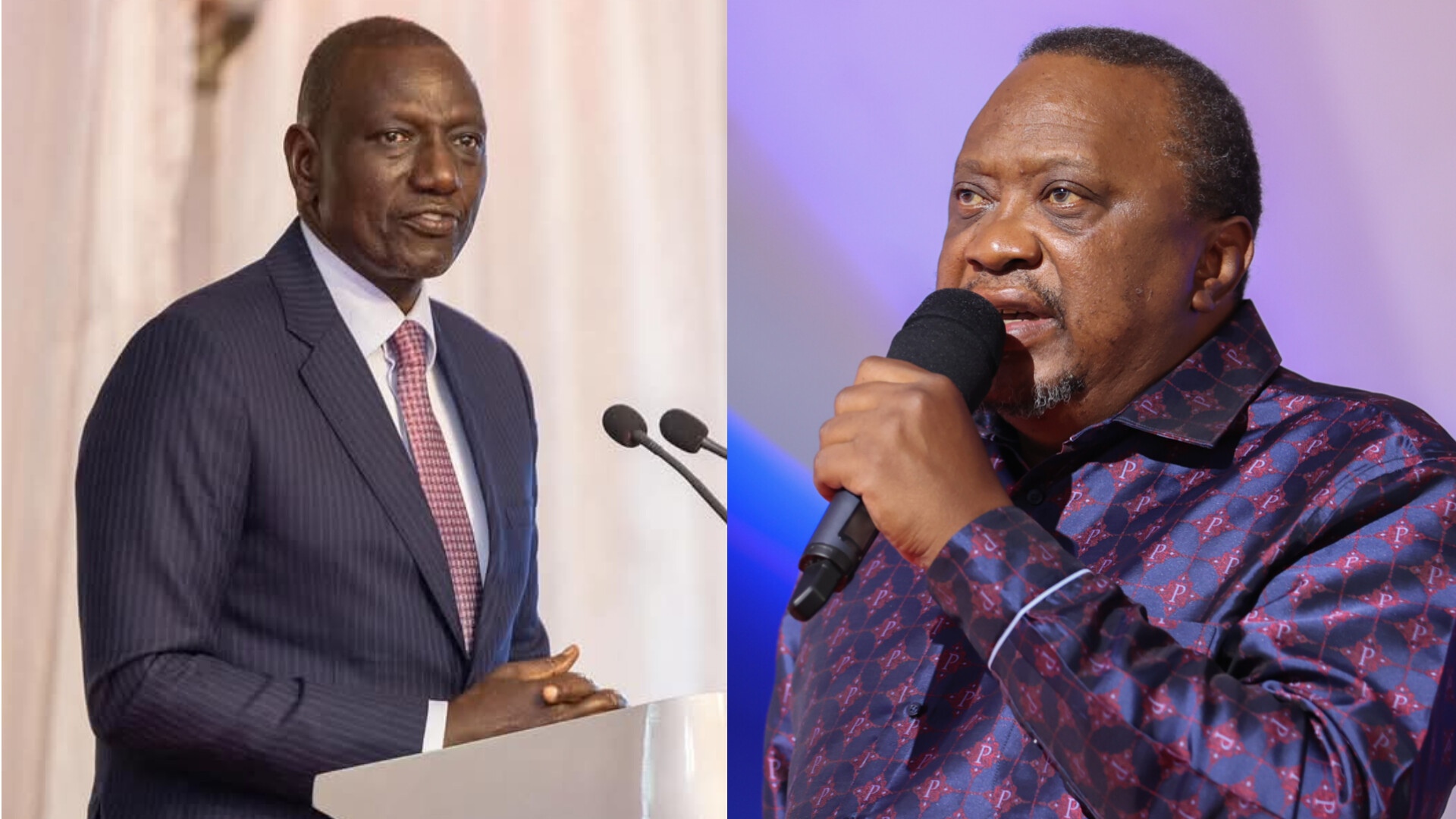
A photo collage of President William Ruto and his predecessor, Uhuru Kenyatta. Photo/Courtesy

With fourteen months to polling day, a bitter falling-out between two former allies is reshaping the battle for State House.
By Dan Mwangi
President William Ruto yesterday publicly accused former President Uhuru Kenyatta of financing the opposition Linda Mwananchi movement, sharpening a political confrontation between two once-inseparable allies that now defines the contours of Kenya’s most consequential electoral contest in a generation.
Speaking to residents in Eldoret, Uasin Gishu County, Ruto did not name Kenyatta directly but left no ambiguity about his target. He described the opposition’s financial backer as a man who had failed to deliver affordable housing, universal health coverage, and free education during his own ten-year presidency, and who had now dispatched surrogates to destabilise a successor who was delivering what he could not. The language was blunt, the setting deliberate — Eldoret is Ruto’s political heartland, and the crowd was his most loyal.
“Every leader is judged by the work they have done,” Ruto said, in remarks translated from Swahili. “Nobody will come and deceive us with slogans — ‘one term’, ‘must go’ — and then we hand them power. That is foolishness.” He went on to dismiss the opposition as a movement without policy, agenda, or ideas, promising to deal with them decisively. “Those people — I will wash them early in the morning,” he said, in a phrase that carried the contemptuous confidence of a politician who believes he controls the political weather.
Whether that confidence is warranted is the central question hanging over Kenya as it enters the final fourteen months before the August 2027 general election.
The Ruto-Kenyatta rupture is by now well-documented, but its consequences continue to reshape the political landscape in ways that were not fully anticipated when the two men parted ways after the 2022 election. Kenyatta, who endorsed Raila Odinga against his own deputy in that contest and lost, has since retreated from public political life — but not, his critics insist, from political financing. A section of Kenya Kwanza leaders has spent weeks alleging that Kenyatta is the invisible hand behind the Linda Mwananchi movement, the opposition vehicle through which Nairobi Senator Edwin Sifuna is building a presidential platform ahead of 2027.
Senate Majority Leader Aaron Cheruiyot was the most explicit. Speaking at an empowerment event in Taita Taveta County on 24 July, he described Linda Mwananchi as a collection of criminals being bankrolled by “that retired gentleman” to soil the president’s name. The language was deliberately provocative — the kind deployed not to inform but to define, placing the opposition outside the bounds of legitimate political competition before the campaign has formally begun.
Sifuna denied it flatly. “He does not provide financial assistance, maybe just encouraging us,” the senator said in a Citizen TV interview on 28 July, referring to Kenyatta. “When he speaks, and he does it in public, he says young people need to be encouraged to take leadership.” It was a careful formulation — acknowledging the relationship, minimising its content, and framing Kenyatta’s involvement in the most anodyne terms available.
The truth, as is almost always the case in Kenyan politics, is likely more layered than either side is willing to concede publicly. What is clear is that Kenyatta’s shadow falls heavily across the opposition’s calculations, whether or not his fingerprints are on any cheque. His endorsement — implicit or explicit — carries weight in vote-rich Central Kenya, a region that delivered for Ruto in 2022 but whose loyalty the president cannot afford to take for granted as economic pressures mount. If Kenyatta is seen to be actively working against Ruto, the political mathematics in the Mount Kenya region become considerably more complicated.
That is the subtext beneath Ruto’s Eldoret remarks. The president is not simply responding to opposition taunts. He is attempting to delegitimise Kenyatta’s political re-entry before it gains momentum — to define the former president as a sore loser operating through proxies rather than as a statesman whose concerns about governance deserve a hearing. It is a strategy that carries risk. Attacking a predecessor with the stature Kenyatta still commands in certain quarters can elevate rather than diminish the target.
For Sifuna and the Linda Mwananchi movement, the government’s attention is, paradoxically, the best thing that could have happened. A crowdfunding campaign that raised KSh6.5 million from thousands of ordinary Kenyans in its opening days generated the kind of organic political energy that money alone cannot manufacture. When Cheruiyot responded by calling the movement’s supporters criminals, he handed Sifuna a narrative gift — the image of an establishment rattled by a citizen-funded challenge to its authority. Opposition movements throughout Kenya’s democratic history have drawn sustenance from exactly this kind of overreach.
The broader political environment into which all of this is projected is one of genuine economic anxiety. Transport costs rose 15.6 percent year-on-year in July. Food inflation sits at nine percent. Housing levy and social health insurance deductions have reduced take-home pay for formal sector workers in ways felt at kitchen tables across the country. Ruto’s administration points to construction sites, affordable housing units, and youth employment programmes as evidence of delivery. The opposition points to the same statistics and argues that the president’s agenda has been paid for by the people least able to afford it.
Both narratives contain truth. That is what makes the next fourteen months so genuinely uncertain. Kenya has historically rewarded incumbents who can demonstrate tangible development, but it has also punished presidents whose economic stewardship is seen to have failed. Ruto occupies both possibilities simultaneously, and the outcome will depend significantly on which story voters choose to believe by August 2027.
What is already beyond doubt is that this election will be fought with an intensity that reflects the personal stakes involved for every major actor. For Ruto, it is about vindication — proof that his presidency delivered and that his enemies could not stop him. For Kenyatta, whatever role he ultimately plays, it is about legacy and perhaps a measure of settling scores. For Sifuna and the opposition, it is about whether a movement built on small contributions and large ambitions can translate energy into votes at the constituency level where elections are actually won and lost.
Kenya’s elections have a long history of being decided by factors that emerge only in the final weeks. But the battle lines are already drawn, the financing is already being contested, and the personal animosities are already too deep for polite accommodation.
The campaign, in every meaningful sense, has already begun.
Similar Posts by Dan:
- Ndindi Nyoro pulls a Kibaki stunt: The mountain stirs again as 2027 looms
- Ruto’s reckoning: Gachagua puts four years on trial
- Mudavadi tells Sifuna: Dreaming about it won’t make you president
- Kalonzo builds a national outlook: Can Wiper’s mountain-to-coast gamble rewrite Kenya’s political map?
- Two visions, one region, one race against time
About the Author

 The Mt Kenya Times