Dan
Dan 
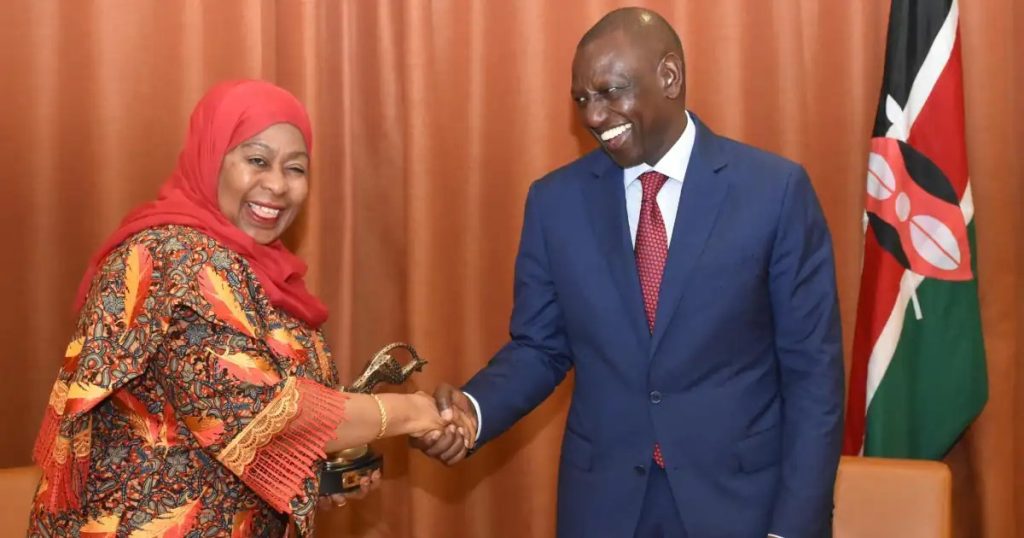
President William Ruto and Tanzanian President Samia Suluhu Hassan

As Ruto dares the opposition to face him at the ballot and Tanzania rolls out its own generational blueprint, East Africa’s two largest economies are betting their futures on the politics of long-term planning — with starkly different odds
By Dan Mwangi
President William Ruto yesterday challenged opposition leaders to face him at the ballot in 2027 rather than reject his proposed national development charter, as he hosted Muslim religious leaders from all 47 counties at State House, Nairobi, widening the political fault lines over a plan that will formally launch next Wednesday — the same week Kenya’s southern neighbour, Tanzania, activated the implementation machinery for its own generational blueprint.
The convergence is striking. On one side of the border, Tanzanian President Samia Suluhu Hassan launched the implementation, monitoring and acceleration tools for the National Development Vision 2050 at State House in Dar es Salaam, fulfilling a directive she issued when the strategy was officially unveiled on July 17, 2025, in Dodoma, outlining Tanzania’s goal of becoming a high-income, inclusive and resilient nation by 2050. On the other side, Ruto announced that Kenya will formally launch a National Conversation on its Future Beyond Vision 2030 on Wednesday, August 12, 2026, describing it as the most consequential exercise in national reflection and public participation since the promulgation of the Constitution in 2010.
Two presidents. Two long-range development blueprints. Two nations in the same regional bloc, both racing to define what their economies will look like a generation from now — and both navigating the same treacherous gap between vision and delivery.
In Nairobi, Ruto used the gathering of Muslim clerics to sharpen his political messaging around the dialogue. Speaking in Kiswahili, he argued that the charter was designed to give citizens an ownership stake in Kenya’s long-term future. “We must come together to deliberate on national development through what we call public participation,” he said. He then turned his fire on the United Opposition, accusing its leaders of rejecting the proposed development charter not out of principled objection but naked political calculation. “They oppose the development charter — they have no interest in development. The development they want is to seize power and divide Kenyans,” Ruto said. He went further still, dismissing the opposition’s policy credentials entirely. “They have no agenda. Their work is to go around dividing Kenyans on ethnic and hatred lines,” he added.
The dare to face him at the ballot was equally combative. “They think winning an election is about chanting ‘One Term’ — I am watching them carefully. All they have is empty noise,” Ruto said.
The opposition’s response confirmed just how fiercely contested this terrain has become. Wiper leader Kalonzo Musyoka, speaking in Yatta, Machakos County, dismissed Ruto’s push for a new development charter as pointless propaganda, saying: “It’s daylight propaganda — nothing substantial will come out of it. Kenyans are not fools.” Former Deputy President Rigathi Gachagua dismissed the planned national conversation as wishful thinking, saying: “How can the same person in power who failed to deliver his promises to Kenyans now purport to deliver?” Jubilee Deputy Party Leader Fred Matiang’i was equally blunt: “President William Ruto’s proposal to launch a national conversation on Kenya’s development post-Vision 2030 is a clear case of misplaced priorities — this is only meant to divert our attention from Ruto’s gross violations of the Constitution and leadership failures.”
The government’s response came from Deputy President Kithure Kindiki, who challenged the opposition to present its own long-term development blueprint instead of dismissing the government’s proposed agenda, saying national planning should rise above partisan politics.
Health Cabinet Secretary Aden Duale, speaking at the State House gathering, thanked Ruto for what he described as equitable development across all religious communities. “We are very grateful because you do not discriminate against the Islamic faith through development,” Duale said. Prime Cabinet Secretary Musalia Mudavadi reinforced the message of inclusivity. “The important thing is that all Kenyans are served equally,” he said.
But the question that neither the government’s enthusiasm nor the opposition’s derision fully addresses is this: what exactly is being proposed, and does Kenya have the institutional machinery to deliver it?
Ruto is advocating for a new plan to take Kenya forward beyond Vision 2030, a long-term national development plan launched in 2008 by President Mwai Kibaki, which aimed to turn Kenya into a newly industrialised, middle-income country. Nearly two decades later, Ruto wants to build on that foundation by replacing a government-owned planning framework with a constitution-anchored National Development Charter that he says will belong to Kenyans and endure beyond administrations. The intellectual scaffolding has been provided by an expert panel that includes Japanese political scientist Hiroyuki Hino, Kisumu Governor Anyang’ Nyong’o and three University of Nairobi academics — Michael Chege, Karuti Kanyinga and Peter Wanyande. Nyong’o has described the process as “the first steps towards the preparation of the plan of the transition to the first world.”
Compare that with Tanzania’s approach and the contrasts are instructive. Vision 2050 was developed through a nationwide consultation process that began in April 2023, with more than 1.17 million Tanzanians contributing ideas before Parliament endorsed the final document in June 2025. The blueprint targets a GDP of one trillion US dollars and a per capita income of seven thousand dollars by 2050, up from approximately one thousand and eighty dollars in 2020. Implementation has already begun: ministries and public institutions began aligning their programmes on July 1, 2026, through the Fourth Five-Year National Development Plan. For the financial year 2026/2027 alone, Tanzania estimates development financing needs of TZS 86.3 trillion, with the private sector expected to contribute approximately 70 per cent.
Tanzania’s blueprint is already in execution. Kenya’s conversation has not yet begun. That gap — between a neighbour rolling out implementation tools and a country still debating whether to talk — is the uncomfortable backdrop against which Ruto’s August 12 launch must be read.
There is also the question of political legitimacy. Commentary from analysts notes that Ruto consulted his predecessor Uhuru Kenyatta and former opposition leader Raila Odinga in developing the charter concept, but appeared to bypass present-day opposition leaders such as Kalonzo Musyoka, Matiang’i and Gachagua — an oversight, or deliberate snub, that helps explain the outright rejection from the opposition side. A development charter that cannot command cross-party buy-in risks becoming exactly what its critics say it already is: a re-election platform dressed in the language of generational planning.
The United Opposition, meanwhile, faces its own credibility problem. It has been months past its self-imposed deadline for unveiling a presidential flagbearer, with no announcement imminent despite vows of unity. A coalition that cannot agree on its own candidate is poorly positioned to offer a coherent counter-narrative to Ruto’s development agenda — however valid their specific critiques of it may be.
The deeper question — one that neither government nor opposition appears eager to confront — is whether either side has truly grappled with the structural reforms that long-term economic transformation requires. Tanzania’s Vision 2050 is ambitious, but analysts note that the country must sustain growth rates, institutional reforms and private sector confidence over a quarter century to make good on its targets. Kenya’s track record on Vision 2030 was mixed: real progress in infrastructure and the financial sector, but persistent deficits in manufacturing, inequality and governance.
What East Africa’s two biggest economies share is the recognition that the development horizons of five-year electoral cycles are not equal to the scale of the challenge. Both Ruto and Samia are reaching for frameworks that outlast their own administrations. Both are betting that the discipline of long-term planning can override the short-termism of politics.
Whether they are right is a question that history, not the next election, will answer.
For now, as Nairobi prepares for August 12 and Dar es Salaam moves from vision to implementation, one thing is clear: the race to define East Africa’s future has begun, and the starting positions could not be more different.
Similar Posts by Dan:
- Ndindi Nyoro pulls a Kibaki stunt: The mountain stirs again as 2027 looms
- Ruto vs Uhuru: The war Kenya never saw coming
- Ruto’s reckoning: Gachagua puts four years on trial
- Mudavadi tells Sifuna: Dreaming about it won’t make you president
- Kalonzo builds a national outlook: Can Wiper’s mountain-to-coast gamble rewrite Kenya’s political map?
About the Author


 The Mt Kenya Times