Mwaura hands over government spokesperson’s office after 33 months
 The Mt Kenya Times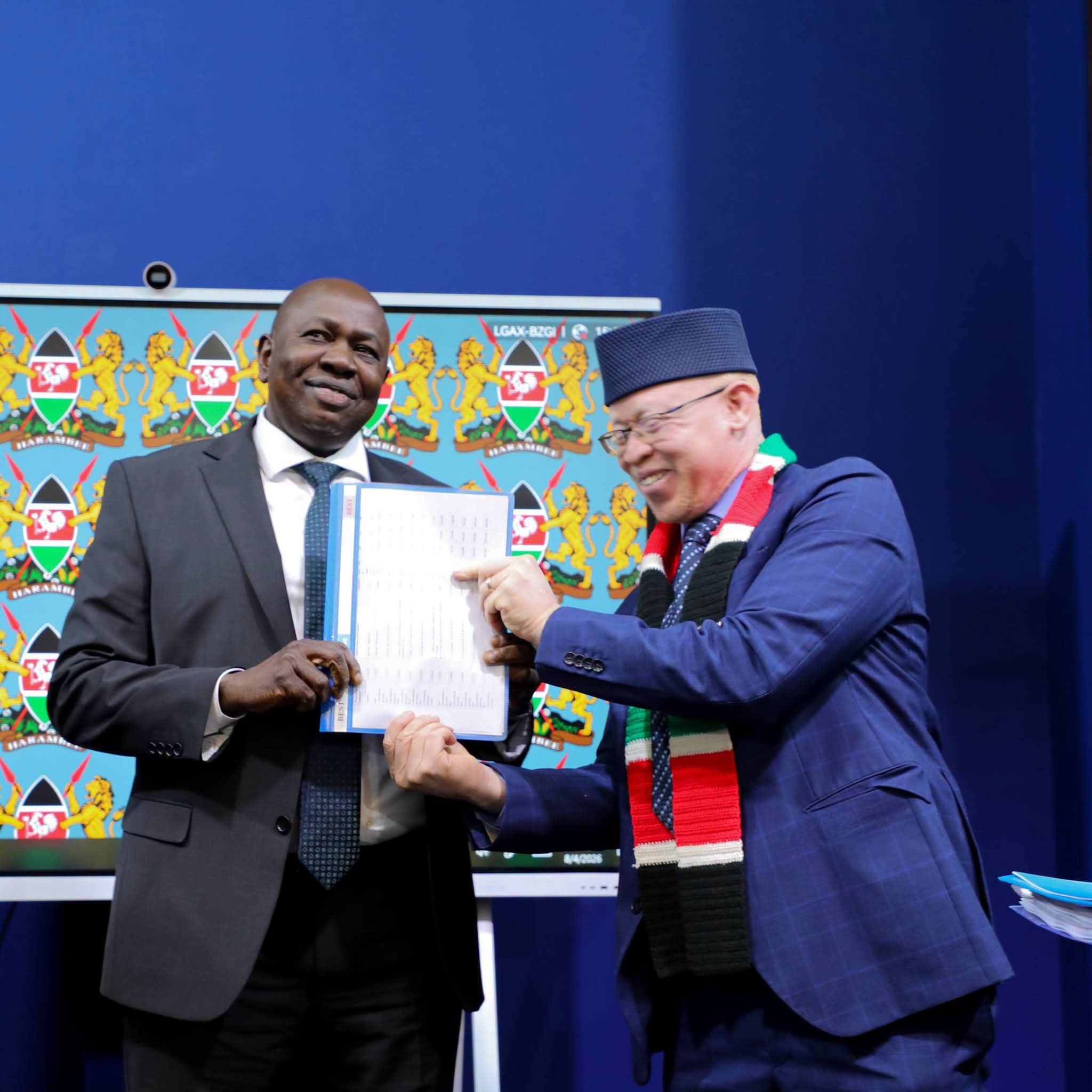
Isaac Mwaura hands over government spokesperson's office to Charles Owino
Outgoing spokesman transfers institutional documents and performance records to successor Charles Owino at Harambee Annex
By John Kariuki
Former Government Spokesperson Isaac Mwaura yesterday formally handed over the Office of the Government Spokesperson to his successor, Charles Owino, after 33 months and 17 days in the role, saying he was leaving behind an institution transformed from a one-person operation into a multidisciplinary communications body.
The ceremony was held at the Government Spokesperson’s Media Centre at Harambee Annex, where Mwaura transferred a comprehensive set of institutional documents — among them a handover report, strategic plan, organisational and staffing framework, operational structure, work plan, procurement plan, standard operating procedures, guiding policy, prospectus, product catalogue and a two-year performance scorecard. The breadth of the documentation was deliberate. Mwaura said the records were designed to preserve institutional memory, strengthen governance and accountability, and ensure that the transition of leadership did not mean the loss of institutional momentum.
“The greatest legacy a leader can leave is not the office they occupy, but the systems they build, the people they empower and the vision they leave behind,” he said.
The numbers Mwaura presented in support of that claim were substantial. During the 2025/26 financial year, the Office reported achieving 150 per cent of its annual target for press statements and media releases, 150 per cent for regional media forums, 187.5 per cent for radio dissemination and 162.5 per cent for television dissemination. Performance in other areas was even more pronounced — 237.5 per cent for inclusive communication and Uzalendo initiatives, 225 per cent for strategic communication narratives and 279.2 per cent for print media publications.
Over the course of his tenure, the Office produced 276 GOK Today headlines, 83 one-minute GOK Today videos, 254 weekly press briefings and media releases, 180 newspaper articles and opinion pieces, 175 radio programmes and 121 television programmes. It also generated 32 episodes of the Sema na Spox Bonga Na Gava podcast, 20 documentaries, 2,512 short videos, 1,280 reels, 844 GAVA Quotes, 120 live streams, 56 weekly bulletins, more than 700 sponsored hashtags, 180 weekly narratives, over 12,000 photographs and 209 GODANEB features, among other communication products.
Mwaura attributed the scale of the output to the dedication of staff, strategic partners, the media fraternity and the support of Kenyans, saying their collective effort had turned the office into a modern, technology-driven and citizen-centred institution. When he took charge, the spokesperson’s function was essentially a single-desk operation. By the time he left, it had grown to 80 officers, including interns, and was organised into six functional departments.
The transformation is not merely a matter of headcount. What Mwaura appeared most determined to leave behind was a documented, replicable way of doing things — a set of systems that could survive a change in leadership and continue functioning regardless of who sat at the top. That instinct, to institutionalise rather than simply perform, is rarer in government than it should be and arguably more valuable than any single communication product the office produced.
Mwaura is moving to his new role as Head of the Office of Diversity, Inclusion and Disability Rights, a position he said he approaches with the same commitment to building lasting structures. He expressed gratitude to President William Ruto for the confidence placed in him throughout his tenure and wished Owino well as he takes on one of the more demanding communication roles in the public service.
“I leave knowing that the Office is stronger, more innovative, more resilient and better prepared for the future than ever before,” Mwaura said. “Leadership may change, but institutions endure. Systems remain. Service continues.”
For Owino, the handover represents both an inheritance and a challenge — a well-documented institution with high performance benchmarks already on the record, and a public that has come to expect a certain pace and quality of government communication. The foundation is there. What he builds on it is now entirely his own.
Similar Posts by The Mt Kenya Times:
- Diaspora Times Global Sep 19 – Sep 25, 2026
- Tibet’s glacial catastrophe: Behind Beijing’s wall of silence, a climate disaster reshapes a region
- Museveni says Uganda overpaid for fuel through Kenyan middlemen as new terminal breaks ground
- Court orders throw KPL season kickoff into doubt
- Can Kenyans abroad become the untapped force that transforms Kenya?
About the Author