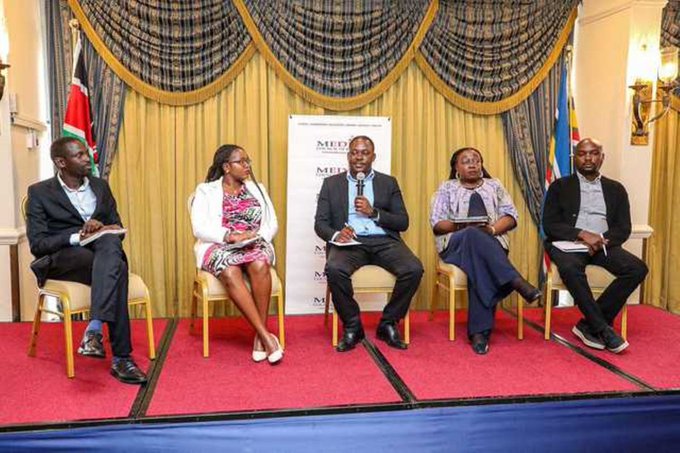
Nyandarua Senator John Methu and other DCP members during a press briefing
The DCP offensive is no longer about Gachagua alone — it is a structured, evidence-based assault on four years of Kenya Kwanza governance.
By David Kimani
Nyandarua Senator John Methu yesterday threw down a direct challenge to the Kenya Kwanza administration, demanding a comprehensive public account of President William Ruto’s four-year record and dismissing government responses to the Democracy for the Citizens Party’s accountability offensive as evasive and substanceless.
The challenge came a day after DCP leader and former Deputy President Rigathi Gachagua issued what the party described as a comprehensive audit of the Ruto administration’s performance since 2022 — a document that ranged across the cost of living, taxation, public debt, healthcare, education, insecurity, and human rights. Methu, speaking with the precision of a legislator building a legal case rather than a politician trading insults, told the government to produce a detailed rebuttal or concede the argument.
“Why can’t you prepare a comprehensive rebuttal on the four-year performance of Gachagua?” he asked. “Provide evidence.”
It was a deceptively simple demand, but its implications were substantial. By framing the DCP’s challenge as a factual audit rather than a political attack, Methu was attempting to shift the terms of the debate — away from the government’s preferred ground of questioning Gachagua’s credibility as a critic, and onto the harder terrain of documented delivery against specific promises. Every government prefers to fight elections on its own narrative. The DCP is trying to ensure that does not happen.
The questions Methu posed were not rhetorical flourishes. They were a structured inventory of the promises on which Ruto won the 2022 election — and the gap, as the opposition sees it, between what was pledged and what has been delivered. Are Kenyans better off on the cost of living than they were in 2022? Has taxation on income increased or decreased? How much public debt did Ruto inherit, and how much has been added since? Are universities, schools, students, and parents experiencing less financial pressure than before? Is the Social Health Authority delivering better and more affordable healthcare than the system it replaced?
Each question was calibrated to land where the government is most vulnerable. The cost of living remains the defining anxiety of most Kenyan households. Transport costs rose 15.6 percent year-on-year in July. Food inflation sits at nine percent. The introduction of the housing levy and social health insurance deductions reduced take-home pay for formal sector workers at precisely the moment when household budgets were already under strain. The government’s response — that these are investments in long-term structural change — is an argument that resonates less urgently when families are calculating whether they can afford school fees at the end of the month.
Methu reserved particular scorn for the government’s use of soft drink consumption as a proxy for economic wellbeing. “You are telling us more Kenyans are taking soda and therefore the economy is good,” he said. “It must be felt in people’s pockets. Don’t just tell Kenyans the economy has grown. Are Kenyans saving more? Are businesses making profits? Are young people finding jobs?” He added, with a sharpness that drew laughter, that the rise in soda consumption was attributable to State House itself. “The consumption of soda has increased because of its consumption in State House. That is what President William Ruto feeds his delegation.”
The joke landed, but the serious point beneath it was not lost. Economic indicators that do not translate into lived household improvement are politically useless to an administration seeking re-election. Gross domestic product figures and foreign investment announcements do not vote. People do — and they vote on whether their lives feel materially better than they did four years ago.
On healthcare, Methu pressed a wound that has been open since July. “Is William Ruto aware nurses are on strike?” he asked. “They have been on strike since July 2026.” The nurses’ industrial action has paralysed services at public health facilities across the country, exposing the gap between the government’s flagship SHA programme — sold as a transformative improvement on the National Hospital Insurance Fund — and the grinding realities of an underfunded, understaffed public health system. That a senator needs to ask publicly whether the president is aware of a strike entering its second month says something about the disconnect between State House communication and ground-level governance.
Methu also renewed the DCP’s demand for accountability over the January attack at St Peter’s ACK Church in Witima, Othaya, where a service attended by Gachagua was disrupted after tear gas was fired and violence broke out outside the building. Police stated in February that investigations were ongoing. No arrests have been made. “Why haven’t the attackers of Witima Church been arrested?” Methu asked. The opposition has announced plans to pursue private prosecution against 12 police officers and two members of parliament over the incident — a legal escalation that signals the DCP’s intention to keep the matter alive as a political liability for the government into the election period.
The government’s standard defence against Gachagua’s criticism — that he spent four years as deputy president and therefore bears co-responsibility for every failure he now decries — is one that Methu directly anticipated and dismissed. “Yes, Gachagua was inside government but it does not invalidate what he is saying,” he argued. “If a former DP tells the people of Kenya that certain things are happening, is what he is saying true or false?” It is, as a matter of logic, a fair point. The messenger’s past does not determine the accuracy of the message. Whether it will be persuasive to voters who remember Gachagua’s own role in the administration he now attacks is a different question — and one that will be answered only at the ballot box.
What Methu’s intervention makes clear is that the DCP’s electoral strategy is not built on Gachagua’s personality alone. It is built on accountability — the methodical accumulation of unanswered questions, unmet promises, and uninvestigated incidents that the party intends to lay before Kenyan voters between now and August 2027. The approach carries genuine risk. Accountability politics requires discipline, consistency, and the patience to keep repeating uncomfortable truths long after the news cycle has moved on. It also requires that the party’s own record withstand the scrutiny it is applying to others.
But if the government cannot produce the comprehensive rebuttal Methu has demanded — evidence-based, promise-by-promise, number-by-number — then the silence itself will become the answer.
And in an election year, silence is never neutral.
Similar Posts by The Mt Kenya Times:
- Mt Kenya Times ePAPER September 30, 2026
- Ruto mocks UNGA critics: “That requires someone with sense”
- Media warns: Information gaps fuel 2027 disinformation risk
- Gachagua’s DCP holds strategic NEC meeting ahead of 2027 polls
- Sifuna’s unending party ownership hurdles
About the Author