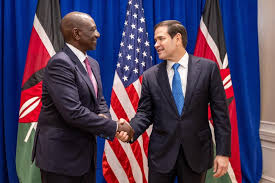
President William Ruto with US Secretary of State Marco Rubio.
By David Kimani
Kenya’s President William Ruto this week became the latest African leader drawn into Washington’s orbit, after U.S. Secretary of State Marco Rubio publicly thanked him for condemning Iran’s missile strikes against Gulf States. The exchange, framed as a gesture of solidarity, has reignited debate over how Western powers enlist African leaders as proxies to validate their foreign policy positions—often at the expense of Africa’s own diplomatic balance.
Rubio, speaking after talks with Ruto in Nairobi, declared: “We deeply appreciate Kenya’s strong voice in condemning Iranian aggression. President Ruto’s leadership reinforces the values we share in defending peace and security.” The U.S. communiqué also praised Kenya’s role in Haiti, where Nairobi has committed forces to support the transition to a Gang Suppression Force.
Yet critics argue this is precisely the problem: African leaders are too often positioned as proxies for Western agendas. Professor James Mwangi of the University of Nairobi observed: “Kenya’s foreign policy risks being reduced to echoing Washington’s talking points. Neutrality has long been our strength, but that is being eroded.”
Trump’s shrinking coalition
The timing is telling. President Donald Trump, now in his second term, has been seeking global backing for his hardline stance against Iran. But his support base is shrinking. Japan, once a reliable ally, has voiced unease over Washington’s unilateral military operations.
During her meeting with Trump at the White House on March 19, 2026, Prime Minister Sanae Takaichi said: “Japan values stability in the Gulf, but we urge restraint and multilateral solutions. Escalation serves no one.”
Her remarks came amid tense exchanges, including Trump’s controversial reference to Pearl Harbor when defending his decision not to inform allies about surprise strikes on Iran. The awkward moment underscored the widening gap between Washington and Tokyo.
European capitals remain divided, with France and Germany pressing for diplomacy, while Britain cautiously aligns with Washington. Analysts say this leaves the U.S. increasingly reliant on symbolic endorsements from leaders in Africa and Latin America.
Dr. Amina Hassan, a regional security analyst, explained: “Kenya’s economy is intertwined with Gulf markets. Taking sides in Middle Eastern conflicts could jeopardize trade, remittances, and diplomatic goodwill. The government must weigh short-term praise against long-term costs.”
Domestic backlash in Kenya
At home, Ruto’s condemnation of Iran has triggered unease. Opposition figures accused him of “outsourcing Kenya’s voice” to Western powers. Civil society groups warned that aligning too closely with U.S.–Israel operations risks inflaming tensions with Arab partners, many of whom are vital trading allies.
The Kenya National Chamber of Commerce has also raised concerns. Its chairperson, Peter Muthoni, said: “Our exports to the Gulf are significant. We cannot afford to jeopardize these markets by appearing partisan in conflicts that do not directly involve us.”
This domestic backlash illustrates the delicate balance Kenya must strike. On one hand, the country values its strategic partnership with Washington, which brings aid, investment, and military cooperation. On the other, Kenya’s economic lifelines—trade with Gulf nations, remittances from diaspora workers, and regional diplomacy—depend on maintaining neutrality.
Africa’s diplomatic crossroads
The broader question is whether African states will continue to serve as proxies in Western geopolitical struggles. With rising economic ties to China, India, and the Gulf, Africa’s leverage is growing. Yet the temptation of Western aid, military support, and diplomatic recognition often pulls leaders into positions that compromise neutrality.
Dr. Hassan added: “Africa must redefine its role. We are no longer passive players. Our economies and populations give us weight. But if we continue to act as proxies, we undermine our own sovereignty.”
This crossroads is particularly stark for Kenya. As a regional hub, Nairobi’s voice carries weight in African diplomacy. Yet each time it aligns too closely with Washington, it risks alienating partners in the Arab world and Africa itself.
Trump’s credibility gap
For Trump, the erosion of support from traditional allies like Japan is a warning sign. Without broad international backing, his administration risks isolation. The reliance on endorsements from African leaders may provide short-term optics but cannot substitute for genuine global consensus.
Political analyst Michael Ochieng argued: “Trump’s strategy of seeking validation from African leaders is a stopgap. It creates headlines but not substance. Global powers like Japan and Germany matter far more in shaping international legitimacy.”
The credibility gap is widening. Trump’s insistence on framing Iran as the singular threat has alienated partners who prefer multilateral dialogue. The United Nations has repeatedly called for restraint, with Secretary-General António Guterres stating: “Escalation in the Gulf endangers global stability. Dialogue, not confrontation, must guide our response.”
The optics of proxy politics
The optics of Ruto’s stance illustrate a wider pattern: Western powers leveraging African voices to legitimize their positions. This dynamic is not new. During the Cold War, African states were courted to endorse superpower narratives. Today, the script remains familiar—only the actors have changed.
Kenya’s challenge is to navigate this terrain without losing its diplomatic identity. As Professor Mwangi noted: “We must ask whether our statements serve Kenya’s interests or merely validate Washington’s battles. Foreign policy should be about sovereignty, not subservience.”
The road ahead
As the dust settles on Ruto’s remarks, one truth emerges: Africa’s leaders must resist being cast as proxies in Western dramas. Kenya’s voice should reflect its own interests, not merely amplify Washington’s. And for Trump, the fading applause from Tokyo and beyond signals a sobering reality—global support cannot be commanded; it must be earned.
The world is watching, and the stage is shifting. Africa must speak for itself, and America must learn that validation abroad is no substitute for credibility at home.
Similar Posts by The Mt Kenya Times:
- Not every struggling student is lazy
- Laikipia University: A natural haven for learning
- Why you should not milk a Kenyan buffalo
- Beyond the scars: The grief, fear and hope of living after breast cancer
- Obaga Momanyi hosts free medical camp for Persons with Disabilities in Bonchari
About the Author