Kenya can make its own medicine — But can it make healthcare reliable?
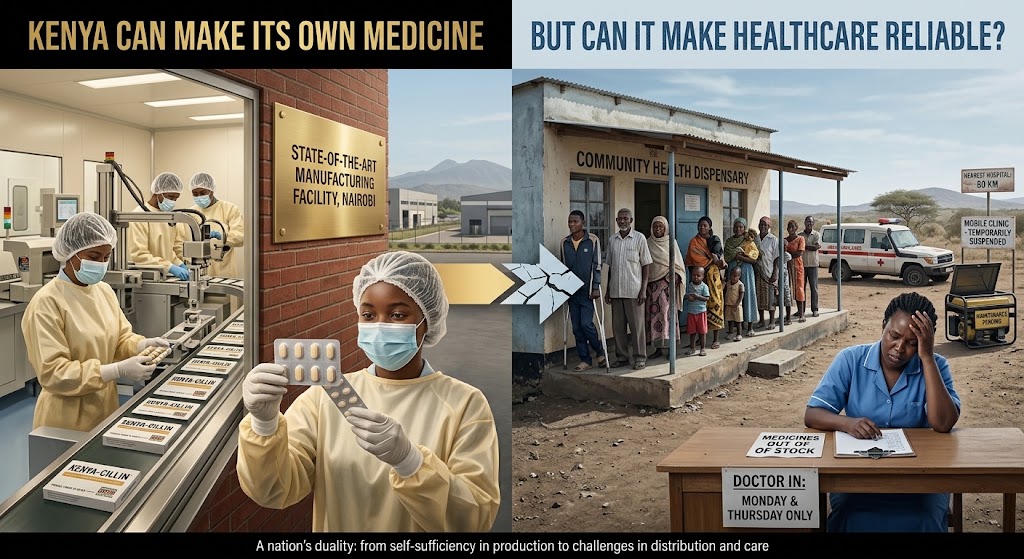
Local pharmaceutical manufacturing is gaining momentum, but factories alone will not fix a fragile health system
By Levis Wangamati
Kenya is beginning to confront an uncomfortable truth about its healthcare system: a country can have hospitals, doctors and ambitious health policies and still remain dangerously exposed if it cannot reliably secure the medicines its people need.
That vulnerability is now being addressed through a growing push to manufacture medicines, vaccines, diagnostics and medical devices locally. The Pharmacy and Poisons Board says 13 pharmaceutical manufacturers are progressing towards establishing or expanding production facilities in the country, signalling a potentially important shift in how Kenya approaches health security.
The development deserves optimism, but not uncritical celebration. A pharmaceutical factory is only the beginning of a much longer journey between a medicine being manufactured and a patient receiving it safely and affordably. Kenya’s challenge is therefore larger than increasing the number of factories. It is about building a health system in which medicines are produced to high standards, properly regulated, efficiently procured, distributed without unnecessary interruption and ultimately available to the people who need them. Anything less risks confusing industrial activity with healthcare progress.
The case for local production is nevertheless compelling. Kenya’s dependence on imported health products leaves it exposed to disruptions entirely beyond its control. Global emergencies, transport interruptions, foreign exchange pressures, manufacturing shortages and shifting international supply chains can all affect both the availability and price of medicines. The Covid-19 pandemic demonstrated how quickly countries discover that global supply chains are not guaranteed. Kenya already has more than 35 licensed pharmaceutical manufacturing facilities, according to PATH, but many remain underutilised — meaning the country possesses part of the foundation required for greater self-reliance without yet having fully used it.
This is why Kenya’s Health Products and Technologies Local Manufacturing Strategy 2026–2030 matters. The strategy seeks to strengthen domestic production while improving the broader environment surrounding health-product manufacturing. It is not simply an industrial policy dressed as a health programme. It is an attempt to connect manufacturing capacity with national health security, reduce supply-chain vulnerabilities and build a more sustainable domestic pharmaceutical sector.
There is an economic argument here as well. When medicines are manufactured locally, the benefits can extend well beyond the pharmacy shelf — creating employment, developing technical expertise, stimulating investment and strengthening related industries. Pharmaceutical manufacturing also offers Kenya an opportunity to become a regional supplier rather than merely a consumer of medical products. The ambition to position the country as a pharmaceutical and health-innovation hub therefore carries implications for both public health and industrial development.
Yet there is a danger in allowing “Made in Kenya” to become an achievement in itself. A medicine does not become better because it crosses fewer borders. Nor does a locally manufactured product automatically become affordable, effective or accessible. The real test is whether it meets rigorous standards and reaches the patient at the right time, at a price that does not make treatment unreachable. National pride should never substitute for pharmaceutical quality.
That is where regulation becomes as important as production. The Pharmacy and Poisons Board is preparing to implement new Good Pharmacy Practice Standards from January 2027. The standards are intended to strengthen professional oversight, improve safety and address problems such as unsafe dispensing and antimicrobial misuse. Recent concerns from pharmacy professionals about the regulations prompted the Ministry of Health to clarify that the standards do not prevent duly registered diploma holders from practising — a controversy that reveals a broader truth about reform: good intentions can still generate uncertainty when implementation is poorly communicated.
Stronger standards are necessary if patients are to trust Kenya’s pharmaceutical system. But regulation must be clear, proportionate and arrived at through genuine consultation. The objective should not be rules that look impressive on paper. It should be a system in which every participant understands their responsibility and patients ultimately receive safer care.
Kenya must also resist interpreting self-reliance as isolation. There is no practical reason to manufacture every medicine consumed domestically. Some products will remain cheaper or more efficient to import, particularly where local production would require enormous investment for relatively small markets. The objective should not be pharmaceutical autarky. It should be strategic resilience — producing locally where capacity and economic rationale exist, while maintaining reliable international partnerships for products that are impractical to manufacture at home.
That distinction matters because protectionism creates its own problems. If local manufacturers are shielded from competition simply for being local, patients could ultimately pay more for products no better than imported alternatives. Government procurement must reward quality, reliability and value — not nationality alone.
The supply chain presents another challenge entirely. Producing a medicine is not the same as delivering it. A factory can operate efficiently while a patient in a remote county still faces a shortage. A warehouse can be full while poor distribution leaves a hospital without essential supplies. Healthcare security depends on the entire chain functioning together, from manufacturing and regulation through to procurement, storage, transportation and dispensing.
Kenya’s pharmaceutical ambitions should ultimately be judged at the level of the ordinary patient. The questions that matter are less glamorous than factory counts or investment figures: Can a parent obtain the medicine their child needs? Can a patient afford a prescribed treatment? Can a rural hospital maintain adequate stocks? Can Kenyans trust the quality of what they are buying?
These questions also explain why pharmaceutical reform cannot be separated from the wider healthcare system. Manufacturing without regulation creates risk. Regulation without adequate supply creates shortages. Supply without affordability creates exclusion. Affordability without quality creates danger. Kenya needs to stop treating medicines as isolated commodities and start treating them as part of a complete public-health ecosystem.
Recent developments offer cautious grounds for confidence. Thirteen manufacturers are moving towards new or expanded production, a five-year strategy for local health-product manufacturing is in place, and regulators are tightening pharmacy-practice standards. These are meaningful steps towards a more resilient system — strengthening the capacity to produce medicines while improving the rules governing how they reach patients.
But implementation will determine whether ambition becomes transformation or another promising document. Factories must become productive rather than ceremonial. Regulatory institutions must have the capacity and independence to enforce standards without interference. Procurement systems must be transparent and efficient. Distribution networks must reach beyond major urban centres.
There is also an opportunity to think beyond Kenya’s borders. A stronger domestic pharmaceutical industry could eventually serve neighbouring African markets as countries across the continent seek greater control over their medical supply chains. Kenya, with its existing manufacturing base and regional economic position, is placed to participate meaningfully in that shift.
The measure of success, in the end, should not be the number of pharmaceutical factories Kenya can count. It should be the number of patients who no longer have to worry about whether the medicine they need will be available, safe and affordable. That is a considerably higher standard. It is also the only standard that matters.
Kenya does not merely need to manufacture its own medicine. It needs to manufacture trust in its healthcare system — and that will not be earned through slogans or factory openings alone. It will be earned when local production, strong regulation, reliable distribution and affordable treatment finally converge around the person who matters most: the patient waiting for care.
Similar Posts by The Mt Kenya Times:
- Mt Kenya Times ePAPER October 22, 2026
- Ruto heads to Harare for COMESA summit on trade and regional security
- Mudavadi and Wetangula walk out as Sifuna speaks at Nabwera memorial
- Police accountability on trial as seven officers face probe over journalist’s arrest
- Learners, teachers graduate from thrive for good organic farming training
About the Author