Kenya unveils KSh1.4 trillion Agriconnect plan to transform farming, create 2.5 million jobs
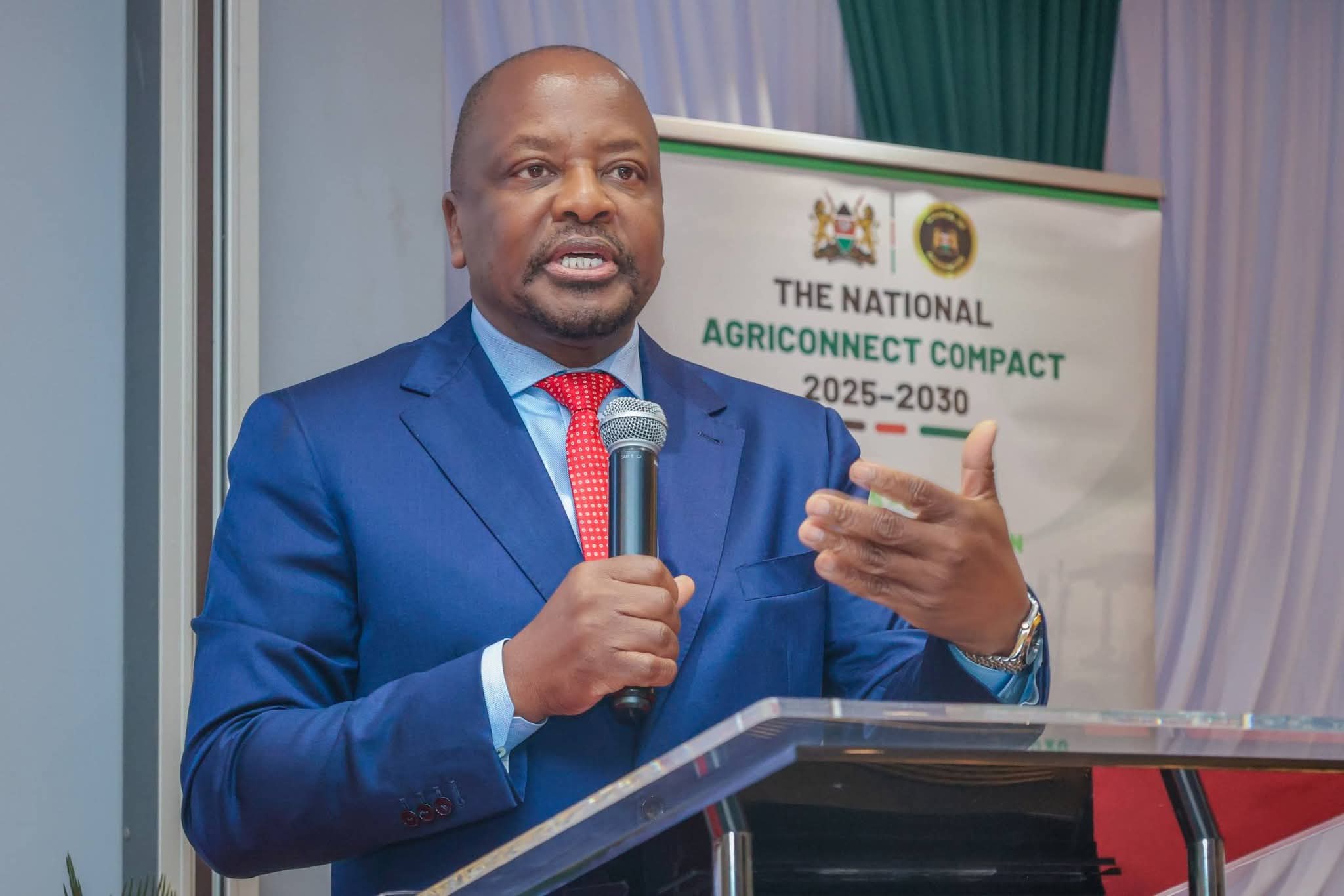
CS Mutahi Kagwe addressing the forum.
By DMS
Kenya has unveiled an ambitious agricultural transformation programme that seeks to mobilise more than KSh1.47 trillion in investments over the next five years, with the government banking on technology, private sector financing and market reforms to turn agriculture into a key driver of economic growth, job creation and food security.
Agriculture and Livestock Development Cabinet Secretary Mutahi Kagwe yesterday officially launched the Kenya AgriConnect Compact (2025-2030), a national framework designed to modernise the country’s agricultural sector and position it as a competitive, climate-smart and investment-ready pillar of the economy.
Speaking during the launch, Mr Kagwe said the initiative marks a fundamental shift from traditional subsistence farming to a modern agricultural system powered by technology, innovation and private investment.
“The AgriConnect Compact positions agriculture not as a subsistence sector, but as a modern, technology-enabled, climate-smart and investment-ready engine for inclusive economic transformation,” he said.
The compact is expected to guide investments and policy reforms across the country’s agri-food system over the next five years as Kenya seeks to increase agricultural productivity, strengthen food security and create employment opportunities, especially for young people.
Public funds to unlock private investment
At the heart of the programme is an investment framework that will see the government commit about KSh490 billion in catalytic public financing aimed at attracting an additional about KSh980 billion from private investors.
According to Mr Kagwe, the strategy is deliberately structured to use public resources to reduce investment risks and create an enabling environment for businesses, financial institutions and development partners to invest in agriculture.
“The AgriConnect Compact is a deliberate, strategic and urgent framework to align public investment with private sector ambition. Public investment finances foundational systems and public goods, reducing risks and creating an enabling environment that attracts large-scale private capital,” he said.
The government plans to leverage public-private partnerships, blended finance instruments and credit guarantee schemes to encourage lending and investment in agriculture, a sector often viewed by financiers as high-risk.
Officials said the framework will channel investments into critical value chains such as dairy, edible oils, horticulture, livestock production, cereals and agro-processing.
The strategy has received backing from the National Treasury, county governments, development partners and private sector organisations, signalling broad support for the reforms.
Representatives from the World Bank Group, International Fund for Agricultural Development (IFAD), African Development Bank, Gates Foundation, Alliance for a Green Revolution in Africa (AGRA), U.S. Embassy Nairobi, Embassy of the Netherlands, German Embassy, GIZ, U.S. Chamber of Commerce, British Chamber of Commerce and Industry, Kenya Private Sector Alliance (KEPSA), Kenya Association of Manufacturers and the Agriculture Sector Network attended the launch.
Digital revolution and market transformation
A key pillar of the AgriConnect Compact is the integration of technology throughout the agricultural value chain.
The government plans to roll out digital extension services to provide farmers with real-time information on farming practices, weather conditions, disease control and market opportunities.
The programme will also support agritech platforms that improve market traceability, facilitate access to finance and connect farmers directly to buyers.
Advanced processing technologies are expected to reduce post-harvest losses, which continue to cost Kenyan farmers billions of shillings annually.
Agricultural experts have long identified post-harvest losses, poor market access, weak value chains and limited technology adoption as some of the biggest constraints facing the sector.
To address these challenges, the compact proposes investments in digital marketplaces, structured trading systems and improved logistics infrastructure.
The reforms are intended to eliminate inefficiencies that have historically disadvantaged farmers by exposing them to exploitative middlemen and fragmented markets.
Government officials believe stronger market systems will not only improve farmer incomes but also enhance the competitiveness of Kenyan agricultural products in regional and international markets.
The compact also seeks to strengthen local value addition through agro-processing and manufacturing, allowing Kenya to export more processed products instead of raw commodities.
As part of the market transformation agenda, the government aims to reduce imports of key food commodities such as rice and maize by 50 per cent while increasing exports of high-value agricultural products by 60 per cent by 2030.
The strategy aligns with broader efforts to improve the country’s trade balance, enhance foreign exchange earnings and build resilience against global supply chain disruptions.
Jobs, food security and economic growth

Beyond increasing agricultural output, the government sees the compact as a major vehicle for addressing unemployment and poverty.
The programme targets the creation and upgrading of 2.482 million jobs by 2030 across farming, agro-processing, logistics, digital supply chains, agribusiness management and agricultural services.
The jobs are expected to particularly benefit young people, who continue to face limited employment opportunities despite constituting the majority of the country’s population.
Highlighting the social impact of the initiative, Mr Kagwe said the programme is designed to create meaningful and sustainable employment while ensuring food security for all Kenyans.
“The jobs to be created will be real jobs with dignity. The food security we achieve will mean that no Kenyan goes to bed hungry,” he said.
Agriculture remains one of Kenya’s most important economic sectors, contributing about a third of the country’s Gross Domestic Product directly and indirectly while supporting millions of livelihoods.
However, recurring droughts, climate change, low productivity, inadequate infrastructure and limited financing have constrained growth and undermined food security in recent years.
The AgriConnect Compact seeks to address these challenges through climate-smart agriculture, improved irrigation systems, enhanced research and innovation, stronger extension services and increased private sector participation.
Government officials say technical preparations for implementation have already been completed and attention will now shift to mobilising investments and executing projects across the country.
Mr Kagwe challenged investors, financial institutions, agribusiness firms and development partners to support the initiative and accelerate the transformation of the agricultural sector.
“We have the strategy. We have the investment framework. We have the political will. What we need now is private sector action,” he said.
The launch signals the beginning of what the government hopes will be a new era for Kenyan agriculture, one in which farming becomes a modern, profitable and globally competitive industry capable of feeding the nation, creating millions of jobs and driving sustained economic prosperity.
Similar Posts by The Mt Kenya Times:
- Mt Kenya Times ePAPER October 13, 2026
- Ruto commissions Uasin Gishu dam to boost year-round farming
- Ruto calls Kenyatta a conman as Kenya’s 2027 battle begins in earnest
- Electricity access must lead to local opportunity
- God had to break your marriage to save your mother’s house
About the Author