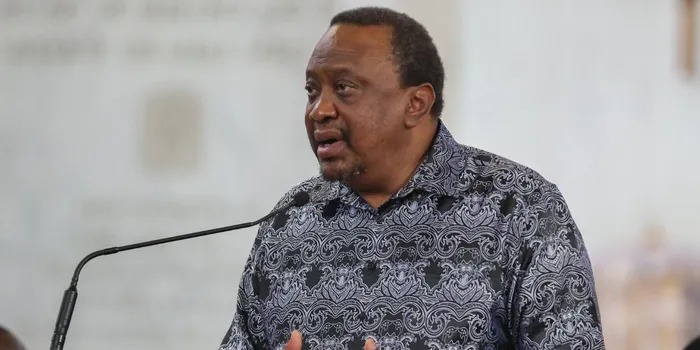
Deputy President Kithure Kindiki greetings with neighbours, Irunduni, Tharaka Nithi County.
Deputy President says he is going nowhere — and the law is largely on his side
By Grace Wanja
Deputy President Kithure Kindiki has flatly refused to resign his office and declared the 2027 Ruto-Kindiki ticket non-negotiable, as mounting pressure from opposition leaders, coalition partners, and senior lawyers converges on his position in the most turbulent stretch of his tenure since he was sworn in in November 2024.
The Deputy President has not flinched. Speaking at the 11th Annual Meru Dairy Farmers’ Field Day in North Imenti Constituency on Saturday, Kindiki dismissed all speculation about his political future in terms that left no room for ambiguity. “I want to state it clearly that I will be President William Ruto’s running mate in next year’s general elections. Those who are salivating for that position should forget it because the Ruto-Kindiki ticket will be on the ballot, and we shall win,” he told a gathering of more than 45,000 farmers.
He reached for a metaphor that has since circulated widely. “Those telling me to quit are out of order. I cannot build a house, furnish it and then I leave to be living in the forest. There are those who are telling me to quit. I won’t quit,” he said. The image was pointed — a direct rebuttal to those within and outside the coalition who have spent recent weeks suggesting he do exactly that.
Three distinct forces have been applying simultaneous pressure on Kindiki’s position: the opposition, his own coalition partners, and the unresolved shadow of a court ruling that has never been fully settled.
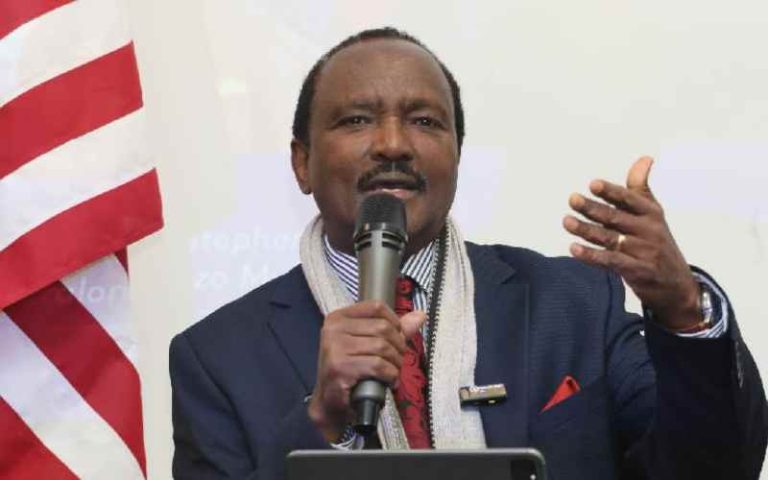
The opposition’s case is led by veteran Wiper leader Kalonzo Musyoka, who has gone further than any other active political figure in questioning the constitutional basis of Kindiki’s office. Following a Court of Appeal ruling in May last year that the High Court bench which cleared Kindiki’s swearing-in was improperly constituted, Kalonzo posted on X: “We are now in a situation where we have two deputy presidents. Kindiki should respect the process and resign to allow justice to take its course. The recent appellate court decision has exposed the unlawful and political manipulation that was involved in removing Gachagua from office.” Martha Karua echoed the demand. Neither has retracted it.
The Court of Appeal found that Deputy Chief Justice Philomena Mwilu acted outside her mandate when she appointed a three-judge bench to hear Gachagua’s petitions, as the Constitution reserves that authority exclusively for the Chief Justice. The ruling did not remove Kindiki from office, but it handed the opposition a credible legal frame — one they have wielded with discipline ever since.
From within the governing coalition, the challenge comes from a different direction but with no less force. Following ODM’s inclusion in the broad-based government, the Orange party has moved aggressively to claim the deputy president slot, with pressure mounting on Ruto to pick Cooperatives Cabinet Secretary Wycliffe Oparanya as his 2027 running mate. If ODM’s demands are ignored, there are implicit threats that the party could pull out of its arrangement with Ruto.
At a Turkana delegates meeting last Wednesday, Kisii Governor Simba Arati — ODM’s deputy party leader — stated his party’s position without qualification. “Kama ni Ruto anaenda urais, deputy ni yetu na tuskizane,” he said, naming Oparanya, Homa Bay Governor Gladys Wanga, and even party leader Raila Odinga as candidates qualified to fill the role. He added that ODM would only stand aside if Ruto contested under the ODM banner or if Kindiki left UDA and joined ODM — conditions that neither man has shown any intention of meeting.
Western Kenya has added its own voice. Leaders from Kakamega have publicly backed National Assembly Speaker Moses Wetang’ula for the position, framing his candidacy as the region’s rightful return on its political investment in Kenya Kwanza. Each of these bids, separately containable, collectively amounts to a sustained siege on Kindiki’s office.
The pressure has been compounded by a report that some responsibilities previously associated with the Deputy President’s office have been quietly redistributed to other senior government figures — a claim Kindiki addressed directly on his official X account on the night of Monday, July 27, dismissing it as fake news and denying any fallout with Ruto. Two days later, a photograph of a late-night one-on-one meeting between Kindiki and Ruto at State House was posted by the Deputy President’s communications team on X — offered as evidence of unbroken solidarity, though political analysts noted that a photograph confirms a meeting, not an alliance.
A viral social media post last week went further, claiming Ruto had privately given Kindiki a deadline to resign over his failure to neutralise Gachagua’s influence. Africa Check investigated and found no evidence that Ruto issued any such instruction, concluding the quote circulating online was fabricated. The correction spread less far than the original claim.
The widespread perception that Kindiki’s political standing is weakening has gathered pace largely because Ruto has neither firmly and publicly endorsed his deputy nor directly addressed the speculation. That silence, in a political environment as febrile as this one, has been read as a signal. Senior counsel Ahmednassir Abdullahi, writing on X, said he did not expect Ruto to drop Kindiki, but argued that the Deputy President ought to show political maturity by stepping aside voluntarily. “Either way, it must be before October 2026 — or it will be TOO LATE,” Ahmednassir wrote.
Not everyone within Kenya Kwanza is hedging. Public Service Cabinet Secretary Geoffrey Ruku, speaking during an NTV interview on Monday, July 27, offered Kindiki direct and unambiguous support. “I support Kindiki to continue being the DP because he has performed very well as Ruto’s principal assistant. He has outperformed himself as DP, and I think he is suited to be the DP from 2027 to 2032,” Ruku said. He added, however, a line that will have unsettled Kindiki’s camp: that if Ruto chose a different running mate, Mt Kenya East would support the President regardless. “It is the prerogative of the head of state to choose his running mate,” Ruku said.
The constitutional reality provides Kindiki his strongest protection. Unlike a Cabinet Secretary, Kindiki cannot simply be removed from office through a presidential decision. Article 150 of the Constitution provides the framework for removal of a Deputy President, incorporating the procedures under Articles 144 and 145 — a process requiring parliamentary involvement, medical certification, or impeachment. Advocate Timothy Kariuki has noted that initiating a second Deputy President removal within one term would carry severe political consequences. “It would make him a political clown to initiate a second round of removing his Deputy inside four years,” Kariuki said.
The polling numbers further complicate the case for change. A TIFA Research survey found Kindiki commanding 59 per cent support as the preferred running mate for Ruto, with Wanga a distant second on 12 per cent. A more recent Infotrak poll placed him at 34 per cent — still ahead of all other contenders. Political analyst Herman Manyora has argued that replacing Kindiki with a candidate from Luo Nyanza could alienate Mt Kenya voters at precisely the moment when former Deputy President Rigathi Gachagua is actively working to pull the region away from Kenya Kwanza. That paradox — that the forces demanding Kindiki’s removal are simultaneously the reason his removal is dangerous — is the trap at the centre of Ruto’s 2027 arithmetic.
Kindiki himself has signalled awareness of the longer game. “Next year is the last time we will be voting for Ruto as President, then he will go on retirement like Uhuru Kenyatta. And then what?” he said at the Meru event on July 25 — a remark that positioned him not merely as a deputy defending his seat, but as a man already thinking about 2032.
He will not resign. The Constitution makes it difficult to force him out. And the political arithmetic of replacing him may cost Ruto more than keeping him does.
The siege continues. But for now, Kindiki is still inside the house — and he built it.
Similar Posts by The Mt Kenya Times:
- Mt Kenya Times ePAPER September 19-20, 2026
- Kenya joins US and UK to put citizens on the terrorism frontline
- Kenya’s parliament races to tame the AI frontier
- Kalonzo calls Ruto to order over Uhuru attacks
- Gachagua takes his 2027 campaign to America
About the Author