Kenya’s debt trap: The case for restructuring before the wall hits
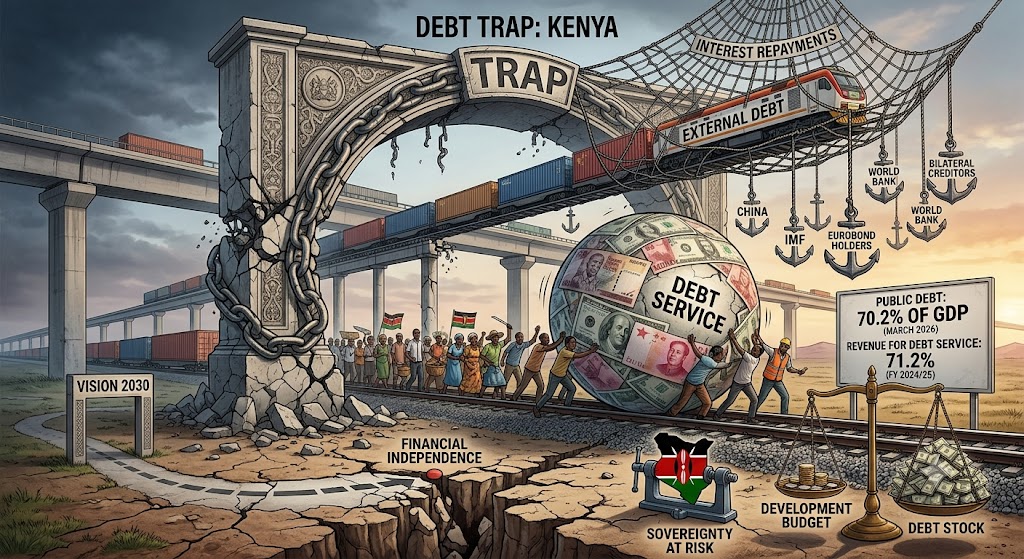
Ignoring the arithmetic of an unsustainable debt burden is not a strategy — it is a slow march toward the crisis the government insists it wants to avoid
By E. Njega
The word “restructuring” has a remarkable ability to end conversations before they begin. The moment it enters the debate around Kenya’s public finances, it conjures images of economic humiliation, currency collapse, and the kind of political fallout that governments spend entire careers trying to avoid. That reaction is understandable. It is also, increasingly, a luxury Kenya can no longer afford.
The fear, on closer inspection, does not survive contact with the evidence. African countries that have gone through debt restructuring or outright default have, in most cases, recovered with considerably more speed and stability than their critics predicted. This is not a theoretical argument. It is the recent history of the continent.
President William Ruto touched on the point — if inadvertently — during his Special National Address last Thursday, broadcast live and shared widely on the government’s official social media channels. Speaking on Kenya’s development trajectory, Ruto noted that Ghana’s GDP per capita stands at approximately US$3,200, roughly 30 per cent higher than Kenya’s, while Zimbabwe — after enduring decades of profound economic hardship — has recovered to a GDP per capita of about US$3,000, now slightly exceeding Kenya’s. The comparisons were intended as a call to action. Analysts, however, drew a different lesson from the same data.
It is worth pausing on those figures. Both Ghana and Zimbabwe have lived through severe debt crises — Ghana completed a restructuring of its domestic and external debt in 2023 and 2024 following a default the year before; Zimbabwe’s economic collapse in the late 2000s remains one of the most dramatic in modern African history. That either country now records GDP per capita comparable to or above Kenya’s is precisely the point that advocates of restructuring have been making. Defaulting, it turns out, is not necessarily the end of the story.
The claims did not go unchallenged. An independent fact-check published yesterday by The Weekly Vision noted that World Bank data places Zimbabwe’s GDP per capita at approximately US$1,420 in nominal terms in 2024, substantially below Kenya’s, suggesting Ruto’s comparison may have relied on purchasing power parity figures rather than nominal US dollar values — a distinction the President did not make explicit in the address. The presidency had not responded to those queries by the time of publication.
The broader point, however, stands — and Kenya’s own numbers, viewed without the benefit of selective comparison, are telling a worrying story.
Domestic debt servicing crossed the KSh 1 trillion mark for the first time in FY 2024/25, with the government spending KSh 1.05 trillion on repayments — a 25.9 per cent increase from KSh 830.2 billion the previous year. Interest payments alone accounted for KSh 678.3 billion of that figure. In the FY 2026/27 budget, domestic interest payments of KSh 986.7 billion exceed the entire education allocation of KSh 668.3 billion. Kenya is, in other words, spending more on interest payments to domestic creditors than it spends on educating its children — a fact that has circulated widely on X and generated sustained commentary from economists, MPs, and civil society organisations, yet has produced no visible shift in fiscal policy.
Kenya’s total public debt has crossed KSh 13 trillion for the first time. The government spent KSh 1.72 trillion servicing debt in FY 2024/25, equivalent to roughly 69 per cent of ordinary revenue collected — more than double the IMF’s recommended 30 per cent threshold. The IMF projects the debt-to-GDP ratio rising to 71.6 per cent in 2026 and 72.4 per cent in 2027, while the statutory ceiling under the Public Finance Management Amendment Act sits at 55 per cent — a target that is not within reach on any current trajectory.
Since President Ruto was sworn in, total debt has grown by KSh 4.14 trillion — 47.6 per cent — with domestic debt expanding 61.8 per cent and the debt-to-GDP ratio rising 7.5 percentage points, all while GDP itself grew at roughly half the pace of debt accumulation. That gap — between what the economy produces and what the government owes — is the arithmetic of a crisis in slow motion, and it has been documented in detail not only by financial institutions but by Kenyan economists and commentators posting thread after thread on X to audiences that dwarf most newspaper circulations.
Consider what the interest bill alone could otherwise do. Domestic interest payments approaching KSh 1 trillion annually represent roughly 5.6 per cent of GDP. Redirected even partially toward infrastructure, health, or education, the development impact would be transformational. A credible combination of debt restructuring and expenditure rationalisation could, in reasonable estimates, reduce the interest burden by at least half — creating the fiscal space that Kenya’s development agenda has needed for years.
Zambia, which defaulted during the Covid pandemic and spent years in difficult restructuring negotiations, is now projected to grow at 6.8 per cent in 2026. The Zambian kwacha was briefly the best-performing currency in the world earlier this year — a data point that circulated extensively on financial Twitter and was noted with some irony by Kenyan economists watching their own currency struggle. Ethiopia, which also defaulted, is stabilising. These are not failure stories. They are, in their complicated way, recovery stories — and Kenya’s policymakers would do well to read them carefully rather than treat restructuring as a word that cannot be spoken in polite company.
Living in denial does not make the trajectory more manageable. It makes it more expensive. Every year that Kenya continues borrowing at current rates to service existing debt, rather than restructuring and breaking the cycle, is a year in which the eventual reckoning becomes more severe and the options narrower. The countries that have emerged from debt crises with the least long-term damage are those that acted early, negotiated from a position of residual strength, and used the breathing room to reform the underlying fiscal structure.
Kenya still has that option. The question is whether the political will exists to take it before the wall arrives — or whether the government will wait until the wall announces itself, by which point the choice will no longer be Kenya’s to make.
Similar Posts by The Mt Kenya Times:
- Mt Kenya Times ePAPER September 19-20, 2026
- Kenya joins US and UK to put citizens on the terrorism frontline
- Kenya’s parliament races to tame the AI frontier
- Kalonzo calls Ruto to order over Uhuru attacks
- Gachagua takes his 2027 campaign to America
About the Author