Kindiki draws a line: The deputy president who refuses to be traded away
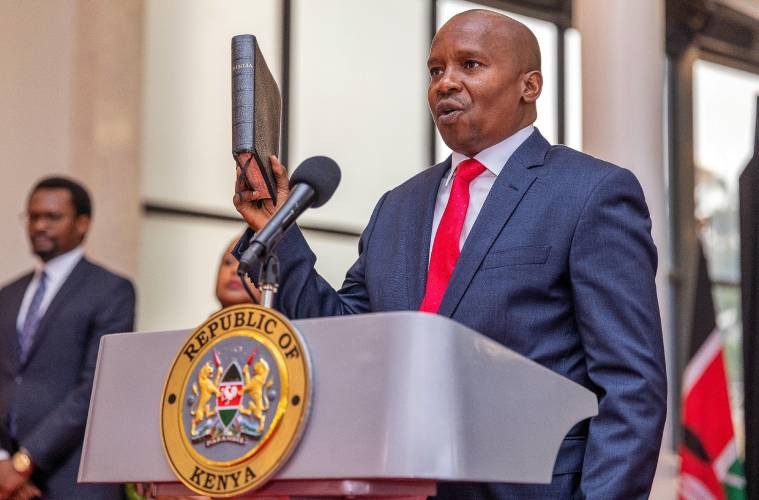
Deputy President Kithure Kindiki
With ODM openly eyeing the second-highest office and Gachagua pressing from the other flank, Kindiki has launched the most consequential fight of his political life.
By Collins Kibet
At Nembure Stadium in Embu County last week, Deputy President Kithure Kindiki stood before 20,000 grassroots leaders and delivered a message that was as much a political declaration as it was a rally address. He told ODM plainly that even in 2027, he will be the running mate of President William Ruto, who will be seeking a second term in office. The crowd roared. The message landed.
But behind the bravado lies one of the most complex and precarious political battles Kenya has seen in years — a three-front war being fought simultaneously against ODM’s ambitions, the lingering shadow of his predecessor and the shifting calculus within the Kenya Kwanza coalition itself. The debate stretches far beyond the corridors of power. It is being fought in church gatherings across Mt Kenya, inside ODM strategy meetings, on social media, at government functions and within the Kenya Kwanza coalition itself. Every political move by Kindiki, every presidential tour and every opinion poll is increasingly being interpreted through one question: Is the Deputy President secure?
How it began
Appointed by President William Ruto in October 2024 to replace impeached Deputy President Rigathi Gachagua, Kindiki’s role was intended to consolidate control over the Mt Kenya voting bloc, which had delivered 87 per cent of the region’s votes to Ruto in 2022. It was a high-stakes appointment from the outset. Kindiki was expected to hold a restless mountain, manage a bruised coalition and deliver results — all while his predecessor refused to disappear.
He has served as Deputy President since 1 November 2024. In under two years, the political ground beneath him has shifted dramatically. Gachagua, refusing to fade into political irrelevance, formed the Democracy for Citizens Party and forged alliances with key Mt Kenya leaders. And then came ODM.
ODM’s demand
What began as a governance partnership is increasingly taking the shape of an early coalition negotiation, with both parties seeking to secure their interests ahead of the 2027 General Election. ODM has made it clear that its support for any future coalition with President Ruto cannot be taken for granted. Senior party leaders have publicly insisted that if UDA fields the presidential candidate in 2027, ODM should produce the running mate.
The Orange party’s position hardened after joining the broad-based government through a Memorandum of Understanding negotiated by the late Raila Odinga in March 2025. On November 3, 2025, Oburu had indicated that ODM would not accept any post below the deputy presidency in negotiations.
The language from Kisumu has grown bolder by the month. Speaking on August 4 at State House during President Ruto’s meeting with village elders, Oburu said the deputy president’s post should be open for negotiation, questioning openly why he could not occupy it. “Particularly the number two position. Don’t you think I deserve to be number two? Can’t I be number two?” he asked, to the evident discomfort of Kindiki’s allies.
Kisii Governor Simba Arati went further, spelling out ODM’s conditions with unusual candour. He stated that the only circumstances under which ODM would relinquish the running mate position would be if President Ruto chose to contest the presidency under the ODM banner instead of UDA, or if Kindiki left UDA and officially joined ODM.
Kindiki’s fightback
Faced with pressure on multiple fronts, Kindiki has responded not with silence but with an escalating mobilisation campaign across Mt Kenya East. On August 15, he met more than 30,000 elders brought together by the Mt Kenya East Council of Elders, representing communities from Meru, Tharaka-Nithi, Embu, Isiolo and Mwea areas. The following weekend, he hosted thousands more at Kinoru Stadium in Meru, before heading back to his Irunduni home in Tharaka-Nithi to address 15,000 UDA grassroots officials.
Kindiki vowed to wipe out the opposition’s influence, terming his mobilisation skills superior to Gachagua’s. “The opposition should not dare mess with me. Gachagua has been having an easy time in the Mountain because we were busy working as they campaigned. Let him know that I am a lethal striker in political campaigns,” he said.
His allies have been equally forceful. Tharaka-Nithi Governor Muthomi Njuki argued that Kindiki was a net electoral asset to President Ruto, capable of mobilising more votes than any running mate proposed by ODM. “We are ready to hand over Prof Kindiki to ODM provided that he remains Deputy President in 2027,” he said. Embu Governor Cecily Mbarire and Public Service Cabinet Secretary Geoffrey Ruku dismissed what they termed persistent and provocative claims by Oburu over the deputy president’s position, insisting the seat is not vacant.
Kindiki has also signalled a longer-term political ambition beyond 2027, positioning himself as a potential presidential contender while challenging opponents to prepare for a prolonged political contest. Speaking to UDA grassroots leaders at his Irunduni home, he presented his political survival as part of a wider battle for influence in the Kenya Kwanza administration and the region.
The Ruto factor
At the heart of this contest is a question that nobody is yet willing to answer publicly: what does President Ruto actually want? President Ruto’s suggestion of gender equity in future tickets could potentially sideline Kindiki. Competition for the Deputy President position within Mt Kenya is intensifying, with Kirinyaga Central MP Gachoki Gitari advocating for Anne Waiguru as a potential running mate.
Ruto has publicly expressed confidence in his deputy. But in Kenyan politics, presidential silence on such matters is rarely reassuring. ODM, emboldened by its cooperation agreement with Kenya Kwanza, has openly declared that it wants the country’s second-highest office if it is to support President Ruto’s re-election. The demands represent more than ordinary coalition bargaining — they introduce an entirely new layer of uncertainty into discussions previously centred almost exclusively on Mt Kenya politics.
The historical parallel
Kindiki’s predicament has historical parallels. In Zambia, Levy Mwanawasa resigned as vice-president in 1994 following differences within Frederick Chiluba’s administration. He briefly left frontline politics but returned as the ruling party’s presidential candidate in 2001, winning and becoming Zambia’s third president. Kenya’s Jaramogi Oginga Odinga followed a different path — he resigned as vice-president in 1966 after falling out with President Jomo Kenyatta, formed the Kenya People’s Union and established himself as the country’s leading opposition figure. History, in other words, offers no single template.
What comes next
For now, Kindiki is betting on the ground — on grassroots numbers, regional solidarity and the argument that replacing him would cost Ruto more votes in Mt Kenya than ODM could ever compensate for from Nyanza. Mt Kenya leaders have maintained that Kindiki will not be sacrificed in an effort to accommodate ODM. The by-elections victory in February, in which Kindiki played a leading role, hardened that conviction.
But coalitions are transactional by nature, and the pressure is real. The coming weeks will determine whether Kindiki’s show of force is enough to settle the question definitively — or whether it simply raises the stakes of a contest that has only just begun.
The Deputy President’s message is clear enough: he is no pushover. Whether that declaration is sufficient to hold his seat is the question Kenya’s political class is watching most closely as 2027 draws near.
Similar Posts by The Mt Kenya Times:
- Mt Kenya Times ePAPER October 17-18, 2026
- Ruto bets billions on Kerio Valley — with one eye on 2027
- Ruto’s health ministry kills Murang’a’s digital hospitals
- Kenya bets on Mount Kenya to drive a billion-shilling tourism revival
- Do you have a wealth vision? Or are you just working until you die?
About the Author