Let Us Not Read Too Much In Ruto, Raila Move To Pick Hardliners To Spearhead Bipartisan Talks
 The Mt Kenya Times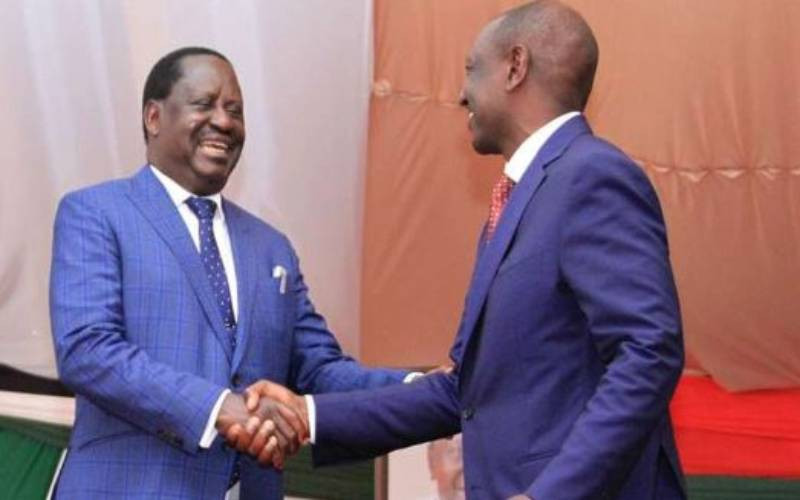
President William Ruto and Azimio La Umoja-One Kenya Party leader Raila Odinga
By: Joseph Mutua Ndonga
Worth Noting:
- This time, Ruto opted to refer Raila as ‘my brother’, a departure from his earlier position where at times he engaged him in no-hold-barred attacks.
- Ruto is a well-schooled politician. He knew Raila felt offended by the remarks made by the senior leaders in his government.
- Raila always complained that the remarks were utterly disrespectful and demeaning to him and his Azimio brigade.
- Again, these people (the government) have turned deaf ear to our demands. They have totally refused to invite us for talks. This was one of the reasons why Raila was hell bent going on with his demonstrations to the bitter end.
Majority of Kenyans welcomed President William Ruto’s speedy interventions in ending the bloody and destructive demonstrations called by the Azimio La Umoja-One Kenya Party leader Raila Odinga.
Just an hour after the President’s televised address to the nation during which he extended an olive branch to Raila and his brigade, Raila convened a press conference and stated.
I have heard what the President has just said and I’m convinced he means well.
As a result, I have called off the demonstrations in order to create a room for dialogue.
In his statement, Dr Ruto had rooted for a bipartisan process through parliament.
We have listened to the grievances raised by Azimio. As Kenya Kwanza government, we are ready to dialogue with the opposition side and I’m sure we shall agree on the issues of mutual interests to our people that can be addressed.
As Ruto reiterated that this process must be anchored within the parameters of law, he only zeroed in on two demands: The high cost of living and a review of the composition of the panel set up to recruit the new IEBC commissioners.
This time, Ruto opted to refer Raila as ‘my brother’, a departure from his earlier position where at times he engaged him in no-hold-barred attacks.
Ruto is a well-schooled politician. He knew Raila felt offended by the remarks made by the senior leaders in his government.
Raila always complained that the remarks were utterly disrespectful and demeaning to him and his Azimio brigade.
Again, these people (the government) have turned deaf ear to our demands. They have totally refused to invite us for talks. This was one of the reasons why Raila was hell bent going on with his demonstrations to the bitter end.
So, by referring as a brother, Ruto knew this was one way of disarming and taming him.
The card worked though it was short-lived. I’m sure Ruto knew that he would shift the goal posts.
However, this would work to his advantage. First, Raila would lose the momentum. His supporters, who were taking part in the demonstrations, would lose trust in him.
Even his fanatical diehard and supporters would feel fatigued and used. As such, it will be an uphill task to return them back to the streets.
Secondly, this will give Kenya Kwanza a chance to expose Raila as a person who spoke from both sides of mouth and as a dishonesty person who thrived in chaos and violence.
To me, this informed the remarks made by the majority leader Kimani Ichungwah.
We are daring Raila to resume his demonstrations so that he can continue to shed more blood of innocent Kenyans, cause destruction of businesses and properties.
I will convene parliament to pass a resolution to write to the International Criminal Court (ICC) in The Hague. We will invite the court to come and probe Raila activities which bordered on terrorizing his own people for selfish reasons.
In a swift rejoinder, ODM Sec-Gen Edwin Sifuna told him to bring it on.
We are ready for you. We cannot keep quiet when our people are suffering. We are not coward. The cost of living and other demands we have raised must be addressed.
Back to Raila’s shift of goal posts, he stated. We want the bipartisan process expanded to include negotiators from outside the two houses of parliament and senate.
This question is. How do you make this legal? Parliament is the law making body and non-members (strangers) are not allowed to participate in this process.
So, If Azimio will have their way, it means that process would become extra-legal and extra-constitutional.
What does this portends? Any person can move to court to challenge the final recommendations.
Chances of winning this case are very high. So, the two houses could end up doing zero work.
Remember the Building Bridges Initiative (BBI) process suffered the same fate.
As the two sides dig in, the report indicating that President Ruto and Azimio leader Raila have picked hardliners to spearhead the bipartisan talks is another issue drawing public attention.
For me, I don’t read too much in this. First, you would not expect the national leaders of the two parties and their respective parliamentary and senate leadership to pick juniors to represent them.
This explains the rationale of picking Kimani Ichungwah, the majority leader, to lead the Kenya Kwanza and Opiyo Wandayi, the minority leader, to lead the Azimio.
My second point is. In the aftermath of 2007 post-election violence that left 1,333 Kenyans dead and caused destruction of properties worth billions of shillings, the newly sworn President Kibaki and ODM leader Raila Odinga picked hardliners to spearhead the mediation talks. This didn’t derail the process.
Some weeks later, the former Sec-Gen of UN Koffi Annan who chaired the talks announced a breakthrough. The two leaders signed the National Peace Accord, a development that led to restoration of calm to normalcy in the country
Today, things are totally different. We have a new constitution. I recall Raila played a key role in this process.
During the referendum campaigns he minced no word in terming the draft constitution as most progressive likening it to South Africa and American constitutions.
Therefore, I totally disagree with his proposal to revert to the process akin to 2008 National Accord. This is unless he is looking for a ‘Nusu Mkate’ (sharing govt with Ruto on 50-50 basis).
At the time he pushed for it and he got it. Raila should thank Ruto for this. He was one of the key negotiators representing him at the talks.
Apart from pushing for the creation of the position of Prime Minister (PM) and Raila take up the seat, Ruto pushed for Raila to become a core-principal alongside President Mwai Kibaki.
Ruto succeeded but this was not a walk in the part. In numerous occasions, he clashed with Annan while vowing that ODM will not accept to be shortchanged.
Joseph Mutua Ndonga is a writer and political analyst based in Nairobi
Similar Posts by The Mt Kenya Times:
- Waititu begs for mercy as Sh588M corruption sentencing looms
- Roads and electricity bring inclusive growth to Masinga as Ruto launches Ukambani development drive
- Meru municipal boss cracks down on illegal PSV stages and addresses market traders’ complaints
- Meru residents demand justice over alleged police killing of teenager
- Can Kenya turn its growing fitness movement into a national wellness revolution?
About the Author