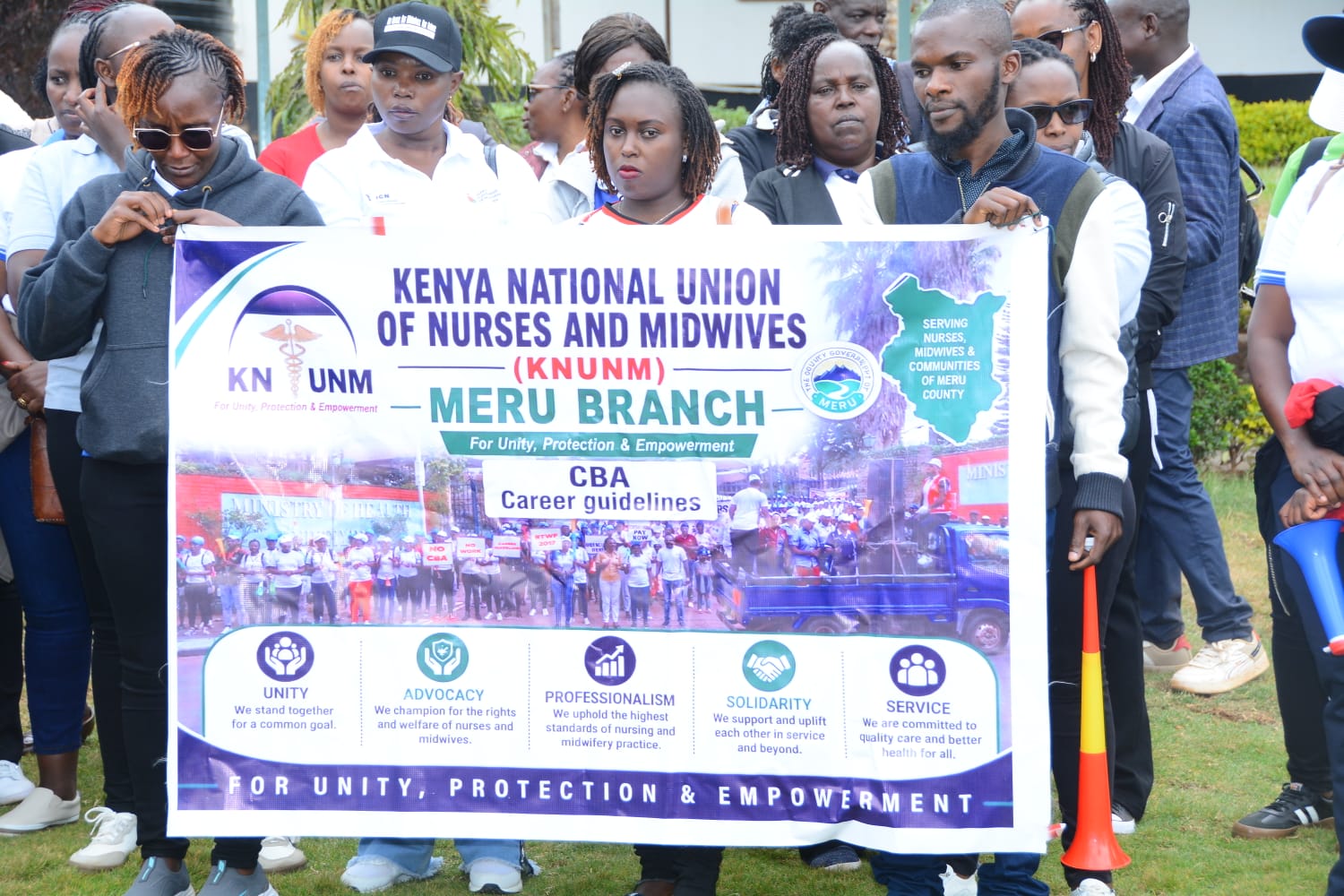
Nurses and Midwives in Meru county stand in Solidarity with colleagues from 47 counties. Photo by Brian Gitonga
Union officials demand CBA conclusion and absorption of over 7,400 UHC workers as industrial action continues to bite across all 47 counties.
By Brian Gitonga
Nurses and midwives in Meru County yesterday reaffirmed their participation in the ongoing nationwide strike, intensifying pressure on the Council of Governors and government agencies to resolve a long-running dispute over a new Collective Bargaining Agreement (CBA) and the absorption of Universal Health Coverage (UHC) workers into permanent county employment.
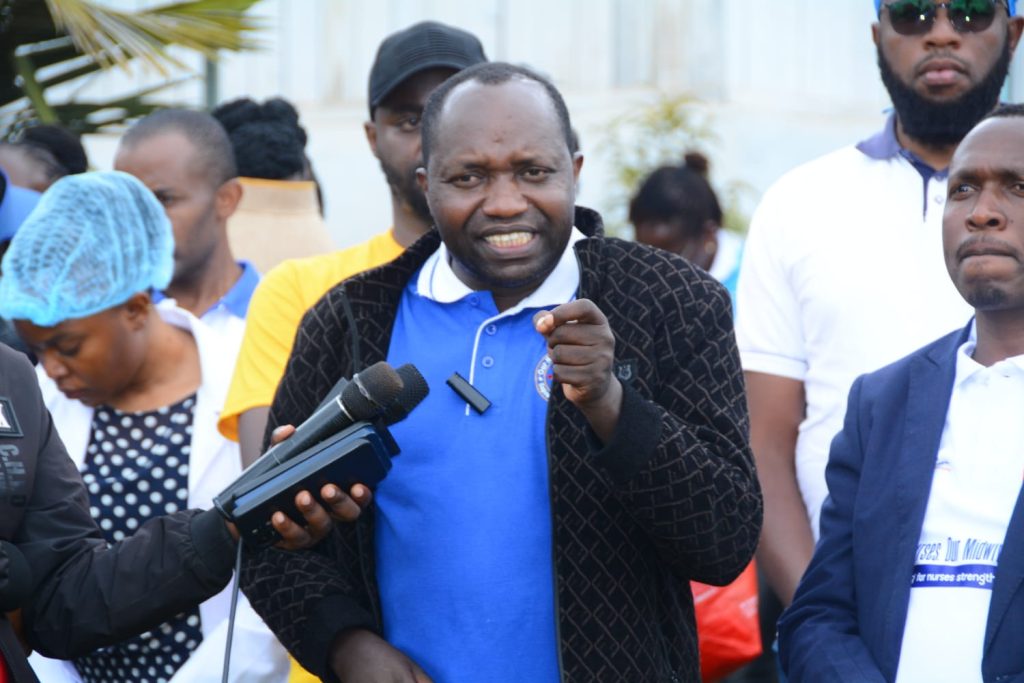
Speaking at a press briefing at Meru Level Five Hospital, Kenya National Union of Nurses and Midwives (KNUNM) Meru branch chairperson Mugambi Bakari said the industrial action, now in its 22nd day, was national in character and would continue until the outstanding grievances were addressed.
“Being the 22nd day of our strike, which is national in nature because it is about the Council of Governors, Salaries and Remuneration Commission, Public Service and any other group mandated to look into the activities and affairs of workers,” said Bakari.
The strike, which commenced on 29 July 2026, was called after KNUNM accused the government of failing to conclude negotiations for the 2025–2029 CBA and implement commitments made under the 2017 Return-to-Work Agreement, despite years of engagement. Bakari said the dispute was grounded in constitutional rights, specifically Article 41, which guarantees workers the right to fair labour practices and collective bargaining. He noted that workers and employers are expected to negotiate and renew a CBA every four years, but nurses had been without one since 2017.
“We had a return-to-work formula which was agreed upon, and the parties involved — including the Council of Governors, the Salaries and Remuneration Commission, the Public Service Commission and the union — agreed, but nothing was implemented,” said Bakari.
The chairperson also highlighted what he described as a glaring inequality between nurses and other professionals in the public sector. Doctors, clinical officers and teachers had all secured CBAs, he said, leaving nurses questioning why their own negotiations had dragged on unresolved for nearly a decade.
Bakari further raised the plight of UHC nurses — a situation he described as deeply unjust. More than 7,400 UHC workers have been demanding permanent and pensionable employment, with the National Treasury allocating KSh8.6B to facilitate their absorption. Despite this, county governments have refused to receive the payroll or issue appointment letters, leaving the workers in prolonged uncertainty.
“We have our colleagues, the UHC nurses, who served for the first three years expecting to be absorbed, but the Council of Governors has continued to refuse to absorb them,” said Bakari.
He stressed that nurses are central to the functioning of any health facility and that the public healthcare system simply cannot operate without them.
“Let it be known to Kenyans that without nurses, there is no hospital. That is the secret with the US, UK and Cuba — all of whom have valued their nurses — and that is why we are saying: let us be valued the way we deserve,” said Bakari.
Bakari was careful to draw a distinction between the national dispute and local county management. He credited Meru Governor Mutuma M’Ethingia with making meaningful progress in the county health sector, noting that the governor had promoted more than 500 health workers and employed 79 nurses during the year. The solidarity action, he emphasised, was directed at national institutions — not the county administration.
He also warned against intimidation of Meru nurses over their participation in the strike, saying the union expected its members to be free to exercise their constitutional rights without interference.
KNUNM Meru branch secretary Nesbit Mugendi said the union had been pursuing a CBA for more than eight years, repeatedly being referred between different government institutions without resolution. The prolonged process, he said, had left health workers exhausted and demoralised.
“Since we began this process, we have always been taken in circles. When we speak with the SRC, they send us to the Council of Governors; the Council of Governors sends us to court. We have become tired of following up this matter,” said Mugendi.
Mugendi also questioned the adequacy of allowances paid to nurses relative to the risks they face daily while providing healthcare — risks he said were insufficiently recognised in their current terms of service.
The strike has continued despite a court order directing nurses to return to work, which the union defied, insisting it would only stand down once the government honoured its agreements. The nurses said their solidarity with colleagues across the country would continue until the 2025–2029 CBA is concluded, the 2017 return-to-work commitments are fully implemented, and the fate of UHC workers is definitively resolved.
Similar Posts by The Mt Kenya Times:
- Mt Kenya Times ePAPER October 9, 2026
- Ruto claims farming revolution as election season dawns
- China grants Kenya $2M for drought and Ebola response
- High Court upholds KSh2.5M IEBC fine against Gikaria
- Kenya’s opposition fractures with 11 months to the ballot
About the Author