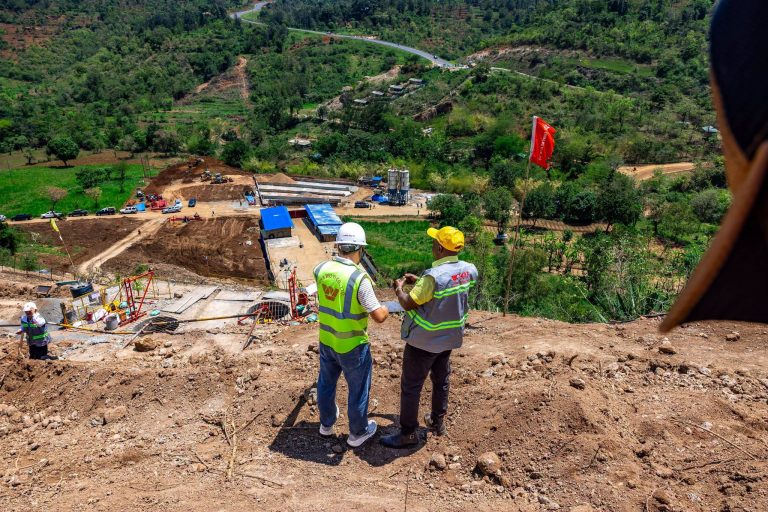
The Principal Secretary for Water and Sanitation later led a high-level delegation to inspect ongoing Water and Sanitation Development Program (WSDP) projects in Malindi County. The delegation included Chief Executive Officers from implementing agencies and Chief Executive Committee Members from counties benefiting from the program. Key projects visited during the tour included: Sabaki and Watamu Faecal Sludge Treatment Facilities, currently at 71% completion, which will greatly improve sanitation services along the coast and Waste to Value Faecal Sludge Treatment Plant in Malindi Town, which is currently at 48.5% completion and set to convert waste into usable resources, creating a cleaner and more sustainable environment. The inspection aimed to assess the progress, address any implementation challenges, and reaffirm the government’s commitment to delivering quality water and sanitation services to all Kenyans. These projects mark a significant step towards achieving sustainable urban sanitation solutions and improving public health outcomes in the region.
 The Ministry of Environment, Climate Change and Forestry on Friday concluded the three-day public participation exercise held in Isiolo, Eldoret and Mombasa. These forums, conducted under the leadership of Mr. Gitonga Mugambi, Principal Secretary, State Department for Forestry and spearheaded by Dr. Magrate Kaigongi, brought together a diverse group of stakeholders in the forestry sector to discuss the draft Forest Conservation and Management Regulations and the Forest Conservation and Management (Amendment) Bill, 2025.
The discussions focused on the Amendment bill, which seeks to modernize the Forest Conservation and Management Act, 2016. The Bill is premised on the reality of emerging needs and existing gaps within the forest sector’s legal and institutional arrangements. These needs and existing gaps have been discussed in the recently approved National Forest Policy, 2023, which now forms the basis for national action with regards to forestry development, conservation and management. Furthermore, there is a need to align institutional roles within the forestry Sector. The Bill proposes to formally include the Kenya Forestry Research Institute (KEFRI), which is currently governed under the Science, Technology and Innovation Act, 2013. Other proposals in the Bill include the establishment of institutions such as the Forest Regulatory Directorate and the Kenya Forest Law Enforcement Academy. By consolidating all the key forestry institutions under the Forest Conservation and Management Act, the Bill aims to improve coordination, oversight and resource use. This will also promote better policy, legal and operational alignment across the sector. The Bill also introduces provisions on forest carbon management, recognition of dryland forestry, forest buffer zones and stronger penalties for illegal activities affecting forest resources. Additionally, it touches on community involvement and benefit-sharing, enhanced support for commercial forestry and improved forest protection, all geared toward promoting accountability, sustainability and equity in forest governance. Stakeholders actively engaged in the discussions and offered valuable insights to strengthen the proposed legal framework.
Next week, the public participation forums will take place in Nairobi County on Tuesday. The Ministry encourages all stakeholders to attend and share their views to help shape policies and regulations that will secure the future of forest governance in Kenya. Deborah Mlongo Barasa
Ministry of Environment, Climate Change & Forestry
Kenya Forest Service
Kenya Forestry Research Institute
 Cabinet Committees assist in synchronizing and hastening the discharge of Cabinet business to ensure faster implementation of Government business and service delivery to the people. On Friday, the cabinet committee concluded a special meeting on Finance, Infrastructure, Land and Production in which key policy and legislative proposals relating to economic recovery, capital markets as well as improving governance in parastatals and strengthening the rule of law were considered. Cabinet Secretaries; Alice Wahome (Lands, Public Works, Housing and Urban Development), John Mbadi (National Treasury and Economic Planning), Davis Chirchir (Roads and Transport), James Opiyo Wandayi (Energy and Petroleum), Dr. Deborah Barasa (Environment, Climate Change and Forestry), Rebecca Miano (Tourism and Wildlife), Dorcas Oduor (Attorney General) and Secretary to the Cabinet Mercy Wanjau in attendance.
 The Kenya Engineering Technology Registration Board (KETRB), in collaboration with Huduma Kenya, has launched registration and licensing services at the Eldoret Huduma Centre for engineering technologists and technicians, thereby enhancing efficiency and accessibility at the grassroots level. Speaking during the launch, the Chief Executive Officer of Huduma Kenya, CPA Ben Kai Chilumo, said the move would ensure engineering services are brought closer to clients. He noted that the programme was undertaken to onboard as many Ministries, Departments, and Agencies (MDAs) as possible to bring services closer to Kenyans and ensure access to simplified, citizen-centric services. Chilumo also called upon other MDAs that have not yet deployed their services to Huduma centres due to insufficient staff to make use of Huduma universal agents, who can represent them without requiring the deployment of their own personnel. KETRB Acting CEO Kigo Florence said the partnership with Huduma Kenya was prompted by the fact that most of their clients, members, and students were unaware of the Board, and this initiative would help accelerate and streamline service delivery.
She emphasized that KETRB is a professional body mandated to license and register engineering technologists and technicians in the country.
According to KETRB, their services are now available in 10 Huduma Centres: Garissa, Eldoret, Meru, Makueni, Mombasa, Makadara, Nyeri, Bomet, Kakamega, and Kisumu. The Board was established in 2016 to set standards for engineering technologists and technicians, and to register and issue licenses to qualified individuals as per the provisions of the Engineering Technology Act No. 23 of 2016, Part II, Section 3(1).
Similar Posts by The Mt Kenya Times:
- Mt Kenya Times ePAPER October 23, 2026
- Ruto’s parting COMESA call: Remove the barriers, honour the commitments
- Direct hospital access to KEMSA cuts drug delays, says PS
- Africa can’t wait: Continent seeks $1 trillion for climate adaptation
- Ruto passes the baton as Africa’s trade bloc faces a fragmenting world
About the Author