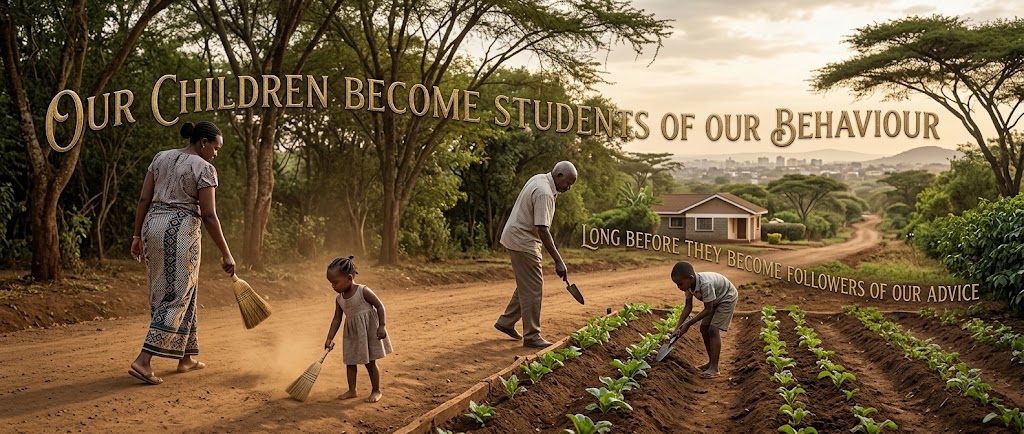
Our children become students of our behaviour long before they become followers of our advice
The longest story in the KCSE anthology holds a mirror to Kenyan parents — and the reflection is uncomfortable
By Ashford Kimani
What are we really passing on to our children? The KCSE short stories anthology, A Silent Song and Other Stories, captures this question with striking clarity in The Sins of the Fathers, by Zimbabwean writer Charles Mungoshi — the longest of the 14 stories in the collection.
Many Kenyan parents spend a significant part of their lives worrying about what they will leave behind. They buy land, build houses, educate their children and invest in businesses. The goal is to leave behind security and opportunity. There is nothing wrong with that. It is, in fact, one of the noblest responsibilities of parenthood.
Yet there is another inheritance that is too often overlooked. It cannot be registered at the lands office, deposited in a bank account or transferred through a will. It is the inheritance of character — and it may be the most consequential gift a parent can ever give.
That reality is at the heart of The Sins of the Fathers. The story follows Rondo Rwafa, a young man carrying the weight of his father’s legacy. His father, Mr Rwafa, is publicly celebrated as a liberation war hero and influential figure — successful, powerful, worthy of admiration. But Rondo knows a different man entirely. Behind the public image lies arrogance, violence, dishonesty and an abuse of power that has quietly shaped his son’s inner world.
The greatest burden Rondo carries is not poverty, lack of education or social disadvantage. It is the emotional and moral damage caused by his father’s conduct. Mr Rwafa leaves his son something far more destructive than financial hardship — he leaves him anger, confusion, fear and shame.
Every parent ought to pause at that.
Many are working hard to leave wealth for their children. But what if, in the same breath, they are passing on habits and attitudes that will undermine that very wealth? What if they are building houses while destroying relationships? What if they are paying school fees while quietly teaching dishonesty, pride or irresponsibility through their daily actions?
Children learn far more from observation than from instruction.
A father may tell his son to be truthful, but if the child watches him lie to customers, evade responsibility or manipulate others, the lesson of honesty is lost. A mother may insist on respect, but if she routinely insults household staff, neighbours or teachers, the child learns disrespect. Children become students of behaviour long before they become followers of advice.
One of the most memorable moments in the story comes when Rondo recalls an incident involving his father and Basil Mzamane. A woman is stranded and threatened by armed men. The celebrated war hero, Mr Rwafa, hides in fear. Mzamane steps forward, confronts the men and protects her. In that moment, Rondo discovers a painful truth: reputation and character are not always the same thing.
That lesson is acutely relevant in Kenya today. Society often celebrates success without examining the character behind it. Wealth is admired without asking how it was acquired. Influence is praised without scrutinising integrity. Titles and achievements impress — while children quietly observe the values, or the absence of them, that sit beneath.
Parents must remember: children do not inherit a public image. They inherit a private example.
A child who grows up witnessing kindness is likely to practise it. One who observes integrity learns it. One who sees responsibility lived out develops it. Equally, children exposed to persistent anger, dishonesty and disrespect often carry those patterns deep into adulthood.
This is not a call for parental perfection. Every family experiences failure and moments of weakness. What matters is how those moments are handled. Among the most powerful lessons a parent can teach is accountability — the willingness to say, plainly and without theatre, “I was wrong. Please forgive me.” Such words do not diminish authority. They model humility, honesty and maturity. Children respect parents who are honest enough to own their shortcomings.
The tragedy in The Sins of the Fathers is that Mr Rwafa never confronts his failures. He continues recounting his own greatness while the damage he has caused festers around him. His son is left to wrestle with the consequences alone.
Many Kenyan families will recognise something of that pattern. Some parents are physically present but emotionally absent. Others meet material needs while neglecting moral guidance. Some achieve impressive professional success while failing to nurture healthy family relationships. Years later, their children may hold degrees, jobs and property — and still carry emotional wounds that quietly govern their lives.
As parents, the difficult questions are worth asking regularly. What memories are we creating? What values are we modelling? What stories will our children tell about us twenty years from now? Will they remember a parent who lived with integrity, treated others with respect and acknowledged mistakes? Or will they remember someone whose public reputation bore little resemblance to private behaviour?
The title The Sins of the Fathers is a reminder that the actions of one generation shape the next. But it also carries an important counterweight: destructive cycles can be broken. Parents have the opportunity to leave behind not only wealth but wisdom, not only property but principles, not only success but significance.
In the end, the greatest inheritance is not what is placed in a child’s hands. It is what is placed in their heart. Long after the land is divided and the money spent, character remains. That is the legacy children will carry for the rest of their lives.
Similar Posts by The Mt Kenya Times:
- Kisumu water project lays foundation for dignified urban growth
- The months ahead offer Kenya a golden opportunity to grow tourism
- Mau Mau groups urged to unite over compensation push
- A comparative insight into Romantic and South Asian Poetic Heritage
- Kenya’s 2027 election is taking shape — and the early signs are troubling
About the Author