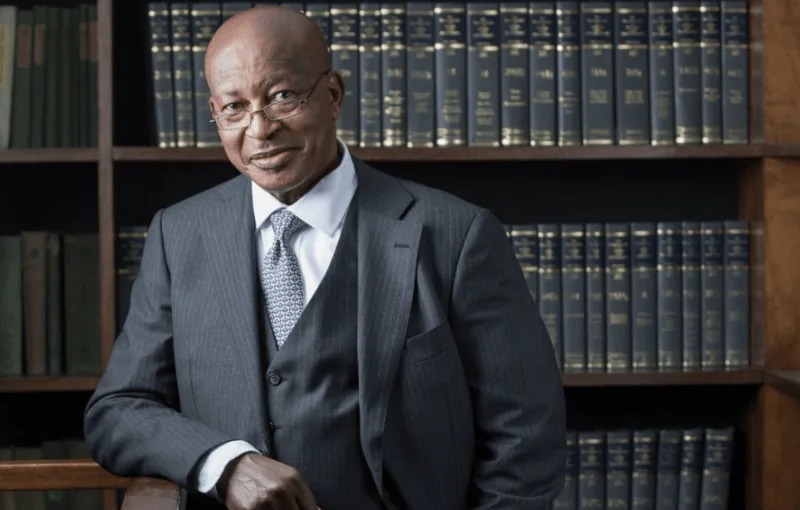
Late Justice Paul Kihara Kariuki
Retired Court of Appeal President and former Attorney General who shaped Kenya’s judicial architecture dies aged 72
By Wanjiru Kamau
Paul Kihara Kariuki, one of Kenya’s most consequential legal minds, died yesterday aged 72, leaving behind a judiciary he helped build, reform and professionalise over more than two decades of public service. The Judiciary paid tribute to him as a distinguished jurist whose contribution to Kenya’s legal institutions will endure. From the High Court bench to Sheria House, Kariuki occupied every significant perch the law offered — and left each one measurably better than he found it.
He was born on 11 May 1954 in Kiambu, Kenya. His early life unfolded in a country still finding its feet as an independent republic, and the law would become his life’s instrument for ordering and strengthening that young nation’s institutions. He read for a Bachelor of Laws degree at the University of Nairobi before earning a Postgraduate Diploma in Law from the Kenya School of Law — the very institution he would later lead as its principal and chief executive officer, a detail that speaks to the circular arc of a career devoted entirely to the legal profession.
Before ascending to the bench, Kariuki cut his professional teeth in legal education and administration. His stewardship of the Kenya School of Law gave him an understanding of how lawyers are made, not merely of how law is argued. It was a foundation that would inform his later insistence, once he reached the appellate courts, that judicial reform was as much about building people and institutions as it was about writing judgments.
In October 2003, Kariuki was among the judges appointed to the High Court by President Mwai Kibaki, joining the bench at a pivotal moment in Kenya’s democratic evolution. The country had just come through the historic 2002 elections that ended more than two decades of single-party rule, and the judiciary was under mounting pressure to demonstrate independence and competence. Kariuki served on the High Court through a decade of constitutional flux, hearing cases that tested the boundaries of a legal order still being renegotiated between citizens and the state.
He was elevated to the Court of Appeal in 2012, and there made history when he became the first President of the Court of Appeal elected by fellow judges under the 2010 Constitution. The significance of that distinction cannot be overstated. Under the old constitutional order, judicial appointments flowed from presidential discretion, leaving the bench dependent on executive goodwill. The 2010 Constitution broke that link, and Kariuki became the embodiment of its new vision — a senior judge chosen by peers, not patrons.
He served as President of the Court of Appeal from 2013 to 2018, during which he championed reforms aimed at improving the court’s efficiency and accessibility, including decentralising its operations. The decentralisation of the Court of Appeal was not a bureaucratic footnote — it meant that Kenyans in Kisumu, Mombasa and Nyeri could access appellate justice without travelling to Nairobi, a practical democratisation of a court that had long seemed remote to ordinary litigants. During his tenure, he contributed to the development of institutional frameworks for the court, including the Court of Appeal Bill and its strategic plan.
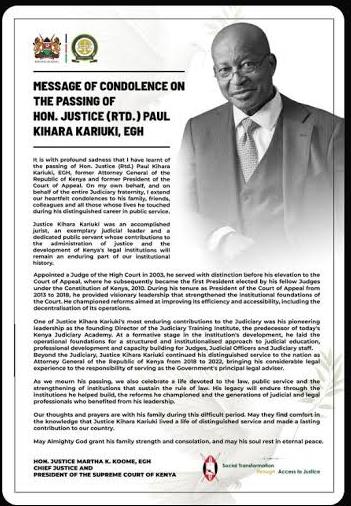
Chief Justice Martha Koome, in her condolence message, recognised his role as the founding Director of the Judiciary Training Institute, the predecessor of the Kenya Judiciary Academy. Koome said he laid the institutional foundations for structured judicial education, professional development and capacity building for judges, judicial officers and Judiciary staff. In establishing that institute, Kariuki solved a problem that had long afflicted Kenyan justice: judges and magistrates were expected to adjudicate complex disputes without any structured ongoing education. He built the architecture to change that, and its successor institution continues his work today.
The competitive nature of the 2013 Court of Appeal presidential election is itself a revealing footnote. David Maraga, who would later become Chief Justice, vied for the presidency of the Court of Appeal in 2013, losing by a single vote to Kariuki. That Kariuki prevailed in such a contest — decided by the secret ballot of his fellow judges — attested to the professional esteem in which he was held by those who knew his work most intimately.
Kariuki served as Kenya’s Attorney General from February 2018 to October 2022, becoming the country’s seventh holder of the office. He succeeded Professor Githu Muigai after nomination by former President Uhuru Kenyatta and was sworn in in April 2018. As Attorney General, he straddled the constitutional divide between the judiciary and the executive, serving as the government’s principal legal adviser at a time of intense political turbulence. His tenure encompassed contested elections, a global pandemic and a succession of constitutional challenges that required careful, measured legal guidance. Colleagues who worked alongside him at Sheria House describe a man who brought judicial temperament to an executive office — slow to anger, meticulous in reasoning and resistant to political pressure.
Koome said Kariuki’s legacy would live on through the institutions he helped build, the reforms he championed and the generations of legal professionals who benefited from his leadership. That assessment is not mere official eulogy. The Court of Appeal he restructured continues to function along the lines he laid down. The Judiciary Academy whose foundations he set continues to train magistrates and judges. The Attorney General’s chambers he occupied still carry the procedural reforms he introduced during his four-year tenure.
He is survived by his wife, Sarah Njoki Kariuki. Beyond his family, he leaves behind a legal fraternity that measured itself against his standards and a country whose rule of law stands on stronger foundations because he chose to devote his life to it. Kenya has produced many lawyers. It has produced far fewer who, across so many decades and so many roles, built as much as Paul Kihara Kariuki built.
Koome prayed for strength and comfort for his family, describing his life as one devoted to the law, public service and the rule of law. In a country where public service is too often measured in what it extracts rather than what it contributes, Kariuki’s career stands as a counterargument — quiet, methodical and, in its cumulative effect, profound.
Similar Posts by The Mt Kenya Times:
- Under Old Trafford lights, dreams refuse to die
- Koome and DCI Amin trade blame over rising political goonism ahead of 2027 polls
- Talanta Stadium under scrutiny as Kenyans question cost of Bayern-Ajax clash
- Cheating in KCSE: A betrayal of education, integrity, and Kenya’s future
- The blue tsunami and the hollow throne: When voters write the epitaph of impunity
About the Author