Prime Cabinet Secretary Responds To MPs Questions On The Rising Cost Of Basic Commodities And Fuel
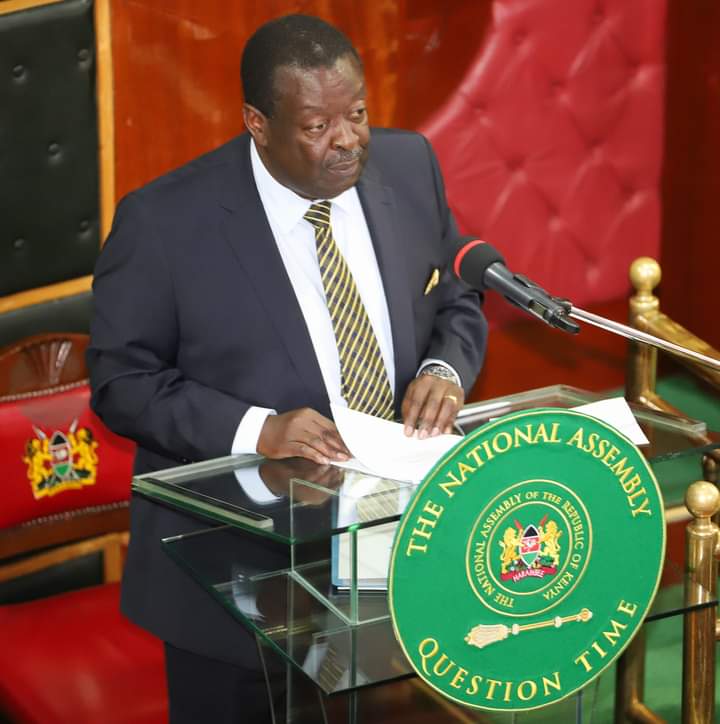
Musalia Mudavadi in the Chambers yesterday

By Our Correspondent
Worth Noting:
- “To address the challenge of food insecurity, the government has invested in biotechnology research and uptake of drought-tolerant crops. In the current year, over 250 MT of assorted drought-tolerant seeds valued at Sh50 Million have been distributed to farmers in several counties. The government expects farmers to multiply and redistribute the seeds in their localities, thus addressing the challenge of seed access and food insecurity,” said Mudavadi.
- In a session chaired by the Speaker Moses Wetangula, Members of the National Assembly sought responses on from Mudavadi on the measures the government has put on place to reduce the cost of fuel and energy.
The Government of Kenya is taking measures to address the rising cost of basic commodities in the country. In response to a question by Yusuf Hassan, MP Kamukunji Constituency, Prime Cabinet Secretary Musalia Mudavadi outlined the government’s efforts to promote food security and reduce the cost of fuel.
While making his submissions, the Prime Cabinet Secretary informed the National Assembly that the government is implementing various initiatives to address food security and reduce the cost of fuel.
These measures are aimed at boosting the country’s economy, which has been hit hard by the COVID-19 pandemic.
“To address the challenge of food insecurity, the government has invested in biotechnology research and uptake of drought-tolerant crops. In the current year, over 250 MT of assorted drought-tolerant seeds valued at Sh50 Million have been distributed to farmers in several counties. The government expects farmers to multiply and redistribute the seeds in their localities, thus addressing the challenge of seed access and food insecurity,” said Mudavadi.
In a session chaired by the Speaker Moses Wetangula, Members of the National Assembly sought responses on from Mudavadi on the measures the government has put on place to reduce the cost of fuel and energy.
According to the Prime Cabinet Secretary, the government has lifted the moratorium on Power Purchase Agreements (PPAs) to enhance the country’s energy security by opening up the energy sector to continued investments.
Documents tabled during the plenary session revealed that prior to April 2023, the government imported all its petroleum products requirements through the Open Tendering System (OTS), which put a strain on the government’s forex reserves and caused a huge deficiency in availability of USD, causing depreciation of the Kenya shilling. To ease this pressure, the government entered into Memoranda of Understanding (MoU) with prospective governments and Master Framework Agreements (MFA) with their respective petroleum trading entities for the supply of petroleum products on extended credit period.
Members asked supplementary questions regarding the importation of maize and the alleged farming of Kenya maize in Zambia.
Mudavadi reiterated that there is no Kenyan maize growing in Zambia. He further informed the House that the government has granted duty waiver for importation of 1.4 Million MT of white maize, 600,000 MT of rice, 500,000 MT of yellow maize, 200,000 MT of soya beans; 300,000 MT of soya bean meal, 1,600 MT of assorted protein concentrate and 40,000 MT of feed additives to bridge the food stocks deficit and stabilize the high food commodity prices.
Additionally, the government is implementing various programmes, including Crop and Livestock Insurance Programmes, National Value Chain Support Programme, and Kenya Climate Smart Support Programme, among others, to enhance farmers’ food security and resilience.
These initiatives are expected to have a positive impact on the country’s economy and enhance food security, as well as reduce the cost of fuel for consumers.
Similar Posts by The Mt Kenya Times:
- From job seekers to job creators: Africa needs a new bargain between universities, governments and business
- BALLOTS, BULLETS AND THE PRICE OF A WARD
- Mt Kenya Times ePAPER October 24-25, 2026
- Muturi calls on IEBC to keep election technology tender clean and on schedule
- Ruto meets UAE minister in push to deepen trade ties
About the Author