Ruaraka land saga: How KSh1.5B was paid for land the government already owned
 The Mt Kenya Times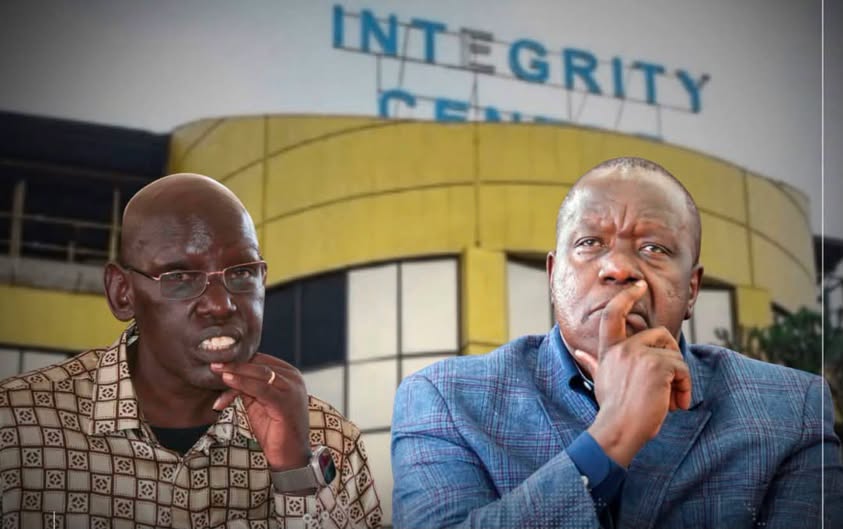
Former Education Cabinet Secretary Fred Matiang'i and former Principal Secretary Belio Kipsang
A Court of Appeal ruling has cleared the way for Kenya’s anti-corruption body to recover billions paid as compensation for public land that was never legally available for acquisition in the first place.
By Hadassah Karangu
The Ethics and Anti-Corruption Commission is moving to recover KSh1.5B in public funds after a Court of Appeal ruling confirmed that compensation paid for land occupied by two Nairobi public schools was unlawful, because the government had been paying for property it already owned.
The disputed land — approximately 13.5 acres in Ruaraka, Nairobi, on which Ruaraka High School and Drive-In Primary School stand — has been at the centre of one of Kenya’s most contentious public land disputes for years. The core question was deceptively simple, and yet it took years of investigations, Senate inquiries and protracted litigation to answer: how does a government end up paying for land that already belongs to it?
According to investigations cited in the case, the land had been surrendered to the State as a condition attached to the approval of the subdivision of LR No. 7879/4, meaning it was designated for public utilities and had ceased to be private property available for later acquisition. Despite that, the National Land Commission proceeded with a compulsory acquisition process and paid KSh1.5B to private interests — a payment the Court of Appeal has now declared null and void.
In its July 3 judgment, the appellate court affirmed that there was no legal basis for the commission to compulsorily acquire land that already belonged to the government. For the EACC, the ruling vindicates years of investigation. “The court’s decision has cleared the way for us to pursue recovery of the funds and further action against those implicated in the transaction,” the commission said.

The case has drawn in several prominent names. Former Education Cabinet Secretary Fred Matiang’i and former Principal Secretary Belio Kipsang are among the public officials whose names have appeared in connection with the transaction. Their appearance in the proceedings should not, however, be read as a finding of criminal guilt — responsibility for any wrongdoing remains a matter for the courts and the relevant prosecutorial processes to determine. That distinction matters enormously in a case that has accumulated considerable political heat over the years.
The Senate had previously sounded the alarm. Its inquiry found that the land on which both schools stood had been surrendered for public purposes and recommended investigations into the circumstances surrounding the compensation, specifically questioning the roles played by officials involved in the acquisition process. Those recommendations were not enough to stop the payment going through.
Recovering the money will not be straightforward. A court finding that a payment was unlawful does not automatically translate into criminal liability for everyone associated with the transaction. The EACC must establish the legal basis for recovery from specific individuals or entities, and where criminal conduct is alleged, investigators and prosecutors must satisfy the evidentiary standards of the criminal justice system. Due process is not a bureaucratic inconvenience — it is the foundation on which any credible anti-corruption effort must stand.
The case also illuminates a systemic problem that runs deeper than any single transaction. Kenya’s land administration involves multiple agencies, records, approvals, surveys, valuations and legal processes. When those systems fail to communicate with one another, or when ownership status is not conclusively established before public funds are committed, taxpayers end up bearing enormous costs. The EACC has previously identified serious weaknesses in the State Department of Lands and Physical Planning — irregular approvals, inaccurate surveys, double registration of parcels, forged documents and missing land records. These are not minor administrative glitches. They are the gaps through which public resources disappear.
KSh1.5B is not merely a figure in a court document. It is money that could have built classrooms, staffed hospitals, laid roads or supplied clean water to communities across Kenya. When public funds vanish through unlawful transactions, the opportunity cost extends far beyond the headline number — and the message sent to the public, if no one is held accountable, is a corrosive one: that government resources can be lost through questionable dealings without meaningful consequences.
Recovery matters. But so does reform. Returning the money addresses the loss. Fixing the systems that allowed the transaction to proceed in the first place addresses the underlying problem. Government agencies need reliable mechanisms for verifying land ownership before any acquisition is approved. Warning signs should trigger scrutiny, not be quietly filed away as administrative inconveniences.
The Ruaraka saga has taken years to reach this point. The Court of Appeal has now answered the ownership question. What remains to be seen is whether Kenya can answer the harder ones — about accountability, institutional reform and what it will take to ensure that taxpayers are never again asked to buy back what already belongs to them.
Similar Posts by The Mt Kenya Times:
- Mt Kenya Times ePAPER October 1, 2026
- Museveni backs Lamu but keeps Uganda’s money at home
- Sifuna’s party wins its name — and Kenya’s opposition race begins in earnest
- Lamu’s $16B gamble: Africa’s biggest refinery divides the region
- Ruto launches KSh2.2 trillion Lamu refinery in East Africa’s biggest energy bet
About the Author