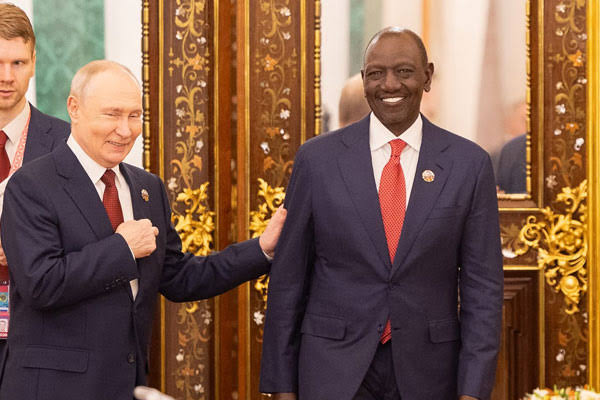
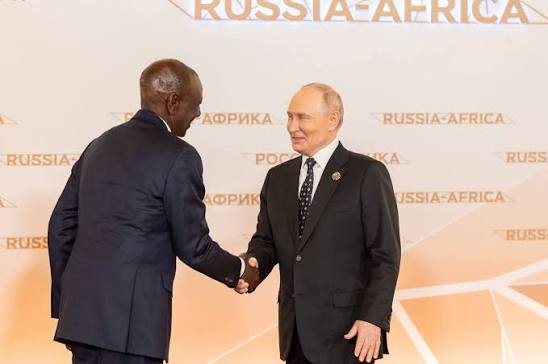
President William Ruto with President Vladimir Putin
Putin designates Kenya a non-source country for enlistment as Nairobi appoints a defence attaché to repatriate and compensate citizens trapped in the Ukraine war.
By James Mwangi
President William Ruto announced Friday that Russia has formally agreed to stop recruiting Kenyan citizens into its military, following bilateral talks with President Vladimir Putin at the Kremlin in Moscow on Friday — a diplomatic breakthrough that brings cautious relief to hundreds of Kenyan families who have spent months searching for sons, brothers and husbands swallowed by a war that was never Kenya’s to fight.
Ruto, speaking after the conclusion of the Russia-Africa Summit, said Putin had confirmed that Kenya had been designated a non-source country for recruitment into the Russian military, effectively closing the enlistment pipeline that drew hundreds of Kenyans into one of the world’s deadliest active conflicts.
“Thanked President Putin for confirming that Kenyans will no longer be enlisted into the Russian military because Kenya has been categorised a non-source country for recruitment into the Russian military,” Ruto posted on his X account on Friday. “Informed President Putin that I have appointed a Defence Attaché at the Kenya Embassy in Moscow, who will liaise with the Russian Ministry of Defence in processing the return of Kenyans who were in Russia for military purposes,” he added.
The announcement caps months of painstaking diplomacy that began in earnest after the scale of Kenya’s exposure to the Russia-Ukraine war became impossible for Nairobi to ignore or contain. What started as scattered reports of missing young men evolved into a national crisis — one that drew protesters to the streets, relatives to Parliament gates, and Kenya’s foreign affairs machinery into urgent, repeated contact with Moscow.
The government has identified at least 289 Kenyans recruited into the Russian military, based on reports received from families and official inquiries, with 153 remaining unaccounted for and 69 confirmed killed in action or reported missing. Those are the verified numbers. The true scale is almost certainly larger. Kenya’s National Intelligence Service reported that more than 1,000 Kenyans were recruited to fight for Russia in Ukraine, misled with promises of skilled employment before being sent to the frontlines. Continent-wide, at least 3,066 Africans from 40 countries were recruited into Russia’s armed forces from October 2022, with 502 documented as killed in action by June 2026 — and Kenya sits at the top of the list of African nations supplying the largest numbers.
The human cost has been devastating and intimate in equal measure. Across Kenya, families have been searching for sons, brothers and husbands who quietly left the country after being promised jobs in Russia, only to disappear into a war that was never theirs. Some have been officially declared dead, others are logged as missing, while many families have received neither bodies nor any word of where their loved ones are buried.
The grief has a geography. In Kisii County, Dennis Bagaka Ombwori, 39, became the latest Kenyan confirmed dead in the Russia-Ukraine war, his mother’s wails filling their family home in Sikonga village. In Donetsk, one Kenyan was killed in what Ukrainian authorities described as a high-casualty assault, his body left unrecovered by Russian forces — he was found still carrying the passports of two other Kenyans. Two Kenyans, Evans Kibet and Macharia Willi Muniu, remain prisoners of war in Ukraine. In Nairobi, families gathered at Jevanjee Gardens to speak publicly about the grief and uncertainty consuming their households, after relatives were duped by Russian agents into frontline deployment.
The recruitment pipeline exploited Kenya’s unemployment pressures with surgical cynicism. Many returnees and families of those still deployed say their relatives were lured or tricked — promised lucrative jobs or skilled employment abroad, only to be issued a weapon and directed towards Ukrainian trenches. Recruiters operated through social media, job agencies and personal networks, presenting what appeared to be credible employment contracts. The reality, for those who arrived in Russia, was starkly different. One message, widely shared among families of recruits and cited by rights organisations, carried a desperate warning from a Kenyan inside the war: “Kenyans, don’t come here. Just death is patrolling here. My friends are dead with their money which we came here for. Please don’t come. There is no champion in war.”
A Kenyan government official had previously acknowledged that citizens were “irregularly recruited” and that many fell victim to “unscrupulous groups” in their desire to work abroad. Kenyan police made arrests connected to the recruitment networks, but the criminal architecture behind the operation — spanning multiple countries and exploiting legal loopholes in labour migration — has proved difficult to dismantle entirely.
The diplomatic groundwork for Friday’s agreement was laid in March 2026, when Mudavadi travelled to Moscow and held talks with Russian Foreign Minister Sergei Lavrov, securing Kenya’s placement on Russia’s recruitment stop list. Friday’s Kremlin summit elevated that commitment to heads-of-state level, lending it political weight that earlier undertakings lacked. According to State House, the two leaders formally agreed to designate Kenya as a non-source country for recruitment into the Russian military.
To give the agreement practical force, Ruto confirmed that a Defence Attaché has been appointed at the Kenyan Embassy in Moscow to work directly with Russia’s Ministry of Defence, coordinating the safe return of Kenyans and determining how compensation claims for those affected — and for families of the dead — will be processed. Of the Kenyans identified in-country, 77 had been on the frontlines, 38 in military camps, 52 in unclassified locations and 34 hospitalised under conditions that restricted consular access. The Defence Attaché’s role will be to cut through that opacity and establish direct institutional contact with the Russian military establishment.
The talks in Moscow ranged considerably beyond the military crisis that dominated headlines. The two leaders agreed to expand Russian scholarships for Kenyan students from 70 to 300 annually and committed their governments to negotiating a bilateral labour agreement that would allow Kenyans to live and work legally in Russia — a structured channel intended, in part, to replace the dangerous informal pathways that recruiters have exploited. The two countries also signed five cooperation instruments covering economic cooperation, labour inspection and employment promotion, transport, diplomatic training and visa-free travel for holders of diplomatic and service passports.
Ruto acknowledged the longstanding diplomatic ties between the two nations, recalling that Russia was the second country to recognise Kenya’s independence in 1963 and noting that Russia remains one of Kenya’s leading suppliers of fertiliser. He pressed for increased Kenyan exports of tea and flowers to address a widening trade imbalance that currently favours Moscow. Putin pledged support for the expansion of United Nations offices in Nairobi, the only UN headquarters located in the developing world, as the two leaders signalled a desire to deepen engagement amid a shifting global diplomatic order.
In a gesture that underscored the warming bilateral tone, Ruto extended a formal invitation for Putin to visit Kenya. If accepted, it would mark the Russian president’s first official visit to the country and his first trip to Africa since 2018 — a visit that would carry considerable symbolic weight given Russia’s expanding continental ambitions and Kenya’s position as East Africa’s diplomatic anchor.
The Moscow accord draws a formal line under a scandal that exposed, with painful clarity, Kenya’s vulnerability to transnational labour exploitation and the limits of state protection for citizens pursuing work abroad. It also raises questions that will outlast Friday’s handshake: how many Kenyans remain unaccounted for, what compensation will actually reach bereaved families, and whether the criminal networks that fed young Kenyans into a foreign war have truly been shut down or merely disrupted.
For the families still waiting — in Kisii, in Nairobi, in villages scattered across central and western Kenya — Friday’s announcement in Moscow is the first credible institutional promise that those who can still come home will be brought home. Whether Russia honours it will determine whether this was a diplomatic victory or simply a more dignified form of delay.
Similar Posts by The Mt Kenya Times:
- AFA boosts sunflower, cotton and cashew nut farming in Tharaka-Nithi
- Can literary works heal human psychology?
- Soda truck crash near DeKUT renews black spot alarm
- Over 2.5 million learners complete national assessments as KCSE written exams begin Monday
- Sifuna launches Linda Mwananchi Party as opposition giants converge on Nairobi
About the Author