Ruto’s Mt Kenya Tour: A Political Reckoning for Allies, A 2027 Bitter Lesson

President William Ruto being taken through the progress of one of the affordable housing projects

By Suleiman Mbatiah

President William Ruto’s highly anticipated five-day development tour of the Mt Kenya region, which concluded on Saturday, has left a trail of political wreckage in its wake. Intended to bolster support and showcase development projects ahead of his 2027 reelection bid, the tour instead exposed deep fissures within his Kenya Kwanza coalition, sending some politicians into potential oblivion while offering Ruto a stark lesson on who to trust, and who to abandon, as he navigates the region’s volatile political landscape.
The Mt Kenya region, a vote-rich powerhouse that delivered more than half of Ruto’s 7.1 million votes in the 2022 election, has been simmering with discontent since the impeachment of former Deputy President Rigathi Gachagua in October 2024.
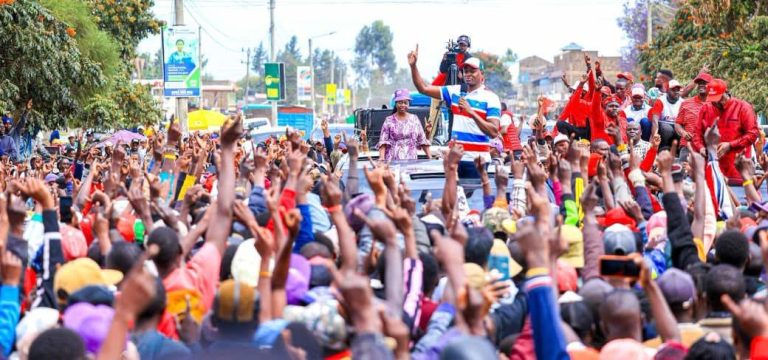
Ruto’s tour, spanning April 1 to April 5, aimed to reaffirm his influence through promises of roads, markets, affordable housing industrial parks, and agricultural reforms. However, the reception ranged from enthusiastic in some quarters to outright hostile in others, with heckling and lukewarm welcomes revealing the fragility of his alliances.
For some of Ruto’s faithful allies, the tour turned into a public humiliation on their home turf.
National Assembly Majority Leader Kimani Ichung’wah faced a barrage of jeers during a stopover in Nyandarua County. As he attempted to rally the crowd in support of Ruto’s development agenda, angry residents shouted him down, accusing him of abandoning their interests for personal gain.
“You’ve sold us out!” one attendee yelled; a sentiment echoed by others who waved off his calls for unity.
Ichung’wah, a key figure in Ruto’s inner circle, appeared rattled, his influence in the region visibly dented. He later blamed the heckling on political rivals, claiming, “The hecklers were mobilised and paid by the Nyandarua governor against the area’s Woman Representative Faith Gitau over their local gubernatorial politics. Still, I think there were also those organised by Senator John Methu against Hon Mwangi Kiunjuri and myself.” He doubled down on his stance, asserting, “Let me tell you. No one can shout me down. I cannot be intimidated,” and vowed to continue supporting Ruto despite the hostility.
The heckling wasn’t isolated to Nyandarua.
On Saturday in Lari, Kiambu County, his home turf, Ichung’wah faced similar jeers, managing only a brief, “I want to thank you for what you are doing here in Kiambu; out of the Housing Fund, you have allocated Ksh46 billion for this county,” before the crowd’s disapproval cut him off again.
Despite this, he maintained his composure, saying, “This noise should not make you afraid because we have been given the work of advancing development.”
Ichung’wah framed the heckling as politically motivated, tied to tensions in Mt. Kenya following Ruto’s fallout with former Deputy President Rigathi Gachagua, whom he’d helped impeach.
His earlier remarks on Wednesday in Meru, mocking critics who said Ruto couldn’t visit the region, “They claimed the president couldn’t enter Meru, yet here he is,” may have fueled the resentment.
Similarly, in Kirinyaga County, Governor Anne Waiguru, who has positioned herself as a vocal Ruto supporter, encountered a frosty reception. At Kagio market, where Ruto launched a market project, Waiguru’s attempts to praise the President were met with murmurs and scattered boos.
Residents, still smarting from perceived economic marginalization, seemed unmoved by her assurances that the region remained “solidly behind” Ruto.
The lukewarm welcome underscored her waning clout, a sharp contrast to her once-dominant presence in Mt Kenya politics.
In Kiambu County, Women Representative Anne Wamuratha faced a particularly bruising encounter during a Thursday rally alongside Ruto. As she rose to address the crowd, urging them to embrace the President’s development agenda, she was met with loud heckling and chants of “Rigathi! Rigathi!”, a clear nod to the ousted deputy president.
Some in the crowd accused her of “betraying the mountain” by aligning too closely with Ruto, with one youth shouting, “Go back to Nairobi, you’ve forgotten us!” Wamuratha struggled to finish her speech, her voice drowned out by the uproar, signaling a steep decline in her local support base.
Other politicians fared little better, receiving warmish responses that signal potential trouble for Ruto’s coalition. In Meru County, Deputy President Kithure Kindiki, a Ruto appointee following Gachagua’s exit, addressed a crowd that greeted him with polite applause but little enthusiasm. Despite his efforts to highlight education reforms and infrastructure investments, the lack of enthusiasm suggested that his new role has yet to resonate with the grassroots. Analysts see this as a sign that Kindiki, while a capable administrator, may lack the populist appeal needed to rally Mt Kenya for Ruto in 2027.
In Murang’a County, Woman Representative Betty Maina, another Ruto ally, struggled to ignite the crowd during a stop at Karugia trading center. Her calls for a peaceful welcome fell flat, with many residents appearing disinterested in her pleas. The muted reaction hinted at a growing disconnect between Ruto’s surrogates and the electorate, a dynamic that could haunt his reelection campaign if left unaddressed.
The tour’s mixed outcomes have handed Ruto a clear blueprint for 2027. Political analysts argue that the heckling of figures like Ichung’wah, Wamuratha, and the lukewarm reception for Waiguru and Kindiki highlight a need to reassess his alliances. “This was a litmus test,” said Robert Makokha, a political commentator based in Nakuru.
“Ruto now knows who can deliver votes and who’s become a liability. The heckling wasn’t just noise—it was a message from the people.”
Beyond Mt Kenya, Ruto leveraged the tour to send a broader message to regions like Western Kenya, the Coast, Northeastern, and Eastern, where his coalition’s grip has been questioned since Gachagua’s fallout.
Flanked by loyalists and touting projects as proof of his commitment, Ruto sought to convince these areas that he still commands the Mt Kenya vote bank, a critical pillar of his 2022 victory.
At one of the rallies, he boldly declared, “I am the kingpin of this region,” a statement that drew cheers from supporters but rattled local leaders wary of his consolidation of power. The assertion, broadcast widely, aimed to quell doubts elsewhere in Kenya, though the heckling and lukewarm responses in parts of Mt Kenya undermined his bravado, exposing the gap between his narrative and the region’s reality.
The issue of being the region kingpin prompted some local leaders,led by Nyeri Governor Dr Mutahi Kahiga to tell him off, reminding him that his mandate was beyond the region.

The President’s development-focused narrative, highlighted by projects like the Mau Mau Road and County Aggregation and Industrial Parks, won applause in some areas, particularly where mobilization efforts succeeded.
In Narumoru, Nyeri County, hundreds of boda boda riders roared their approval, sporting jackets emblazoned with “Kazi Bila Break” (Work Without Break). Yet, the shadow of Gachagua loomed large. The former deputy, now a fierce critic, has urged residents to “take Ruto’s money but not his promises,” a call that appeared to resonate in pockets of resistance.
For Ruto, the tour exposed the limits of financial inducements and staged welcomes.
Reports surfaced of elders and local groups being paid to mobilize crowds, a tactic that backfired when genuine discontent broke through. “He can’t buy loyalty forever,” noted Dr Peter Mbae, a governance and communications expert.
“The heckling of Ichung’wah and Waiguru shows that some allies are too toxic and invaluable to keep. Ruto must decide whether to trash them or risk sinking with them.”
As Ruto reflects on the tour, the stakes for 2027 are clearer than ever. Mt Kenya’s rebellion, fueled by Gachagua’s defiance and economic grievances, demands a strategic axle. Politicians like Ichung’wah, once seen as indispensable, now face an uncertain future, their influence eroded by public rejection.
Waiguru’s fading star may push Ruto to seek fresh faces, while Kindiki’s lukewarm reception suggests a need for a more charismatic deputy to shore up the region.
The tour’s Nyeri leg saw local leaders, including Governor Mutahi Kahiga, plead for decorum amid earlier confrontations. Kahiga, a sometime critic of Kenya Kwanza, cautioned that heckling could harm the region’s standing, yet his words did little to mask the underlying unrest.
On Tuesday, during Ruto’s visit to Kieni in Nyeri County, Kahiga warmly welcomed the president, expressing gratitude for the development funds allocated to the region. He said, “I take this opportunity to welcome you to Kieni, Nyeri County, your excellency. We want to thank you because you have come bearing the gift of development. We have seen that you have brought more than KSh 850 million, which will go a long way in addressing the needs of our people.”
He urged Ruto to visit frequently, stating, “Let no one tell you not to visit Nyeri; come as many times as you can. We looked for this government, and we are in to stay,” signaling a willingness to work with Ruto’s administration for Nyeri’s benefit.
However, Kahiga later clarified that his presence during the tour should not be misinterpreted as unwavering political support. He posted on Facebook, “I have noted frenzied interest in my attendance of the President’s functions in Kieni. Do not read too much into this photo and others shared all over. The presidency must be respected. The Governor of Nyeri received the President of the Republic of Kenya in Nyeri, Kieni Constituency. The Governor of Nyeri will still receive the President of the Republic of Kenya on Saturday in both Nyeri Town and Othaya Constituencies. Ni lazima kutofautishana mambo!” This underscored his view that hosting Ruto was a duty of his office, not a shift in allegiance.
Governor Kahiga’s comments consistently framed Ruto’s tour as a development opportunity Nyeri couldn’t ignore, given his role as governor, while distancing himself from endorsing Ruto as the region’s political leader. He portrayed Mt. Kenya’s engagement with Ruto as transactional, welcoming the “gifts” of development and “allowances”, but insisted the region’s political loyalty remained unchanged, shaped by events like the impeachment of Rigathi Gachagua, his close ally.
The President concluded his week-long Mt. Kenya tour with veiled remarks in Othaya, Nyeri County emphasizing a focus on development over politics and expressed his intention to maintain a strong connection with the region. He told residents that he was not done with them yet and promised to return frequently, stating, “Governor, soon I will be visiting you people so often that you’ll wonder if I have nowhere else to go.”
For him, the lesson is stark: development alone won’t win Mt Kenya. He must navigate its complex political currents, choosing allies who can withstand the heat, or risk losing the mountain that crowned him king in 2022. As the dust settles, one thing is certain: the Mt Kenya tour has redrawn the political map, sending some into oblivion and signaling to Ruto that the path to reelection runs through a region no longer willing to cheer on command.
Similar Posts by The Mt Kenya Times:
- When comradeship saves a life
- Not every struggling student is lazy
- Laikipia University: A natural haven for learning
- Why you should not milk a Kenyan buffalo
- Beyond the scars: The grief, fear and hope of living after breast cancer
About the Author