Ruto’s Taita Taveta visit puts land and power at the heart of coastal development
 The Mt Kenya Times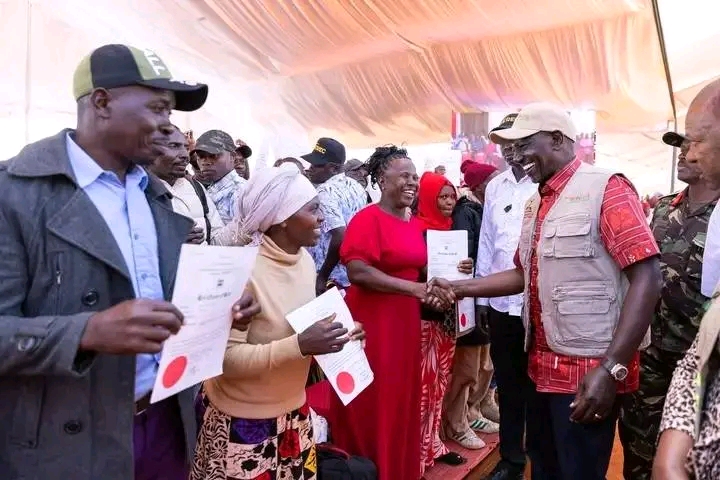
President William Ruto, in Taita Taveta County for the issuance of title deeds to residents

Title deeds and electricity connections, delivered together, signal a shift in how the state approaches communities that have waited too long
By James Kilonzo Bwire
There is something quietly powerful about a title deed. It is a piece of paper, yes, but for a family that has lived for decades without formal recognition of the land beneath their feet, it is also a declaration — that they exist, that they belong, and that the state sees them. When President William Ruto travelled to Taita Taveta County yesterday to hand over title deeds to residents of Chawuse, Old Mwatate Market, Bura Ndogo, and Kaloleni in Mwatate Constituency, he was joined by Cabinet Secretary for Lands Alice Wahome, Cabinet Secretary for Energy and Petroleum Opiyo Wandayi, and Senate Speaker Amason Kingi. That combination of land, energy, and legislative leadership in one room was not incidental. It was a statement of intent.
The decision to combine land titling with electricity connectivity in a single visit reflects an understanding that these two interventions are not separate projects — they are two sides of the same coin. You cannot meaningfully empower a household with a title deed if that home has no power. And you cannot justify running electricity to a community whose land tenure remains in dispute. When land and energy are treated as interconnected pillars rather than competing budget lines, the result is development that actually sticks.
Taita Taveta has waited long enough for both. The areas receiving title deeds yesterday are places where residents have lived in genuine uncertainty, farming land they could not call their own and building homes on ground that offered no legal security. For many of those families, yesterday was the day the waiting ended. A title deed gives a household something that no amount of goodwill can substitute: the legal certainty to invest, to improve, to borrow against an asset, and to plan beyond the next planting season. When people know their land is secure, they behave differently. They build better structures. They plant trees. They open small businesses. They participate more fully in the local economy. The document in their hands unlocks that potential.
The Last Mile Connectivity Programme running alongside the titling exercise in Taita Taveta is designed to deliver exactly the same kind of transformation through a different mechanism. Electricity access is not a luxury in the twenty-first century — it is the difference between a child studying after dark and a child who cannot, between a cold store that keeps produce fresh and one that does not, between a small welding yard that can take on more work and one that shuts at sunset. The government’s allocation for electrification in Taita Taveta reflects a deliberate choice to prioritise a county that has historically been underserved in national infrastructure planning. That is worth acknowledging plainly.
Ruto’s directive to Wandayi and the Principal Secretary to ensure that all electricity projects in the county are completed before the end of the year carries real weight. Timelines matter in public works. Communities have seen too many projects announced, launched, and then stalled. When a president sets a deadline publicly, with the affected residents present, it becomes a commitment that cannot quietly be walked back. Whether the sector meets that deadline will be the true measure of this visit — not the photographs or the speeches, but the actual connections made and the lights that come on.
What happened in Taita Taveta is also part of a wider pattern. The Coast development tour that has included Kwale, Kilifi, Lamu, Mombasa, and Tana River alongside Taita Taveta suggests a coordinated regional strategy rather than a one-off event. Land ownership challenges across the Coast have persisted for generations, rooted in colonial-era land settlement patterns, unclear demarcations, and the long absence of formal adjudication in many areas. Addressing those challenges at scale requires sustained effort: surveying, adjudication, compensation where boundaries overlap, and finally the distribution of ownership documents. The exercise now under way is not simple, and its scale reflects the depth of the problem it is trying to solve.
The social dimension of land security is often underappreciated in policy discussions. Many of the disputes that have simmered in Taita Taveta and other coastal communities for years trace directly back to unclear ownership. When nobody can say for certain who holds legal title, neighbours become adversaries, investments are withheld, and community cohesion frays. Clarifying ownership does not just resolve legal questions — it reduces conflict, builds social trust, and creates a more stable environment in which other development investments can take root. Schools, clinics, and roads all deliver greater value in communities where people are settled and at peace.
The environmental dimension is equally worth noting. Secure tenure encourages landowners to think and act long-term. A family confident that their land is legally theirs is far more likely to invest in soil conservation, plant trees, and farm sustainably. Access to electricity, meanwhile, reduces the pressure on forests and woodlands that comes from dependence on firewood and charcoal for cooking and lighting. These are co-benefits that align with Kenya’s broader climate commitments, and they are delivered not through separate environmental programmes but through the practical work of getting titles into people’s hands and power into their homes.
Development that is comprehensive is development that lasts. Building a road into a community where land tenure is contested and power is unavailable delivers a fraction of its potential value. The same road, combined with secure tenure and electricity, becomes a corridor for commerce, a connection to markets, a lifeline for small enterprise. The government’s approach in Taita Taveta recognises these interdependencies explicitly. That recognition should shape how similar interventions are designed and delivered across the rest of the country.
The residents who received their title deeds yesterday, and those who will gain electricity connections before the year is out, did not ask for charity. They asked for fairness — for the recognition that had been withheld and the infrastructure that had been delayed. That is what equitable development actually looks like when it moves from rhetoric to action. The measure of yesterday’s visit will not be the number of documents handed over or the length of the speeches delivered. It will be the quality of the lives that change as a result.
Similar Posts by The Mt Kenya Times:
- Ronaldo walks out of Portugal camp on eve of Denmark clash
- From mobile money to AI: How technology is reshaping small businesses across Mount Kenya
- Stanbic Bank brings Ne-Yo to Nairobi in creative economy push
- Campus traders: Chasing financial freedom, risking it all
- Politicians must stop advancing tribal narratives
About the Author