For Kenya’s university students, online trading promises escape from campus poverty — but the market rarely forgives inexperience
By Sallo Gobana
Can a smartphone really rescue a struggling university student from financial hardship, or is it simply a digital trapdoor to ruin? For thousands of young Kenyans juggling lectures, assignments, and empty pockets, the temptation to find out is only a click away.
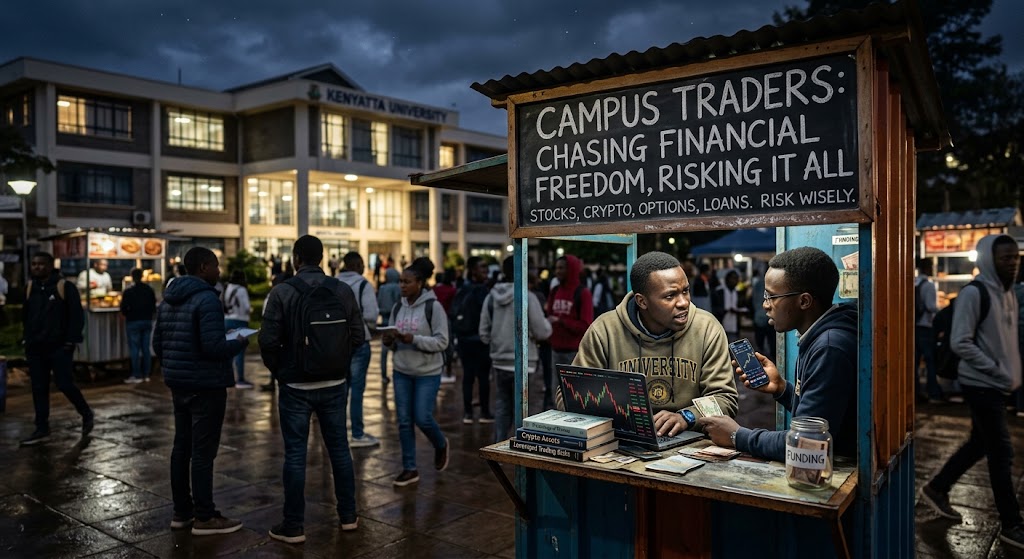
Online trading is the buying and selling of financial assets through internet-based platforms, with participants hoping to profit from shifts in market prices. One of the most common forms is foreign exchange — forex — where traders speculate on the movement of currencies such as the US dollar, the euro, the British pound, and the Japanese yen. Other accessible markets include commodities and stock indices, making online trading an increasingly reachable activity for young people armed with nothing more than a smartphone and a mobile data connection.
While the 2024 FinAccess Household Survey found that just 0.46% of respondents reported online forex as an investment asset class, that national figure does not capture how visible trading has become on university campuses. Cheap smartphones, mobile money, and social media have made financial platforms far easier to access than ever before, and some students are now turning their hostels and bedrooms into makeshift trading floors.
The appeal is straightforward. For students struggling to make ends meet, online trading appears to offer flexibility, independence, and the prospect of earning money without waiting for formal employment. But beneath the screenshots of profits and the stories of young traders living lavishly lies a volatile market where losses can arrive just as swiftly as gains — and where inexperience carries a steep price.
The journey into digital markets rarely begins in an economics lecture hall. More often, it starts on a social media feed, through a conversation with a friend, or in a campus corridor where one student tells another about someone making real money from their phone.
For Chuka University student Shamger, the hook was visual. A friend introduced her to a prominent young figure known online as Rich the All Time Trader. What caught her attention was not a financial analysis or a trading strategy — it was the lifestyle. Rich himself was a third-year student who was already driving his second car, having purchased his first while still in second year. For Shamger, watching someone close to her own age appear financially successful made trading feel like a credible route to freedom.
But the most dangerous aspect of campus trading is often where the starting capital comes from. Without a formal income, students frequently reach for money set aside for daily necessities. Lured by the promise of independence, Shamger used her upkeep funds to open her first trading account. She drew one firm line — school fees were off-limits — but that boundary could not protect everything else. Her accumulated losses eventually reached KSh300,000, wiping out all her savings. Despite the blow, she has no intention of stopping. She says she has grown accustomed to the income that trading can generate and does not want to return to where she started.
For other students, the motivation runs even deeper than ambition — it is basic survival. Shivulu, also at Chuka University, entered the markets after a friend introduced him, but his circumstances were defined by financial hardship and, at times, hunger. He watched his capital evaporate and ultimately accumulated losses of KSh200,000. His experience left him with a clear-eyed view of what the market actually demands.
“The biggest risks are that it can eventually take your money and your sanity,” he says. “Trading — you won’t get rich quick. It needs learning.”
The reality of online trading is far removed from the winning screenshots circulated on WhatsApp statuses and social media timelines. For every trader celebrating a profitable run, there are many others dealing with blown accounts — a term traders use to describe accounts that have lost all available capital. Shivulu describes the experience as a hard cycle of learning from losses, rebuilding, losing again, stepping away, and eventually returning with slightly more understanding. The emotional and financial toll, he says, remains consistently high throughout.
This growing campus trend also raises serious questions about regulation and consumer protection. The Capital Markets Authority has repeatedly warned the public against engaging with unlicensed investment entities and strongly advises anyone considering an investment to verify that the entity they are dealing with holds a valid licence. On campuses, where word of mouth drives recruitment and mentors operate informally, that due diligence rarely happens.
Despite the risks, forex trading continues to draw young people for reasons that are not entirely irrational. The market offers genuine flexibility — traders can participate from almost anywhere with an internet connection. It is one of the most liquid markets in the world, currencies are traded in enormous volumes around the clock, and many platforms allow participants to start with relatively small amounts of capital. For students who invest time in learning market analysis, risk management, and trading discipline, there is also an opportunity to build financial and digital skills that have real-world value.
None of that, however, removes the dangers. Leverage amplifies both potential gains and potential losses. Poor risk management, insufficient knowledge, and decisions driven by emotion rather than analysis can turn a promising start into a costly education very quickly. The market does not reward enthusiasm — it rewards preparation.
The attraction of financial freedom, flashy cars, and the idea of earning money from a bedroom will continue to draw young people searching for a way out of campus poverty. That is unlikely to change while the gap between student allowances and the cost of living remains as wide as it is.
For university students considering the markets, the question is not simply whether online trading can make money. It is whether they understand the market well enough to know what they are getting into, what the realistic risks are, and — crucially — what they can genuinely afford to lose.
Sallo Gobana is a 22-year-old fourth-year student pursuing Communication Studies at Chuka University.
Similar Posts by The Mt Kenya Times:
- Ronaldo walks out of Portugal camp on eve of Denmark clash
- From mobile money to AI: How technology is reshaping small businesses across Mount Kenya
- Stanbic Bank brings Ne-Yo to Nairobi in creative economy push
- Ruto’s Taita Taveta visit puts land and power at the heart of coastal development
- Politicians must stop advancing tribal narratives
About the Author